Revising policies and forms, such as AF Form 2030 Drug and Alcohol Abuse Certificates (or equal) and Standard Form 86 Background Investigation Questionnaire (or equal), relating to questions about cannabis use asked by the federal government (notably the Department of Defense, Office of Personnel Management, etc.) and its contractors.
Providing supporting arguments for how cannabis revenues are a force-multiplier that supports National Security.
Uncovering possible racial disparity in grants of Security Clearances.
Short Title: Revising forms relating to questions involving cannabis and how cannabis is a force-multiplier for National Security
Quinton M. Mitchell, Asc. Applied Science, B.A., M.S., USAF (Honorably Separated)
Definitions:
Contractor in this letter is meant to be any business, corporation, self-proprietor, etc., who has received federal funds, thus creating a legal contract between contractor and government, to perform work, services, construction, and/or to provide equipment or materials to the Federal Government, and/or any business, corporation, self-proprietor, etc., who is a part of the Federal Procurement Data Systems (FPDS) and/or registered or having been registered in systems such as the Systems for Award Management (SAM.gov), Central Contractor Registration (CCR), Online Representations and Certification Application (ORCA), etc.
Marijuana or Cannabis (genus of flowering plants in the family Cannabaceae) used throughout this letter are meant to be interchangeable but also include any other word or variant of Marijuana such as Cannabis Indica, Cannabis Salvia, CBD (Cannabidiol), Pot, Hemp, Hash, Hashish, Kief, Keef, Ganja, etc.
TABLE OF CONTENTS
Section I – Revising Forms and Policies Relating to Marijuana Questions, etc.
Section II – The State Argument, Increases in Cannabis Lobbying, Decreases in Prison Lobbying
Section III – Our Canadian Allies
Section IV – Veteran Support of Cannabis
Section V – Current Pro-Cannabis Legislation & Section 528 of the NDAA FY20
Section VI – Other Supporting Arguments (the right to not Self-Incriminate)
Section VII – Possible hypocrisies Section
Section VIII – Cannabis a Force Multiplier, National Guard Argument
Section IX – Welfare Argument
Section X – Ideas and Arguments Continued
24 Section XI – Race and Civil Rights
Images & Figures:
Figure 1 – AF Form 2030 Section II Question Relating to Marijuana ………………………. p. 6
Figure 2 – SF 86 Section 23 Question Relating to Marijuana……………………… …………p. 8
Figure 3 – Center for Responsive Politics estimates of Pro-Cannabis Lobbying Funds….…. p. 11
Figure 4 – Section 528 of the National Defense Reauthorization Act……………………….. p. 15
Figure 5 – Washington State’s Liquor and Cannabis Board Annual Fiscal Report (2019) ….. p. 21
Figure 6 – Governor Inslee’s 2019-2021 Proposed Biennial Budget …………………………p. 22
Figure 7 – Use of Marijuana Between Blacks and Whites for Ages 12+ (2018) …….………. p. 27
Figure 8 – Marijuana Arrests by the Numbers…………………………………………..……p. 27
Figure 9 – States with Highest Black Arrests Rate for Marijuana Possession (2018) ………p. 29
Keywords: reform, marijuana, military, defense, security, justice, disparity
Methodology: This paper uses a qualitative approach of searching various online sources for supporting facts, but also utilizes quantitative data pulled from publications, reports, etc.
Abstract & Highlights:
- There is no value added in asking for use of marijuana not attached to criminal convictions such as on AF Force Form 2030 Drug and Alcohol Abuse Certificates (or equal across the Service Branches), relating to entry or re-entry into the Armed Services, seeking employment with a federal contractor (such as those attached to the Department of Defense), or when a recruit/employee/potential employee either of the federal government or a federal contractor is seeking a Security Clearance (Standard Form 86).
- There might exist a disparity regarding rejection of Security Clearances between minorities and white federal employees, contractors, and military service members, relating to criminally charged marijuana offenses or admission of marijuana use not attached to criminal charges. White Americans report a higher lifetime use of marijuana, but black people make up a higher percentage of arrests cases (ACLU, 2020) and this disparity can lead to rejection of security clearances/loss of employment/rejection of employment, thus resulting in lower levels of minority representation, which thus violates the vision of the Civil Rights Act despite many states finding marijuana to be a commodity with economic, medicinal, and therapeutic properties. My claim is supported by a Department of the Air Force Inspector General (DAF IG) Report (December 2020), titled: Report of Inquiry (S8918P) -Independent Racial Disparity Review (No. S8918P).
- Pro-Marijuana Lobbying Funding saw an estimated increase of 16,357.1% from 2011 to 2020, meaning supporting Pro-Marijuana policies is great for re-election campaigns.
- According to Pew Research, Americans favor cannabis legalization at 67% (Daniller, 2019).
- In states where marijuana is legal and taxed, these marijuana taxes might be funding the Total Force Structure of the United States military, thus making marijuana revenues a force multiplier for National Security, such as construction/infrastructure projects funded by state-accounts or social programs (e.g., educational programs which produce component recruits or officers, facilities used by Active Duty Troops utilizing Tuition Assistance, or educational facilities which house Reserve Officer Training Corps, i.e., ROTC units), which directly & indirectly supports the overall Department of Defense. State National Guard Units are de-facto a part of the federal military due to the Montgomery Amendment, because of Perpich v. Department of Defense, 496 U.S. 334 (1990). Taxation of state legal cannabis is having a positive economic and social effect on the military despite the military’s antiquated stance on marijuana.
- Marijuana offers the potential to be a positive external variable towards force multiplication that can help pay for military equipment, etc., where force multiplication is defined in Joint Publication (JP) 3-05.1 (published 26 April 2007) as a capability that, when added to and employed by a combat force, significantly increases the combat potential of that force, and thus enhances the probability of successful mission accomplishment (p. 394).
- US States such as Washington State collected a total of $395.5 million in legal marijuana income and license fees in fiscal year 2019 up from 2018 numbers (Washington State Treasury, 2020). California has possibly generated $1 Billion since January 2018 (Staggs, 2020). Wall Street analysts estimate cannabis could become an $85 billion industry by 2030 (Business Insider Prime, 2020).
- When thinking about aircraft for example when compared to Washington State’s 2019 fiscal year cannabis revenues of $395.5 million.
- The F-35A by Lockheed Martin – the most common variant of the weapon system – has/will have a cost of $82.4 million in 2020, $79.17 million in 2021 and $77.9 million in 2022 (Stone, 2019). Dividing WA State Marijuana Revenues by the F-35A cost, we get 4.79 aircraft (FY20), 4.89 aircraft (FY21), and 5.07 aircraft (FY22). In other words, 4 aircraft with $65.1 Million remaining FY20 (.79 or 79% of 1 aircraft cost is the remaining value), 4 aircraft with $73.36 Million remaining in FY21 (.89 or 89% of 1 aircraft cost is the remaining value), 5 aircraft with $5.54 Million remaining in FY22 (.07 or 7% 1 aircraft cost is the remaining value). That is 13 theoretical F-35A aircraft, or (1) F-35A squadron (12 aircraft is a squadron) plus one funded by marijuana tax revenues. Total residual (remaining) balance across the three fiscal years is $144 Million ($48 Million per year), which can lead to additional aircraft purchases, spare part Purchase Orders, sustainment contracts, calibration/maintenance, fueling, training, etc. Granted this is theoretical since most of the marijuana tax revenues goes to education, public health, law enforcement (ironic), etc. However, it is possible that marijuana tax revenue can support the military mission, particularly with Federal Fiscal concerns relating to the debt ceiling, risk of sequestration (government shutdowns, compensation payments to contractors), etc. Essentially the states raising revenue from marijuana for the public good is a cost savings to the Federal government since the states might ask for less money from agencies such as the Department of Education, Health and Human Services, Department of Justice, the Department of Defense, etc.
- Interestingly, according to Losey (2020) of the Air Force Times, the State of Oregon where marijuana is fully legal, two bases in Oregon — Kingsley Field and Portland Air National Guard Base — will be among the first to host the F-15EX, the updated and upgraded version of the Strike Eagle now under production. Losey (2020) also states that Jacksonville Air National Guard Base in Florida will receive the F-35A in 2024, the guard said in an Aug. 14 release (end quote). Florida has decriminalized marijuana for medicinal purposes.
- There is no substantial evidence that use of marijuana makes it harder for military recruits or people wishing re-entry into the Armed Forces from learning their job specialty, nor is there any evidence proving that use of marijuana not connected with criminal charges or connected with criminal charges possess a security risk, since moderate or casual alcohol use has no proof of increasing security risks. Troops are tested at MEPs, randomly tested while serving, and in lockdown during Basic Military Training.
- Waivers for Marijuana use not attached to criminal convictions should not be needed and the requirement for waivers connected to criminal charges tied to marijuana use, should be loosened, especially if a member with charges was charged in a state where marijuana is now legal.
- Many states including our largest states have legal marijuana, and these states hold strong Electoral College and Popular Vote power.
Forward: I understand that making bills is not an easy task, but the idea which I am presenting and arguing for in this letter/paper, I feel should follow the strategy of the successful passage of Section 528 within the current year National Defense Authorization Act (in which I feel Section 528 does not do enough but it is a great step in the right direction). I understand that bills must be drafted, be recommended to committees, may require Congressional Budget Office Cost Estimates, be voted for upon the floor, and then be passed by the United Senates before signature by the President (although, if he or she doesn’t sign within 10 days of receipt and Congress does not “sine die”, i.e., for good, adjourn prior to the 10-day limit, the bill becomes law, alleviating the “pocket veto” scenario, i.e., the bill was on his or her desk, while Congress was open, thus the bill becomes law after 10 days). However, I do know that certain sections of laws do not seem to require as much groundwork to be inserted into legislation.
Also, with soon-to-be out of office, President Donald J. Trump, vetoing the upcoming NDAA, this might be a convenient time to insert my idea. If not, my idea could also influence an Executive Order of the upcoming Biden Harris Administration while the legislative process works itself out. Yet, with the Supreme Court majority conservative, the time to act is now. Yet, I think I have a good idea and make decent arguments. For example, marijuana is a cash commodity that helps states generate tax revenues which goes to public works, education, law enforcement, etc., and in direct and indirect ways, legal marijuana tax revenues are supporting the Total Force Structure of the US Department of Defense (Federal Force, State National Guard, etc.). Further, since our laws create disparity among the races and ethnicities of the United States, I feel that the current federal criminalization of marijuana has led to increased administrative burdens since waivers are required for military entry/re-entry, but also possible disparities in the granting of Security Clearances.
Disclaimer: I respect you. I respect our country. I respect authority. I respect the military. Yet, I also consider myself a Progressive. I am a Progressive Veteran and Patriot. I support unwavering defense for the USA and its allies, but I believe in progressive social policy, inclusion, diversity, and welfare that enables people to have a fair shot. So, nothing in this is letter/paper is intended to be perceived as a personal attack to you at all.
Purpose: I am writing you this letter to offer what I consider is a good idea which should be easy to pass until more legislation on progressive policies on marijuana are passed or an Executive Order reflecting pro-marijuana policies is signed by the President. My idea is inspired to (A) continue to support our Government and its Armed Forces (and its prime contractors) by ensuring we have a large selection pool of diverse people with a “Don’t Ask, Don’t Tell” policy concerning marijuana use not attached to criminal convictions for new recruits, members who wish to seek re-entry to the Armed forces, or external/internal applicants of federal contractors, thus not requiring waivers and not requiring admissions of use not attached to criminal charges on Federal Background Checks, (B) to reform recruiting/hiring policies relating to marijuana use not attached to criminal charges, (C) to show how marijuana tax revenues are a force multiplier that helps National Defense and Security, and (D) to hopefully raise the current minimum in Section 528 of the current NDAA so that more than one criminal charge for marijuana use isn’t a disqualifier for entry or re-entry into the Armed Services.
Section I – Revising Forms and Policies Relating to Marijuana Questions on the SF86, etc. I feel that Congress should pass an amendment or bill, or, the Executive Branch should sign an Executive Order until legislation is signed (or bring back Coles Memo of the Obama Administration with new caveats based on points I am presenting), which will revise military forms, e.g., Air Force Form 2030 Drug and Alcohol Abuse Certificate (and any equivalent forms among military Sister Branches, including the United States Coast Guard which falls under Homeland Security, the U.S Merchant Marines under the Department of the Navy & Department of Transportation, etc.); revise questionnaires regarding questions asking about marijuana use not attached to criminal convictions; revise recruiting questions regarding marijuana use not attached to criminal convictions that are given either verbally, electronically, and/or written either by contractors working for recruiters, i.e., call center personnel, or actual recruiters/volunteer recruiters of the Armed Services, and revise questions asked on SF86 Background Investigation Questionnaires OMB No. 32006 0005 (or equal), so that only criminal convictions relating to marijuana is asked rather than the current policy of simply asking for “use”.
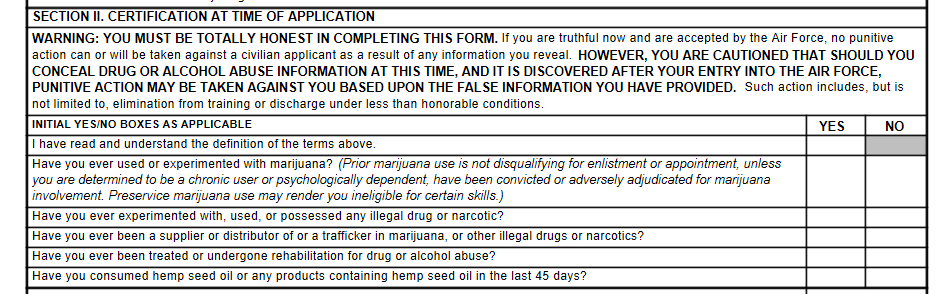
Figure 1 – AF Form 2030 Section II Question Relating to Marijuana
As you can see above in AF Form 2030, AF Drug and Alcohol Abuse Certificate, Section II, the question asks for “use not attached to criminal charges”, but instead states, “have you ever used or experimented with marijuana?”, yet, it has a caveat stating, “prior marijuana use is not a disqualifying for enlistment or appointment, unless you are determined to be a chronic user or psychologically dependent….”, and further it states, “Preservice marijuana use may render you ineligible for certain skills.”.
The question should be revised to only state, “Do you have any criminal convictions related to marijuana, please do not state use not attached to documented criminal charges.”, and there should be special instructions for recruits who are from/have lived in States or municipalities where marijuana is legal and/or decriminalized.
Further, it states a person can be disqualified if determined to be a chronic user or psychologically dependent, which to me seems subjective, because how the Air Force determines this is not stated in the form; studies to determine if marijuana is an addictive substance that is somehow worst than legal Schedule II or III drugs are debatable or non-existent due to federal restrictions on further studies; many States have legalized marijuana for medicinal and recreational purposes (some of our largest states as far as population, Electoral College Power, economic output, etc.), and most Americans favor cannabis legalization at 67% (Daniller, 2019) meaning the general public deems marijuana to be acceptable.
Further, the statement “Preservice marijuana use may render your ineligible for certain skills”, is an “interesting” statement to put into the form. This question seems to dissuade recruits and seems to state that the Department of Defense is not entirely confident in its abilities to reshape and reform individuals who come from diverse backgrounds, unique life situations, etc. Even if there are limited peer-reviewed studies relating to the effects of chronic marijuana use which might insinuate fractions of a percentage loss in IQ levels, the thing is that the military requires aptitude testing prior to even going to MEPS (Medical Examination Processing Stations) and Basic Training such as the Armed Services Vocational Aptitude Battery (ASVAB), Officer Aptitude Rating Test (OAR Test) of the US Marine Corps, US Navy, and United States Coast Guard, or the AFOQT (Air Force Officer Qualification Test). Thus, cannabis use – not attached to criminal charges or attached to charges – cannot realistically be used to disqualify a person from a certain job specialty when the military gauges mental competency with the ASVAB (or equivalent), and even if the military were to make the argument that cannabis has long-term detrimental cognitive side-effects, the Federal Government has limited the possibilities of expanded research, and the same arguments could be made for environment, educational funding, poverty, income level, etc. Yet, we rightfully do not disqualify candidates because of economic origins, income levels, if they were born in an area with underfunded schools, etc.
When a recruit attends Basic Military Training (BMT), Basic Combat Training (BCT), Officer Candidate School (OCS), Officer Training School (OTS), or equivalent, recruits are often not learning any skills related to their future job skill or specialty. Rather, they are undergoing intensive physical training and learning basic military culture and protocol.
According to Military.com (2019), the timespans of military trainings are 9 weeks (2 months and 1 week) for the US Army, 10 weeks for the US Air Force (it was 8 weeks but an additional 2 weeks were added on), the US Navy is 8 Weeks (technically 7 weeks but it includes an additional week, typically referred to in military culture as Zero Week), the US Marine Corps is 12 Weeks (3 months, not including 4-days of in-processing time), and the US Coast Guard is 7.5 Weeks (a little less than 2 months).
These training times do not include the date a recruit or candidate seeking entry goes to MEPS (Military Examination Processing Station) and travels to Basic Military Training (or equal), etc. So, for 2-months to 3-months, plus the time from MEPS to Training, the recruit is not learning a skill attached to their MOS (Military Occupational Specialty Code) for the US Army and US Marine Corps, AFSC (Air Force Specialty Code) for the United States Air Force or Space Force, or Job Category as Listed in Rating Systems in the case of the US Navy or US Coast Guard.
Basic Military Training (or equal) is effectively a time for rehabilitation and to insinuate that use of marijuana not attached to criminal charges or even attached to criminal charges, especially when recruits are tested for aptitude prior to going to Basic Training, will somehow make a recruit ineligible for a skill is debatable, and it is on the Service Branches to justify with evidence and proof of such a claim. The statement provided in the AF Form 2030 (or equal) seems highly subjective, judgmental, biased, and grandfathered into the present day. For example, the stigma around marijuana is being dictated by older people in higher ranks, e.g., roughly 30% in 1989 supported legal cannabis versus 67% support for legal cannabis in 2019 (Daniller, 2019), in which marijuana was demonized or turned into a drug of caricature, i.e., Cheech and Chong culture, Dazed and Confused imagery, etc. Further, there could possibly be a sense of generational disdain or envy considering older generations who typically see younger generations as “weaker”, might simply be barring access to entry because of their own personal beliefs/experiences which are not backed by science, facts, and the current political realities of the day, but rather propaganda attached to political agendas. While in BMT, I can attest that I did not drink caffeine (which is a stimulant with addictive properties, and is a Schedule III drug that is common for workers, troops, etc., to assist with job performance, studying, etc.), had little to no sugar (no Gatorade, juice, etc.), was forbade from tobacco, etc. BMT was a total mind and body restructuring, so to assume that previous marijuana use either attached or not attached to criminal charges, somehow makes a person ineligible for entry and unable to learn a job specialty is highly debatable. Our Canadian allies permit marijuana use with pilots included (Burns, 2018). I am not saying that US troops should be smoking marijuana (until policy can change after laws are reformed), but forms such as the AF Form 2030 Drug and Alcohol Abuse Certificate need to be reformed based on the logic I am presenting.

Figure 2 – SF 86 Section 23 Question Relating to Marijuana for Federal Background Checks
Above you can see the question within the Standard Form 86 (SF86) which is the Federal Background Check or Investigation Questionnaire, which can be found online at (https://nbib.opm.gov/e-qip-background-investigations/) and this form is used for granting Security Clearances. Since marijuana (cannabis) is legal and/or decriminalized in many states, cities, municipalities, and even allied nations to the United States, asking for “use not attached to criminal charges” has no value.
For example, what about Canadian troops (our allies going back as far as the World Wars in which Canada under Major General Rod Keller bravely sacrificed themselves at Juno Beach to achieve Allied objectives at Normandy) who are currently permitted to use marijuana (which is good policy in my opinion), happened to work on a Joint Force effort with the United States, but they require a Security Clearances and Canada defends the sovereign rights of its own citizens?
Regardless, what is one really gaining from knowing a person has used marijuana, especially when it is not attached to criminal charges? Criminally charged use of marijuana might help make better Security Clearance determinations, for any array of reasons (which in themselves could be argued as debatable), because it could insinuate a problem with law enforcement or criminal activity with a gang (which in many communities people are forced to be in as a means of surviving), but if there is no recorded criminal use for marijuana, which restated is legal in many places (some of the most economically powerful places in the United States who also have strong military/federal presences), then this question has no value. I can understand keeping the other drugs on the questionnaire (until policy reform occurs), yet, for marijuana which is helping to fund the public good (education, infrastructure, law enforcement, etc.), it is time to reform or remove this question. There is no proof to my knowledge of someone smoking marijuana becoming a security risk, no different than legal alcohol used moderately as not posing a risk. A Myers-Briggs personality test might have better insight as to whether a person “will spill the beans”, rather than asking for use of a substance that many states find to be acceptable.
Powell (2020) of the Harvard Gazette interviewed Kevin Hill, associate professor of psychiatry at Harvard Medical School and director of the Division of Addiction Psychiatry at Beth Israel Deaconess Medical Center, and regarding marijuana (cannabis), he stated, “It’s less addictive than alcohol, less addictive than opioids, but just because it’s less addictive doesn’t mean that it’s not addictive.” Further. Dr. Hill in the Powell (2020) interview in the Harvard Gazette stated, “Schedule 1 really means two things. Number one, does it have addictive potential? Cannabis does, clearly. But it also means that there is no medical value. I think you are hard-pressed at this point to say that cannabis and cannabinoids have no medical value. So, I do not think it should be a Schedule 1 substance and changing that really would make it a lot easier to study. Funding is a bigger barrier.”
Further, a question asking for marijuana use not attached to criminal charges, especially when many states – some of our most economically dynamic states and largest as far as population – deem marijuana to be legal and socially acceptable, when the Department of Defense, Office of Personnel Management, etc., asks a person about use not attached to criminal charges, yet, makes determinations about a person which insinuates they are possibly a criminal, this seems a violation of Constitutional Rights of a person. The Fifth Amendment of the United States Constitution allows people to not self-incriminate themselves and further parts of the Uniform Code of Military Justice (UCMJ) has similar protections, so asking for use of marijuana not attached to criminal charges, especially when a person who is seeking entry into the military (when they will be tested anyways at MEPs and randomly and/or routinely while in service), re-entry into the military, or seeking employment with a federal contractor (especially if the position requires a Security Clearance), seems a casual violation of a person’s privacy and their ability to not self-incriminate under The United States Constitution. I repeat this is only for marijuana because the many of the States have expressed legality of the drug.
Section II – The State Argument, Increases in Cannabis Lobbying, Decreases in Prison Lobbying
I am only saying marijuana largely since as a nation founded on federalism (a balance between centralized and decentralized authorities, i.e., the Federal Government and States), which is a reason why we have Representatives and Senators, marijuana is fully legal (decriminalized) in more than a dozen states and growing. Currently only six (6) states have marijuana as fully illegal (criminalized), i.e., only 12% of the States. According to DISA Global Solutions (2020), fifteen (15) states (and the District of Columbia where our laws are created & the where the Pentagon is housed) have full decriminalization for recreational and medicinal use (end quote). Guam and the Northern Marina Islands also have full legalization for recreational use. Additionally, out of these 15 states, California has 55 Electoral College votes, New York has 29 Electoral College Votes, Illinois has 20 Electoral College Votes, Michigan has 16 Electoral College Votes, and states such as Nevada and Arizona helped to swing the 2020 Presidential Election, insinuating the momentum for marijuana legalization is gaining more traction.
Even the states with mixed approaches such as Pennsylvania (20 Electoral College Votes) and even the conservative-leaning state of Georgia (16 Electoral College Votes. Note: The City of Atlanta decriminalized under one ounce of cannabis, Source: Hawkins Spizman Trial Lawyers, n.d.) are playing a major role in current 2020 politics, with Georgia going so far as resulting in two Congressional Senate Run-Off elections, meaning in the case of The State of Georgia (an agricultural state), that voting for conservative anti-marijuana politicians is no longer a given, i.e., times are changing. Many of these states are the largest economies of our nation and they hold most of the electoral college votes and provide the bulk of the popular vote due to population, e.g., California (39,512,223 people est.), Florida (21,477,737 people est.), New York (19,453,561 people est.), Illinois (12,671,821 people est.), etc. Thus, the politicians who support marijuana reform, have a higher chance of re-election for a multitude of reasons.
In 2011 according to the Center for Responsive Politics (2020), pro-cannabis lobbying was only a marginal $35,000.00 USD but in 2020 it was estimated the total of pro-cannabis lobbying investments increased to $5,760,000.00 USD, which is a 16,357.1% increase. When compared to lobbying funds for controversial private prisons, according to Center for Responsive Politics (2020), in 2019 total spend was estimated at $4.3 Million and $3.2 Million in 2020. CoreCivic Group contributed $1,310,000.00, GEO Group contributed $1,100,000 etc., to politicians for private prisons (Center for Responsive Politics, 2020). In these Center for Responsive Politics (2020) findings, 19 out of 20 reported politicians (Donald Trump included as well as Georgia Senator David Perdue who is facing a Senate run-off election race) accepted funds from private prisons. 19 politicians were Republicans with only 1 being Democrat (from the State of Texas).

Despite the unfortunate existence of private prisons, the 2020 estimated lobbying donations for this industry amount to $3.2 Million which is 44% less than the $5.76 Million that went to the cannabis industry in 2020. This means that it is less lucrative to take money from an industry (prisons) which tries to further enrich itself by arresting/fining people (resulting in loss of employment, displacement, increased risks of disease and STD transmission, strain on single parents, and inflated costs in poorly audited and administered contracts), than it is to support a growing industry of marijuana which produces jobs, taxes, reduces black market crime, etc. Supporting marijuana is pragmatic, progressive and realist politics.
My idea can be quite simple to do and have bipartisan support, e.g., leveraging Republican support from former House Speaker and House Minority Leader John Boehner, who currently is chair of the National Cannabis Roundtable, an organization which spent $428,000 on pro-cannabis lobbying efforts in Fiscal Year 2020 (Center for Responsive Politics, 2020.). Also, there is former Republican Governor of Massachusetts Bill Weld who sits on Acreage Holding’s board with John Boehner which is a marijuana investment company which has helped create jobs in Flint, Michigan, according to Breana Noble, Detroit Times (2018). Current Republicans in Congress who supported cannabis legalization are Matt Gaetz (Fla.) — the only GOP co-sponsor on the MORE Act —, Denver Riggleman (Va.) who stated he voted for it because his brother was jailed for a marijuana offense, Don Young (Alaska), Tom McClintock (Calif.) and Brian Mast (Fla.) according to Julie-Grace Brufke (2020) of The Hill. There are also more Republicans as well (see page 17, para 2).
Section III – Our Canadian Allies
Further, our neighbor to the North in Canada, which is a NATO (North American Treaty Organization), NORAD (North American Aerospace Defense Command), Five Eyes Partner (intelligence gathering) and AFNORTH/USNORTHCOM member, has full legalization of cannabis across the board and Canadian cannabis firms can be sold on stock exchanges such as Toronto Stock Exchange (which can be sold legally in the United States on exchanges such as E-Trade, owned by Morgan Stanley, by way of the Over-the-Counter Market). On October 17, 2018, Canada passed Bill C-45, which made recreational use of marijuana (cannabis) totally legal (Kestler-D’Amours, 2018). Relating to passage of Canada’s Bill C-45, Prime Minister Justin Trudeau established a Task Force to pave the way for cannabis legalization and used US States such as Colorado and Washington State as a model (Kestler-D’Amours, 2018).
Think about that, Canada, our military ally, a member of the prestigious NATO Alliance, legalized weed by basing their policy on Washington State and Colorado’s pro-cannabis policies, and these US States have a strong military presence ranging from Joint Base Fort Lewis – McChord (JBLM); Camp Murray National Guard Center; Fairchild Air Force Base; Everett Naval Base; Naval Air Station Whidbey Island; Bremerton Naval Base and Submarine Base; the Western Air Defense Sector (WADS); Fort Carson; Cheyenne Mountain Air Force Station; Peterson Air Force Base (Home to the US Space Command, i.e., the predecessor of the newly created United States Space Force); Schriever Air Force Base and Buckley Air Force Base.
Relating to Peterson-Schriever Garrison (P-S GAR) in Colorado (where cannabis is legal), the United States Space Command (formerly the United States Air Force Space Command) operates Geographically Separated Units (GSUs) such as New Boston Air (Space) Force Station in New Hampshire (where cannabis is decriminalized); Cape Code Air (Space) Force Station (where in Massachusetts, cannabis is fully legal for both recreational and medicinal purposes); Kaena Point Air (Space) Force Station (where in Hawaii marijuana is decriminalized in a mixed approach); Clear Air (Space) Force Station (where in Alaska, marijuana is fully decriminalized) [Clear Air Force (Space) Station also houses Royal Canadian Air Force Units, where Canadian forces are legally allowed to use marijuana], and Cavalier Air (Space) Force Station (where in North Dakota, cannabis is decriminalized and able to be used for medicinal purposes), etc.
Burns (2018) wrote an article about how the Government of Canada (or, Gouvernement du Canada in French) issued a directive, Defence (the British/Canadian spelling) Administrative Orders and Directives (DAOD) – 9000, which permits Canadian military service members to use marijuana, i.e., cannabis. Under the new policy, members of the Canadian Armed Forces (CAF) will be prohibited from using recreational cannabis within eight hours of a duty shift, and within 24 hours of work that involves operating weapons or vehicles (Burns, 2018). Cannabis use will additionally be barred within 28 days of duty that includes service on a military aircraft, operation in a hyperbaric environment, or high-altitude parachuting (Burns, 2018). Somewhat understandably, service members will not be allowed to use recreational cannabis during work hours or carry it with them on international operations, either (Burns, 2018). Effectively, Canadian troops are safely allowed to use marijuana within the time stipulations listed above but most likely in the safe zone while on leave or Rest and Relaxation (R&R), so they do not violate the time minimums listed above.
IV. Veteran Support of Cannabis
According to the Veterans Cannabis Project (n.d.), 34 States Allow Medical Marijuana, 83% of Veterans support Medical Marijuana Programs, yet 0% of Veteran Administration facilities provide medical cannabis (though HR712 or the separate MORE Act might and should correct this fact).
Further, According to DiGiovanni (2018) decorated veterans are supporting the legalization of marijuana efforts such as retired Lieutenant Colonel Todd Scattini, i.e., The Hemp Colonel, who is a United States West Point Academy graduate, and is the current CEO of Harvest 360 and the European representative of CW Hemp. According to the article by the DiGiovanni (2018) on the Veterans Cannabis Project’s website, Scattini served in combat arms roles, including Tank & Scout platoon leader and Cavalry troop commander. His language skills and passion for foreign service led to positions overseas, including at the US Embassies in Bosnia and Herzegovina, and Slovenia (DiGiovanni, 2018). But it was his assignment in 2011, as a senior advisor to the commander of the International Security Assistance Force in Afghanistan, that opened his eyes to the both the opportunity of hemp and the healing power of medical cannabis (DiGiovanni, 2018).
V. Current Pro-Cannabis Legislation & Section 528 of the NDAA FY20
Current pro-cannabis legalization laws of recent that I have read into are the SAFE Banking Act (S. 1200), sponsored by Senator Jeff Merkley (D-Oregon), which strives to improve safety for cannabis businesses, employees, and consumers by prohibiting a federal banking regulator from penalizing a depository institution for providing banking services to a legitimate marijuana-related business (Status: Senate – 04/11/2019 Read twice and referred to the Committee on Banking, Housing, and Urban Affairs); Small Business Tax Equity Act (H.R.1118 & S.422), sponsored by Senator Ron Wyden (D-Oregon) which would allow compliant, tax-paying cannabis businesses to deduct normal business expenses and access tax credits that are available to other lawful businesses (Status: Senate – 02/07/2019 Read twice and referred to the Committee on Finance); Marijuana Justice Act (S. 597 & H.R. 1456), sponsored by Representative Barbara Lee (D-California-13th District) strives to remove marijuana from the list of controlled substances and expunging the convictions of those who have served federal time for marijuana use and possession offenses (Status: House – 04/08/2019 Referred to the Subcommittee on Crime, Terrorism, and Homeland Security); Realizing Equitable & Sustainable Participation in Emerging Cannabis Trades (RESPECT) Resolution (H.Res.163), sponsored by Representative Barbara Lee (D-California-13th District), offers best practices and recommended steps for states and localities to reduce financial barriers to entry relating to cannabis businesses, eliminate constrained licensing frameworks that perpetuate disadvantages relating to cannabis businesses, encourages automated expungement and resentencing for prior cannabis offenses (Status: House – 03/25/2019 Referred to the Subcommittee on Crime, Terrorism, and Homeland Security); Marijuana Opportunity Reinvestment and Expungement (MORE) Act (H.R. 3884. S. 2227), sponsored by Representative Jerrold Nadler (D-NY-10th District), is bipartisan legislation that removes marijuana from the Controlled Substances Act, thus decriminalizing the substance at the federal level and enabling states to set their own policies (Status: Senate – 12/07/2020 Received in the Senate and Read twice and referred to the Committee on Finance), and HR712 VA (Veterans Administration) Medicinal Cannabis Research Act of 2019, sponsored by Representative Luis J. Correa (D-CA-46th District) which would direct the Secretary of Veterans Affairs to carry out a clinical trial of the effects of cannabis on certain health outcomes of adults with chronic pain and post-traumatic stress disorder, and for other purposes (Status: House – 03/12/2020 Ordered to be Reported (Amended) by Voice Vote).
Republicans who supported HR712 are Matt Gaetz of Florida’s 1st District, Pete King of New York’s 2nd District, Mike Waltz of Florida’s 6th District, Greg Steube of Florida’s 17th District, Don Young of Alaska (At Large), and Dave Joyce of Ohio’s 14th District.
Relating to H.R. 712, the Congressional Budget Office as ordered by the House Committee on Veteran Affairs on March 12, 2020 (The United States Congress, n.d.), issued a Cost Estimate by Ann E. Futrell on April 13, 2020. On February 1, 2019, VA began a 5-year research study at its medical center in San Diego, California, to evaluate effects of the use of medical cannabis among 136 participants with PTSD and other health conditions (Futrell, 2020). The department plans to spend $1 million to conduct the study (Futrell, 2020). CBO expects that trial would satisfy the bill’s requirement for research. Satisfying the reporting requirement would cost less than $500,000 over the 2020-2025 period, CBO estimates (Futrell, 2020). That spending would be subject to the availability of appropriated funds (Futrell, 2020). Ms. Futrell’s Cost Estimate was reviewed by Leo Lex, Deputy Director of Budget Analysis.
Further, we have 2020 National Defense Authorization Act (NDAA), Sec. 528. Reenlistment waivers for persons separated from the Armed Forces who commit one misdemeanor cannabis offense. This is a step in the right direction, but it does not go far enough, yet, what I am arguing in this paper is for the federal government (and its contractors) to not ask about use not attached to federal charges, but also, the minimum threshold as specified in Section 528 must be raised considering the relationship of states to the federal government.
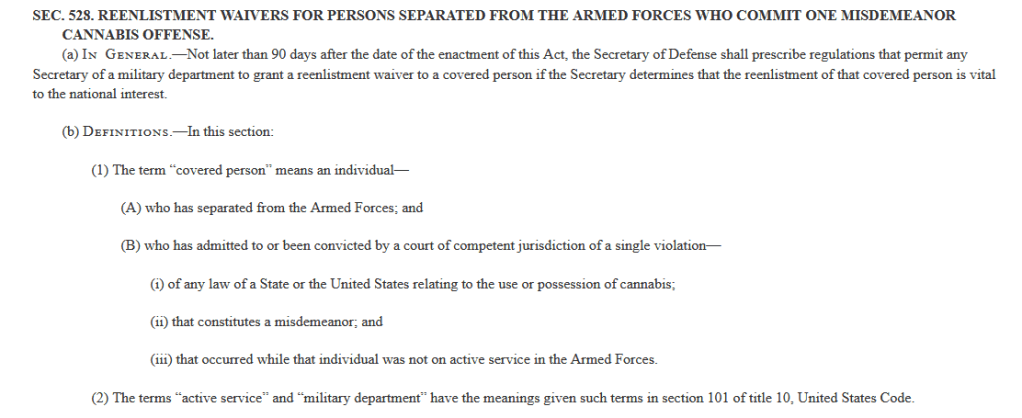
Section 528 which was helped passed by House Representative Ruben Gallego of Arizona’s 7th Congressional District (a US Marine Corps veteran who served in Iraq) is great and a proper step forward, yet I feel it doesn’t go far enough (e.g., a misdemeanor can be very marginal), because the military (and its contractors where workers often have to do SF 86 Background Investigation Questionnaires) are still asking if new recruits, former military members who wish to rejoin, or applicants for employment with federal contracts, if they have used marijuana even if it is not attached to any criminal conviction. It seems the military’s forms such AF Form 2030 or equal (and Standard Form 86 or any other agency equivalent) are still asking these statements to new recruits/members who seek re-entry, employees of federal contractors. Regarding, the military it is still requiring waivers (or possible rejections of clearances relating to contractors or troops).
VI. Other Supporting Arguments (the right to not Self-Incriminate)
Based on my ideas and evidence presented so far, the military/federal government should not be asking for marijuana use that is not attached to criminal charges, largely (but not limited to the fact) that Section 528 of the FY20 NDAA, it only speaks to convictions by a court of a competent jurisdiction. Considering that the Office of Personnel Management via its e-QIP System which does background checks for the government and its contractors, I feel the question on the SF 86 relating to marijuana use not relating to criminally convicted charges in courts of competent jurisdiction should be removed from the questionnaire since its relevance is waning. Further, people who do have criminal convictions relating to marijuana such a possession should not fear having a clearance revoked.
There does not seem to be coherent and publicly published logic that is readily available to the public and published in a way which is palpable for the general public to understand that details how the OPM or equivalent makes it security clearance determinations, thus preventing the person who may have had their clearances revoked or employment terminated, from having all the cognizant facts to utilize their constitutional right to challenge such determinations, e.g., obtain legal representation, appeal, etc.
Section VII – Possible existing hypocrisies
Further, since the vast array of questions on Background Checks can incidentally lead to subjective determinations, many good people have possibly suffered simply because of human bias which is not an exceptional look for the Federal Government; however, I am sure investigators do their jobs to the best of their abilities. For example, if a highly paid non-elected GS Civil Servant has had three DUIs, missed alimony payments, has domestic dispute charges, has had frequent travel outside of the United States, and has a higher debt-to-asset ratio (insinuating higher risk of financial default, i.e., bankruptcy), but they get to keep their job and/or get a Security Clearance. Why should a person, such as a recently college graduate, person who has been seeking employment, person from an underrepresented group and/or low-income area, or your average worker have to admit use of marijuana use not attached to criminal charges, when stating use not attached to criminal convictions, could possibly result in getting a Security Clearance revoked, which could mean loss of employment, having to seek another internal opportunity, increased unemployment insurance registration, destitution, falling behind on bills, etc.?
That is why the SF86 must be reformed. SF86 questions relating to marijuana should be changed to only ask about cannabis use for convicted charges, yet, convicted charges should not be a barrier to employment or gaining a clearance, due to 1) the general shift of perception within the public that supports legalization of cannabis, 2) there is no proof that marijuana/cannabis use leads to any sort of Security Breaches, 3) many States where it is legal have a strong federal employment and military presence, etc.I am not saying the Federal Agencies including the Department of Defense or its contractors cannot test for marijuana (until policy shifts), but rather asking for use not attached to criminal charges does not provide any value.
To reiterate, my idea is that the Department of Defense, Office of Personnel Management (who manages the SF86 Screening Process), or any other agency, or contractor to the federal government, can only ask for use for marijuana related to criminal offenses, and not just “use”. Further, recruiters, contractors who work with recruiters (such as call center staff), and the Human Resource Departments of federal contractors should be educated that they legally can only ask for criminally charged marijuana convictions and not simple use, and any statement made voluntarily of use, either in the past or present, that is not attached to a criminal conviction cannot be used against a military recruit, person who wishes to re-enter the military, or applicant to the federal government or its contractors. Further, if a person has had their record cleared, sometimes charges can still show up on background checks and such charges should not be asked for either.
Once a law, amendment to a law (or revision that expands upon Section 528), or Executive Order based on my idea is approved, I also feel it should be retroactively applied to anyone who was rejected for entry or re-entry into the military (or disqualified for a Security Clearance), or disbarred from employment either as federal civil servant or contractor, so when they try again, they do not have to say anything about use not attached to criminal convictions (even if they admitted on a previous government form), and if even they do admit use voluntarily, it does not matter, because…the military (or employer) will test you regardless upon entry or re-entry and while serving (or working) [until policy changes such as full legalization of cannabis]. It as if it did not happen.
Relating to military recruitment, there should be no requirement of a military waiver for marijuana use not attached to criminal charges and any waivers that are on record for people who admitted marijuana use not attached to criminal charges before active duty or even after active duty who wish to rejoin (regardless if they used within the inactive portion of their Military Service Obligation which aligns to Section 528 of the FY2020 National Defense Authorization Act, considering the section insinuates that waivers are only needed for “active duty”, i.e., not “inactive duty”), should be expunged immediately.
I added on, “within the inactive portion of their Military Service Obligation” is because once a person separates from active-duty service, they are not getting active-duty benefits, they typically fall under Non-Participating Inactive Reserve Status which is effectively back to Selective Service status of the general public, they receive no BAH (Housing Allowance) from the military, no BAS (Sustenance or Food Allowance) from the military, no uniform stipend from the military, perform no military Physical Tests (PT) or Fitness Tests, likely do not receive Tri-Care Health Insurance from the military, and most fall under the jurisdiction of the Veterans Administration, i.e., once you start drawing Veteran Benefits you can’t receive active-duty benefits.
Further, my idea is good, because The United States only has roughly 300 to 330 Million people; however, we have vast responsibilities covering the globe spanning Eurasia, Eastern Europe, the South China Sea, etc., where our adversaries have populations of 1 Billion and that is not including their own allies. So, to limit the candidate pool because of stigma over something that many states deem to be acceptable, same as many people serving in Congress find it to be acceptable, is simply bad policy of an antiquated time that has systemically embedded itself into negative stereotypes, mass arrests, ruined lives, administrative burdens, and ruined futures, etc.
I see no value to the military (Department of Defense), federal contractors, or the taxpayers who fund the military in asking military recruits, people who wish to seek re-entry into the military, civilian federal employees, or employees of federal contractors, if they have used marijuana, especially if it not attached to any recorded criminal conviction.
For now, the military should only care about criminal charges relating to marijuana – until Congress can reschedule cannabis in the Controlled Substances Act and/or pass legislation such as the MORE Act or equivalent – since criminal charges could possibly create liability issues, e.g., possible outstanding warrants. Criminal convictions pose more of a constraint on logistics and planning for the military, e.g., dates in which recruits can go to Basic Military Training, Officer Training/Candidate School, etc. However, even criminal convictions do not disqualify a person from service (which is good since the military can reshape lives), but simply asking for use without any criminal record has no value and should require no waiver.
Think of it as the “Don’t Ask, Don’t Tell” regarding Marijuana use for initial entry or re-entry into the Armed Forces (or even relating to Security Clearances for troops and contractors). “Don’t Ask, Don’t Tell” was acceptable for decades, but we finally progressed passed that, and now it is time for marijuana, which is a commodity which is traded on stock market via the Over-the-Counter Market which is readily available on commercial exchanges such as E-Trade (owned my Morgan Stanley), taxed by states, creates jobs, reduces black-market crime and trafficking, and was legal for most of our nation’s history. In other words, The Founding Fathers and Revolutionaries had more leeway than people in 2020.
According to Booker (2018) of NPR (National Public Radio), “For the first time in what historians say could be centuries, hemp has been grown and harvested at Mount Vernon, George Washington’s historic estate. In the 1760s, Washington predicted that hemp could be a more profitable crop than tobacco and grew it across his farm. At the time, hemp was abundant in Virginia and elsewhere in the U.S. This summer, horticulturists at Mount Vernon partnered with the University of Virginia and planted hemp once again. “To bring this crop back it just really helps complete our agricultural story,” says Dean Norton, the director of horticulture at the estate. The push to bring back hemp came from a Charlottesville, Va., farmer, Brian Walden, who considers himself a “hemp patriot.””.
Regarding that fact about Mount Vernon, Virginia, i.e., George and Martha Washington’s estate, Mount Vernon is registered with the U.S. National Register of Historic Places, U.S. National Historic Landmarks, and Virginia Landmarks Register. The U.S. National Register of Historic Places is operated by the National Park Service which falls under the Department of Interior, giving further support to the fact that Federal Government does support the growth of marijuana, which in this case, has historical basis considering cannabis was legal for most of the United States’ history.
It is… useless to ask for “use” of marijuana. The military should care for criminal convictions (which is debatable in itself) for cannabis (until the United States reschedules cannabis) because A) the military should only care for use while in Active Status – emphasis on active status – due to readiness, investment, troops get paid, etc., B) the military test randomly all the time such as at MEPS and during active service C) asking for use not tied to criminal convictions encourages people to shy away from the military, and D) the trend of legalization is already here in which many states have full decriminalization for recreational and medicinal use.
For example, if a person lives or has lived in a state, city, locality, municipality, etc., where cannabis (marijuana) is legal and/or decriminalized, but they end up wanting to serve the United States in the military or as a civil servant or contractor, or a former member wants to come back and serve some more, why would a person need a waiver or be asked about “use not attached to criminal convictions”, especially when many states say it is legal and these states contribute to the Total Force Structure of the Department of Defense via the National Guard?
Part of the military is state driven; thus, part of the military is de-facto sovereign (despite the controversial Montgomery Amendment) where the State Governor is Commander-in-Chief (unless under federal orders). Many states with these National Guard Units are fine with marijuana thus meaning the Commander-in-Chief is fine with marijuana; taxes from marijuana might be directly and indirectly funding National Guard units such as roads, air strips, utilities, etc.; state marijuana tax revenues free up federal funds (less money states request from the federal government), and marijuana taxes fund social programs such as education. State marijuana tax revenues thus supports the overall Total Force Structure of the Department of Defense in direct and indirect ways.
States that tax marijuana and distribute funds throughout their state support the Total Force Structure of the military both federally and at the state level (National Guard). Many states with legal marijuana use that money to fund educational programs such as colleges which house ROTC (Reserve Officer Training Corps) units. Since marijuana tax revenue is going to education, this possibly increases the cognitive competencies of workers and potential recruits or service-member who wish to seek re-entry.
For example:
- A state might fund a community college system with marijuana tax revenues (or, by other means enabled by diverting funds from elsewhere only made possible by marijuana taxes), but a troop using Tuition Assistance might be taking classes at that facility.
- A state library system might be sharing resources with a military base library.
- A State University system by expanding construction projects produces direct benefits for ROTC units, such expanded fitness facilities, classrooms, etc.
Further, marijuana tax revenue is going to fund law enforcement in these states and local law enforcement works in unison with the military and Military Police when it comes to legal matters such as responding to emergencies. In addition, marijuana tax revenue is going towards public health efforts which also helps to protect the military, civil servants, and workers for federal contractors. Public Health has always been a concern of the military going back as far as the military educating troops about diseases such as a Syphilis during the World Wars. By states increasing public health funding, enabling testing services, providing contraception, tracking viral outbreaks, offering clean needle exchanges, providing family planning services, etc., this provides an extra level of protection to service members, civil servants, and federal contractors.
Further, many Air National Guard Units are cohabiting with civilian airports which are used as runways, and I am confident that tax revenues from marijuana is helping to fund infrastructure which supports the State National Guard Units but also upstream to the Federal forces of the Department of Defense and Pentagon. In support of this claim, Washington State Treasury (2020), led by Duane A. Davidson who reports to Washington State’s Governor and National Guard Commander-in-Chief, Jay Inslee (Democrat), referenced statistics from the Washington State Liquor and Cannabis Control Board’s Fiscal Year 2019 Annual Report. Statistics provided by the Washington State Treasury (2020) included that fact that Washington State collected a total of $395.5 million in legal marijuana income and license fees in fiscal year 2019, all but $5.2 million of it from the state’s marijuana excise, or sales tax. Further Washington State Treasury (2020) stated that the report also shows that the marijuana revenues were $172 million more than that of liquor, and that the marijuana tax income of the state for fiscal year 2019 of $395.5 million grew by slightly more than $28 million from the prior fiscal year. Lastly, based on the statistics provided by the Washington State Treasurer (2020) the General Fund received $116.5 million.

Marijuana tax allocation to public services in Washington State has a positive social benefit, particularly for a state which lacks a state income tax. Relating to how Washington State distributes its revenues generated from taxation on marijuana, in RCW (Revised Code of Washington) 69.50.540, Titled: Dedicated marijuana account—Appropriations, per section (g), at the end of each fiscal year, the treasurer must transfer any amounts in the dedicated marijuana account that are not appropriated pursuant to subsection (1) of this section and this subsection (2) into the general fund. Later sections of RCW 69.50.540 states that revenues that go into the general funds are distributed to counties, cities, and towns where licensed marijuana retailers are physically located, etc.
Speaking back to the $116.5 million in Washington State’s General Fund which was funded by taxation on legal marijuana per RCW 69.50.540 Section (g), I went to Washington States Office of Financial Management which published the Governor Inslee’s 2019-2021 Proposed Biennial Budget. The Military Department (which includes the Air and Army National Guard Units of Washington State) was allocated $14.7 Million in which $5 Million goes to Shake-Alert Monitoring System for the procurement of seismic monitoring stations and global navigation satellite systems which integrates with the overall Shake-Alert System; $928,000 for Tsunami Sirens for Coast Cities which involves the procurement of sixteen (16 each) All-Hazard Alert Broadcast (AHAB) Systems; $750,000 to National Guard Wildfire Pay which pays State Active Duty Wages for service members with firefighter certifications to that of their civilian counter-parts, etc.
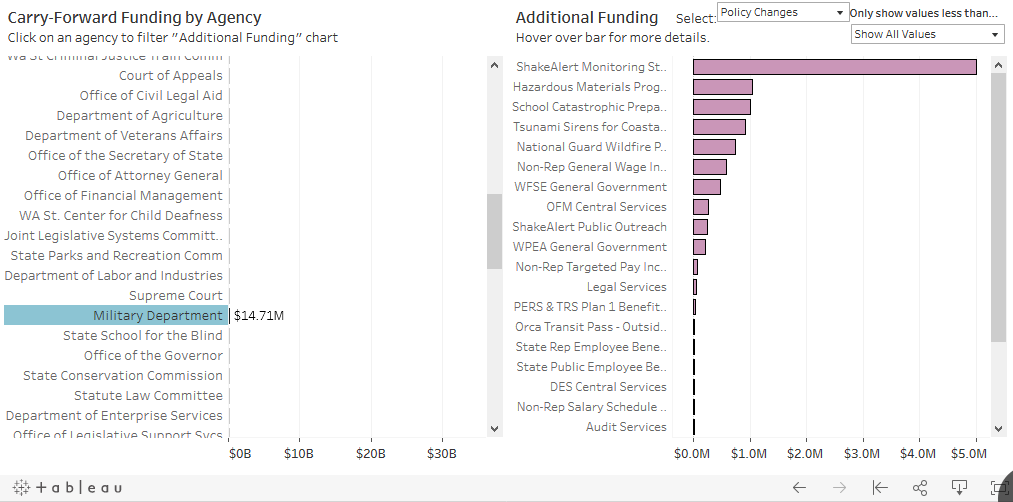
Further, while I was searching Washington State’s Office of Financial Management’s website relating to General Fund allocations (which seems to align with marijuana tax revenues allocated through RCW 69.50.540 Section (g)), I found a document Titled: Agency Information Technology Budget Detail, authorized by RCW 43.88.092, Appendix A – IT Projects with OCIO Oversight: Completed for Fiscal Year 2018, where on page 47 of this Appendix, the Military Department (National Guard, etc.) received or will receive a new contract for Next Generation 911 (NG911) Emergency Services IP Network Re-procurement since the current CenturyLink contract is due to expire or has expired. The CenturyLink contract was a transitional system that was awarded before national-standards were implemented and the new NG911 System provides complete call-maker to call-taker Turn-Key services that meets the national standard. [Source: Washington State Office of Financial Management (2019)].
Looking elsewhere on the Office of Financial Management’s website, I found Transportation Projects that directly tied to the U.S. Military, and we can assume that marijuana tax revenues in one shape or another directly or indirectly helps fund these projects.
For Example, per Washington State’s Office of Financial Management’s (2019) documented, titled: OFM Transportation Document 19GOV001 as developed December 10, 2018 – Hwy Mgmt. & Facilities Program (D), one project listed was the I-5 JBLM (Joint Base Lewis McChord) Corridor Improvements under Project No. M00100R.
Further, according to the Washington State Office of Financial Management (2019), on their website in a section titled, 2019-21 Governor’s proposed budgets, 2019-29 capital plan, Agency capital project detail, Military Department, I also found National Guard construction projects issued by the Washington State Military Department based out of Camp Murray under RFP-19-GS-006 which was funded by the State Building Construction Account such as $75,000.00 going towards Project No. 40000004 (per the Office of Financial Management) for Anacortes Readiness Center Major Renovation, where the Readiness Center is a National Guard Center that was badly in need of upgrades. Per the Office of Financial Management (2019), The Anacortes Readiness Center is one of the smallest facilities in the Washington National Guard inventory. It has no female restrooms, showers, and locker rooms; lacks office space and classrooms for training purposes; has an inadequate supply room for necessary equipment; and is not ADA (Americans with Disabilities Act) compliant. This project will perform predesign for an ADA compliant facility, which will add 6,000 square feet of new space; renovate offices, classrooms, the kitchen, and supply and storage areas; and create a new locker room, restrooms, and showers for female members.
Lastly, at the Washington State Office of Financial Management (2019) 2019-21 Governor’s proposed budgets, 2019-29 capital plan, Agency capital project detail, Military Department, I found Camp Murray Building 33 Addition/Alteration funded by the State Building Construction Account funded at an amount of $1,000,000 to $4,000,000.00. Camp Murray is the National Guard Center for the Washington State National Guard and is right across I-5 from Joint Base Lewis McChord, which is a place I am familiar with since I lived in Fort Lewis and DuPont, WA as a pre-teen.
Looking at these projects I noticed some were listed as federal funded whereas others were listed as state funded, meaning that state marijuana tax revenues which affect the state fund (either directly, or indirectly, i.e., freed up funds from one account made possible by marijuana taxes) for construction projects might be helping to fund military infrastructure.
According to a report titled, Oregon Marijuana Tax Statistics: Accounting Information by Oregon.gov (2020), the State of Oregon as of September 2020 collected $15,765,218 of state taxes and $2,445,050 from local taxes, yet only some local marijuana taxes are collected by the state; those collected locally are not counted here. Actual state and local amounts will be known when quarterly tax returns are filed.
So, based on the report listed above, the total of marijuana tax revenues is $18,210,268.00, yet, on the same Oregon.gov website, there is another report titled, Oregon Marijuana Tax: Distribution Information, which calculated a total of $29,832,637 in which 40% went to the State School Fund, 20% Mental Health, Alcoholism, and Drug Services, Oregon State Police (15%), Oregon Health Authority, for Drug Treatment and Prevention (5%), and 20% went back to the City and Local Governments.
Staggs (2020) of the Orange County Register stated that California has raised $1 billion in cannabis tax revenue since the industry kicked into gear in January 2018, according to figures recently released by the state. The bulk of that $1.03 billion in tax money, after covering regulatory costs, has been spent on programs such as childcare for low-income families, cannabis research, public safety grants and cleaning up public lands harmed by illegal marijuana grows (Staggs, 2020). Yet, for concrete numbers, the State of California Department of Tax and Fee Administration issued a public news release by Wells (2020) which stated that total tax revenue reported by the cannabis industry is $172.7 million for 4th quarter returns due by January 31, 2020 and this does not include tax revenue collected by each jurisdiction.
Section IX – Welfare Argument
Speaking to the Stagg (2020) article, in which he speaks of programs for low-income families, I am confident that some troops, especially lower enlisted troops, might be using State Welfare programs to help supplement income, such as WIC (Women, Infant, and Children Special Nutritional Supplemental programs), childcare support services, etc. These programs are sustaining themselves in part with marijuana tax revenues.
The data shows that during the 2018-19 school year, a third of children at DOD-run schools on military bases in the United States — more than 6,500 children — were eligible for free or reduced lunches. At one base — Georgia’s Fort Stewart — 65 percent were eligible (McFadden, Romo, & Abou-Sabe, 2019).
In 2016, the Government Accountability Office published a report recommending that the Defense Department start tracking data on service members’ and their families’ use of food assistance programs such as SNAP and the Special Supplemental Nutrition Program for Women, Infants, and Children, or WIC, but aid groups and lawmakers question whether the department is collecting meaningful data (McFadden, Romo, & Abou-Sabe, 2019).
Section X – Ideas and Arguments Continued
It serves no use to ask for use of marijuana not attached to criminal convictions for new recruits, people who wish to re-enter the military, federal contractors seeking employment, federal civil servants seeking employment, etc. I do respect that the military can test while on active duty considering the importance of the mission, but it is time to progress.
Here is another argument for my idea. For example, does the military ask if you have ever had a beer or glass of wine when wanting to serve? No, they do not, even though alcoholism and social drinking are a part of military life (I grew up around it), even though the reported statistics likely do not state that, because many troops likely do not state the accurate facts for fear of having marks on their record (which might not to be actual policy) or being sent to rehabilitation, which could (even though it is not stated) influence a troop in thinking they might not be successful at promotion levels where character & social politics plays an important role in interviews at board selection committees. Does the military ask if a recruit or person who wishes to seek re-entry ever touched a person in an inappropriate manner? No, they do not, even though – lets be frank – the military does not have the best track record with assault, despite its efforts to combat it. So, we make a big deal about marijuana use not attached to criminal charges, even though prior service or out-of-service marijuana use does not create a bruised eye for the military, yet we do not ask questions or require waivers that relate to alcohol use that is not tied to criminal charges, nor does the military have means to search for improper sexual misconduct that is not reported, etc.
Regarding marijuana, there are stereotypes and stigmas, and even if there were studies, they are likely are so antiquated and outdated, that their relevancy has no sway considering such studies were most likely highly biased based on the times (such as previous times being more racist such as against African Americans and Hispanics, most notably Mexican Americans – note: Hispanic participation in the military is growing and African Americans have served in each conflict of the United States).
Further, stigma in part comes from the social change in the 1960s and 1970s in which the outcome of the Vietnam War was likely blamed in the social consciousness on drug use to hide the mismanagement of the Nixon and Johnson Administrations. The War on Drugs was arguably a strategy to quell the anti-Vietnam War and pro-Civil Rights efforts, even though the real drug culprit was opium, not marijuana, yet, ironically, for nearly two decades we had a legal opium market via prescription drugs (in which company stock were common in every-day Americans 401ks, possibly even military or government Thrift Savings Plans (TSP), i.e., the American public profited from opium addiction which is far more dangerous than marijuana).
The only reason why marijuana is considered a “gateway drug” as you know is because our policies push people to the gatekeepers, i.e., drug dealers (traditionally speaking, since many states with decriminalization efforts have functional, safe, and regulated commercial enterprises where people do not have to go into the black market for cannabis).
Even, Republicans such as former House Speaker and House Minority Leader, John Boehner is profiting from it and that is fine. Are people really going to convince me that he or people associated with him have lost Security Clearances or do not grant commission to Service Academies, or write recommendations, etc.? Presidents from both major parties have admitted using marijuana. Think about that. Our Commander-in-Chiefs have used marijuana but also ironically incarcerated others for it or have disbarred or rejected people because of marijuana. Note: I understand that politics is not easy, but still, there is the moral behind what I am saying.
I am not stating that active-duty troops should be using marijuana until policy changes occurs (which could be modeled on the Canadian model which in itself is based in part from American States where marijuana is legal) but asking newcomers to the military, people who rotated into civilian life and wish to serve again, civil servants or employees of federal contractors, etc., if they’ve use marijuana when there is no criminal record of it is a waste of time. Time is money. Only worry about criminal charges, yet even criminal charges are debatable because of disparities along racial, ethnic, and income lines. To my analogy of alcohol or sexual content, there is plenty of abuse of alcohol at all ranks and there has been plenty of sexual predators who have slipped through the cracks who have no record, but irresponsible alcohol use and assault of any kind, but particularly that of a sexual nature, are way more of a threat than marijuana ever could be, especially since many states have made cannabis legal (and these states have Guard Units that are a part of the Total Force Structure which supports the Department of Defense).
A measure which reforms military Drug and Alcohol Abuse Certificates (or equivalent) across the Sister Service Branches of the Department of Defense for entry or re-entry into the military and which revises forms (questions asked on applications, Standard Form 86s, etc.) of Federal contractors to only ask for criminal convictions relating to marijuana until an Executive Order from the President and/or legislation from the Congress relating to legalization and/or rescheduling of marijuana to a decriminalized category is needed. The measure will reform forms and practices for the federal government and its contractors to only ask for use relating to recorded convictions, rather than asking any question relating to simple “use”. Candidates, recruits, applicants, etc., do not have to state whether they have used marijuana if not attached to criminal convictions, considering the government and many companies have robust drug testing policies.
Section XI – Race and Civil Rights
Asking for marijuana use not attached to criminal charges on forms such as AF Form 2030 Drug and Alcohol Abuse Forms (or equal across Sister Service Branches) and SF 86, are also systemically racist, even if incidental by nature, and thus violates the goals of the Civil Rights Act of 1964, which has provisions such as Title VII which strives on increase minority and woman representation within government. Title VII provisions of the Civil Rights Act of 1964 are expressed in Federal Acquisition Regulation Clause FAR 52.222-25 Affirmative Action Compliance, meaning that federal contractors must follow this clause, which further means that asking questions about marijuana use not attached to criminal charges increasingly violates the goals of the Civil Rights Act of 1964. Effectively the Controlled Substance Act is hampering Civil Rights, particularly through the judicial system via policing policies, etc.
According the American Civil Liberties Union’s (ACLU) website section, titled: Marijuana Arrest by Numbers, 52% of all drug arrests in 2010 were for marijuana, and that most people that people are arresting are not kingpins but rather people with small amounts of pot (end quote). Further, the ACLU (2020) issued a more recent report, titled: Tale of Two Countries: Racially Targeted Arrests in the Era of Marijuana Reform, which details marijuana arrests from 2010 to 2018 and examines racial disparities at the national, state, and county levels. Two key findings that I will point out in the ACLU (2020) report is that Marijuana Arrests Decreased after Legalization or Decriminalization, yet Racial Disparities in Arrests Persist Even in States That Legalized or Decriminalized Marijuana. Many of these states (which some are the whitest states in America) also have a strong military presence. For example, F.E. Warren AFB in Wyoming, Ellsworth Air Force Base in South Dakota, Hill AFB in Utah, Mountain Home AFB in Idaho, Minot or Grand Forks AFB in North Dakota, Offutt AFB in Nebraska, etc. These states in our current political environment are not immune to the national debates, especially those relating to race, so being an African American or Hispanic American (or, any minority group), it is my impression that troops of

| Figure 8 – Use of Marijuana Between Blacks and Whites for Ages 12+ (2018) |
color, or civil servants or federal contractors, can be singled out or targeted, thus increasing risk of judicial punishment (thus, loss of security clearances). For example, there is an intersection between Blue Lives Matters and the fringes of the Alternative Right.
There might exist a disparity regarding rejections of Security Clearances between minorities and white federal employees and military service members, relating to criminally charged marijuana offenses or admission of marijuana use not attached to criminal charges. White Americans report a higher use of marijuana over a lifetime as compared to blacks at 50.7% white versus 42.4% black (ACLU, 2020, p. 30), but black people make up a higher percentage of arrests cases and this disparity can lead to rejection of security clearances/loss of employment/rejection of employment, thus resulting in lower levels of minority representation, which thus violates the vision of the Civil Rights Act considering many states find marijuana to be a commodity with economic, medicinal, and therapeutic properties.
The ACLU (2020) issued a report titled, Tale Two Countries: Racially Targeted Arrests in the Era of Marijuana Reform, in which the ACLU presented data sourced from Uniform Crime Reporting Data (p. 15), the National Archive of Criminal Justice Data, i.e., NACJD (p.15) and the US Census Bureau (p. 15) proving disparity between white versus black arrests regarding marijuana, and the findings still found a higher level of arrests for African Americans even in states where it is legal. Further, the report stated that its focus was primarily on African Americans in relation to White Americans, and per the report ,the ACLU (2020) were not able to compare marijuana for the Latin (Latinx) community since the FBI Uniform Criminal Reporting system (UCR) does not racially categorize the Latin (Latinx) community since it is comprised of different races, making it impossible to distinguish between Latinx and non-Latinx individuals in the Black and white populations arrest rates for Latinx individuals the report (ACLU, 2020, p. 11). However, the report by the ACLU (2020) does state that it is critical to continue examining the extent of racial bias in the enforcement of marijuana laws, specifically against Black and Latinx populations, but also that of Native and Indigenous populations, Arab and Middle Eastern populations, Asian populations, Pacific Islander populations, and those with multiple racial/ethnic identities (e.g., biracial populations) (p. 30).

Further, ACLU (2020) stated that The Substance Abuse and Mental Health Services Administration (SAMHSA), a federal branch of the U.S. Department of Health and Human Services, conducts nationally representative annual surveys of marijuana use over respondents’ lifetime, over the past year, and over the past month. SAMSHA survey data consistently finds that rates of ever use and recent use by race do not significantly differ between Black and white populations (ACLU, 2020, p. 31, para 2). Therefore, the wide racial disparities in marijuana possession arrest rates cannot be explained by differences in marijuana usage rates between Black and white people (ACLU, 2020, p. 31, para 2). In other words, there is something else going on.
In 2018, there were almost 700,000 marijuana arrests, which accounted for more than 43% of all drug arrests (ACLU, 2020, p 7). In fact, in 2018, police made more marijuana arrests than for all violent crimes combined, according to the FBI. Further, it is not clear that marijuana arrests are trending down—they have actually risen in the past few years, with almost 100,000 more arrests in 2018 than 2015 (ACLU, 2020, p 7). On average, a Black person is 3.64 times more likely to be arrested for marijuana possession than a white person, even though Black and white people use marijuana at similar rates (ACLU, 2020, p 7). Black people are still more likely to be arrested for possession than white people (ACLU, 2020, p 10). (See Next Page)
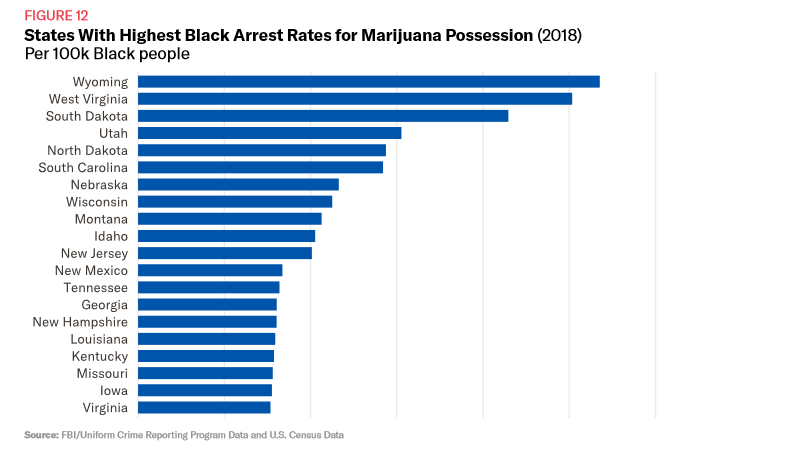
Figure 10 – Figure 12 within the ACLU (2020) Report (p. 33), titled: A Tale of Two Countries: Racially Targeted Arrests in the Era of Marijuana Reform.
How do the facts presented by the ACLU (2020) affect the United States Military, federal government, or government contractors, particularly relating to Security Clearances, employment, recruitment, etc.?
Dickstein (2020) of Stars and Stripes presented a story on how African American troops in the United States Air Force and Space Force are not treated the same as white troops based on a four-month investigation by the Department of the Air Force Inspector General (DAF IG), Lt. General Sami Said. Based on data presented in DAF IG Lt. General Sami Said’s 150-page report, which is careful to note that the identification of racial disparity does not automatically mean racial bias or racism is present, Dickstein (2020) extracted the below bullet-points for his Stars and Stripes article:
- Enlisted Black airmen and guardians were 72% more likely than whites to be punished through the Uniform Code of Military Justice or through nonjudicial punishment measures. (Dickstein, 2020).
- Enlisted Black airmen and guardians were 57% more likely than whites to face a court-martial. (Dickstein, 2020).
- Black junior enlisted Air Force and Space Force troops are twice as likely to be involuntarily discharged for misconduct than white troops. (Dickstein, 2020).
- Black Air Force and Space Force service members are 1.64 times more likely to be named suspects in Air Force Office of Special Investigations criminal cases than white service members. (Dickstein, 2020).
- Black airmen and guardians are twice as likely be apprehended by Air Force security forces than white airmen and guardians. (Dickstein, 2020).
- Black officers are less likely than white officers to be designated to attend professional military education courses. (Dickstein, 2020). ** Note: This bullet is interesting because it doesn’t seem attached to crime, suspicion of crime, or punishment, but rather perception regarding race, yet, the DAF IG is saying that the data doesn’t mean that there is racism?”
Looking at the report myself, although there is an up to 2% racial disparity in overall testing rate for black service members from 2015 to 2019, when broken down by rank, the numbers show black E1-E4s are underrepresented in random testing when compared to their white peers, which indicates there was no inappropriate targeting of young black enlisted members for drug testing. Overall, this report revealed enlisted members were tested at a higher rate than officers consistently from 2015 to 2019, as depicted below (The Department of the Air Force Inspector General, p. 13).
The Inspector General Department of the Air Force (2020) states, objective investigation data from OSI and Security Forces indicate some of the disparity in NJP (Non-Judicial Punishment) results from a disparity in behavior rather than race (The Department of the Air Force Inspector General, p. 11). Accessions data show that members who joined the service with moral waivers are more likely to receive military discipline during their time in service (The Department of the Air Force Inspector General, p. 11). Finally, the disparity in population numbers between demographic groups disproportionally impacts the RPT (Rates Per Thousand) data (The Department of the Air Force Inspector General, p. 11). Because there are fewer black service members than white service members (ratio of about 1:5 overall and 1:13 for officers), even one additional individual disciplinary action will have a far greater impact on the RPT for black service members (The Department of the Air Force Inspector General, p. 11).
Racial disparities in military justice actions against black service members is a complex issue that has been reviewed in-depth by the Air Force Judge Advocate General’s Corps (AFJAG) (The Department of the Air Force Inspector General, p. 11). A 20-year analysis of Air Force NJP data and courts-martial revealed the following: For every single year between 1999 and 2019, black Airmen were more likely to receive NJP than white service members, in terms of RPT. Black service members were 1.74 times more likely than white service members to receive NJP (Non-Judicial Punishment) and 1.60 times more likely than white service members to be court-martialed (The Department of the Air Force Inspector General, p.11). For every single year, black service members were more likely to face courts-martial than white service members. Black service members were court-martialed at an average RPT of 3.39, compared with white service members at an average RPT of 2.12. This data reveals that black Airmen were 60% more likely to face court-martial than white service members (The Department of the Air Force Inspector General, p.11).
The report released by the Department of the Air Force (2020), i.e., DAF IG (2020) relating to racial disparity in Air Force disciplinary action, got me thinking because the DAF IG (2020) talks about “behavior”. What are they really saying with this statement? Is this statement a sort of passive way of insinuating that African Americans have issues? And, if so, are we being sympathetic to the struggles of the African American community and its history, but also the current realities, in which there is a historic and present condition of oppression, imprisonment, laws created to explicitly target African Americans, Hispanic Americans, Indigenous Native Americans (First Peoples), etc.? However, I am not saying the Air Force is not taking the proper steps forward to address racial disparity issues, but one thing they could do is the ideas I am presenting through this paper. Also, they might have to better weigh where they are stationing troops of color by establishing some sort of index which accounts for local hate crimes, political atmosphere, demography, etc. Being a veteran of the United States Air Force, I can attest that most of my experience were positive and I received no disciplinary action (no UCMJ Court Martial, no Non-Judicial Punishments, etc.). I walked a straight line. Yet, I can also attest that the general culture of America where dealing with militarism is largely still dictated and catered to the majority (white) class of the United States. There is an intersectionality between country culture, Republicanism, YouTube military videos, trucks, guns, Soldier of Fortune culture, police, etc. In a way, militarism can be co-opted to be a force for silent white supremacy. When is the last time you have seen an authentic Hollywood blockbuster that showed minorities in a patriotic light while factoring in their pre-military living situations, the social pressures they face both external and internal, the systemic oppression external to the military, etc.?
Yet, I assume that a disparity exists because of marijuana in part, though not entirely (reducing the African American experience to marijuana would be stereotypical in itself). To my understanding, alcohol culture is very Eurocentric whereas cannabis smoking is not (though stats prove otherwise), thus, our nation’s view of alcohol is largely dictated by ethnocentrism, supremacy, etc. However, facts provided by the ACLU (2020) shows that white America consumes the same amount, if not more, cannabis than African Americans do, despite the imagery or stereotypes we see on television.
So, where is this disparity, such as that of the DAF IG (2020) coming from? Likely from a combination of factors, such as what I call “amplification”, i.e., minorities stand out, whereas the majority ironically fades into the background. The DAF IG (2020) did mention the same concept. Further, our there is our criminal justice system. Being a teenager from highly policed urban area is much different than a white teenager from a rural, exurban, or suburban environment.
This got me thinking further. Black Americans, i.e., African Americans, did not have fair voting rights for 77% of the time the United States has been in existence as an officially independent nation. In other words, African Americans were disbarred from law creation, and these laws in many ways have had negative consequences on the community, i.e., African Americans were unable to put their cultural viewpoint or how they view certain issues or substances, on the table. Transatlantic Slavery existed from the late fifteen-hundreds to the late eighteen-hundreds (not including the continuation of sharecropping policies, Jim Crow Apartheid Policies, etc.). 2020 to 1776 (Independence Day) is 244 years. 1776 to 1964 (Civil Rights Act of 1964 was passed on July 2, 1964) is 188 years. 188/244 is 0.77 or 77%, i.e., African Americans did not have full Civil Rights protections for 77% of the time since the United States declared independence.
The Voting Rights Act of 1965 was passed on August 6, 1965 which means 189 years since 1776, i.e., 189/244 is 0.774 or 77.4%. African Americans did not have full Voting or Civil Rights protections for 77%-77.4% of the time the United States has officially been in existence.
The first record black African slaves were brought to what is now the United States of America, to Jamestown Colony on August 20, 1619 after being kidnapped from Angola (History Channel.com Editors, 2020).
2020 from 1619 is 401 years. 1619 to 1964 (the year the Civil Rights Act of 1964 was passed) is 345 years. 345/401 is .86%. 1619 to 1965 (the year the Voting Rights Act of 1965 was passed) is 346 years. 346/401 is 86.2%. So, the from the time the first Africans stepped foot on US soil (that is officially recorded), descendants of black African slaves have not had full civil or voting rights protections for 86-86.2% of the time from colonial America to the modern era.
1965 to 2020 is 55 years and 1964 to 2020 is 56 years. Many if not most Black Baby Boomers were born without having Civil or Voting Rights, i.e., my father was born in 1959, meaning his developmental years were formed in a segregated environment, i.e., Southern Georgia.
Think about that,86-77% of Black America’s existence, we were disenfranchised without Civil or Voting Rights protections, and by the time we had full legal protections, most of the economic wealth was already consolidated, such as during the eighteen-hundreds. From 1860 to 1900, the wealthiest 2% of American households owned more than a third (33%) of the nation’s wealth, while the top 10% owned roughly three quarters (75%) of it (Tindall & Shi, 2012, p. 589). The bottom 40% had no wealth at all (Fraser, 2015, p. 66).
So, 1619 to 1900 is 281 years and 1776 to 1900 is 124 years. 281/401 (70%) and 124/401 (30.9%), meaning that from the first time a recorded African stepped foot on what is now the United States or from the later date of American Independence, African Americans by the 1900s were excluded from wealth creation for 70% of the time, later down to 30% of the time, and it would take 64 to 65 additional years to even be granted the Civil and Voting Rights protections they were disbarred from for 86-77% of the time of the United States’ existence.
To amplify the levels of oppression, we must realize that African Americans, according to Bennett, Martin, & Debarros (1993) of the US Census Bureau noted that in 1900, African Americans only made up 11.6% of the population (p.4), and by 1910, 90% of African Americans lived in the Southern United States (p. 4), i.e., the worst place for African Americans to live (though after the Great Migrations, the North proved it was not a good place either, and the West Coast was being settled by many ex-Confederates). Our law policy (drug policy included) is inseparable from race in this county unless we do something about it.
A population making up 11.6-13% of the United States population, has not had Voting or Civil Rights protections for 86-77% of the time the US (and its predecessor colonies) have been in existence, and further, this 11.6-13% was disbarred from the largest centralization of wealth from Founding to the Gilded Age (70-30% of the time since the Colonial Era and Independence), and the bulk of this population (90%) by the early twentieth century still lived in the American South, and on average, per the ACLU (2020) a Black person is 3.64 times more likely to be arrested for marijuana possession than a white person, even though black and white people use marijuana at similar rates.
African Americans, similarly, to Hispanic Americans (which is an ethnicity with a racial spectrum, so some get labeled as “white” whereas others not), Indigenous Native Americans (First Peoples), etc., need help, though we have this notion of “we are all equal”, yet I would argue that a stark view of equality is an inequality, because a moral view of equality does not make up for the real lack of equality (structural, legal, perceptual, etc.) that exists.
Conclusion
A bill, amendment to a bill, rider amendment, or Executive Order should be passed which states that Federal Agencies (the Department of Defense included) should reform forms such as AF Form 2030 (or an equivalent among current or previous Sister Service Branches) and forms such as Standard Form 86 for Federal Background Checks, so that these forms only ask for marijuana use attached to criminal charges (though criminal charges for marijuana should not be ranked as a high disqualifying factor), rather than the current policy of asking for use not attached to criminal charges. This should be done immediately and applied retroactively to any person who was denied entry into the military, denied re-entry into the military, denied employment by for a civil servant position, denied employment by a federal contractor, or denied a Security Clearance regardless if for military employment, federal civilian employment, or employment within a federal contractor.
REFERENCES:
American Civil Liberties Union. (2020). Marijuana Arrests by the Numbers. https://www.aclu.org/gallery/marijuana-arrests-numbers
American Civil Liberties Union. (2020). A Tale of Two Countries. Racially Targeted Arrests in the Era of Marijuana Reform https://www.aclu.org/sites/default/files/field_document/tale_of_two_countries_racially_targeted_arrests_in_the_era_of_marijuana_reform_revised_7.1.20_0.pdf
Baig, S. F. (2015, July 21). A fairytale visit from America’s darling. FSU News. https://eu.fsunews.com/story/life/2015/07/21/jackie-kennedy-thomasville-georgia/30458941/
Bennett, C. E., Martin, B. M., & Debarros, K. (1993, September). We the Americans: Blacks [PDF]. Washington, D.C.: U.S. Government Printing Office on behalf of the U.S. Department of Commerce, Economics & Statistics Administration, Bureau of the Census. Retrieved from https://www.census.gov/prod/cen1990/wepeople/we-1.pdf
Breana Noble, The Detroit News. (2018, November 28). Boehner-backed Acreage Holdings acquires Michigan cannabis company. The Detroit News. https://eu.detroitnews.com/story/business/2018/11/27/john-boehner-acreage-holdings-buys-michigan-marijuana-company/2126895002/
Booker, B (2018, August 23). After Centuries, Hemp Makes A Comeback at George Washington’s Home. Retrieved December 18, 2020, from https://www.npr.org/2018/08/23/640662989/after-centuries-hemp-makes-a-comeback-at-george-washingtons-home
Brufke, J. (2020, December 4). Five Republicans vote for bill to decriminalize marijuana. The Hill. https://thehill.com/homenews/house/528806-five-republicans-vote-for-bill-to-decriminalize-marijuana
Burns, J. (2018, September 12). Canadian Military Green-Lights Cannabis Use for Most Personnel. Forbes. https://www.forbes.com/sites/janetwburns/2018/09/11/canadas-military-green-lights-adult-cannabis-use-for-most-personnel/?sh=48c9ff3375a3
Business Insider Prime. (2020, December 23). 6-Figure Jobs in Cannabis. https://www.businessinsider.com/bi-prime-six-figure-cannabis-jobs?international=true&r=US&IR=T
Carr, C. (2020, July 1). Rep. Gallego Fights for Smarter Reenlistment Policy on Marijuana Use. Congressman Ruben Gallego. https://rubengallego.house.gov/media-center/press-releases/rep-gallego-fights-smarter-reenlistment-policy-marijuana-use
Congress.gov. (n.d.). Text – H.R.2500 – 116th Congress (2019-2020): National Defense Authorization Act for Fiscal Year 2020. Congress.Gov | Library of Congress. Retrieved December 19, 2020, from https://www.congress.gov/bill/116th-congress/house-bill/2500/text#toc-HCB3C1B110A174E4EBF7BD9BB4FF17E31
Daniller, A. (2019, November 14). Two-thirds of Americans support marijuana legalization. Pew Research Center. https://www.pewresearch.org/fact-tank/2019/11/14/americans-support-marijuana-legalization/
Dickstein, C. (2020, December 21). Report: Black members of Air Force, Space Force not treated the same as white troops, services need to figure out why. Stars and Stripes. https://www.stripes.com/news/us/report-black-members-of-air-force-space-force-not-treated-the-same-as-white-troops-services-need-to-figure-out-why-1.656057
DiGiovanni, D. (2018, January 17). Veterans for Cannabis: Meet Todd Scattini, ‘The Hemp Colonel.’ Veterans Cannabis Project. https://www.vetscp.org/news/2018/1/17/veterans-for-cannabis-meet-todd-scattini-the-hemp-colonel
DISA Global Solutions. (2020, November 10). Map of Marijuana Legality by State. https://disa.com/map-of-marijuana-legality-by-state
Fraser, S. (2015). The Age of Acquiescence: The Life and Death of American Resistance to Organized Wealth and Power (Edition Unstated ed.). Little, Brown, and Company
Futrell, A. E. (2020, April). Congressional Budget Office, Cost Estimate: H.R. 712, a bill to direct the Secretary of Veterans Affairs to carry out a clinical trial of the effects of cannabis on certain health outcomes of adults with chronic pain and post-traumatic stress disorder, and for other purposes, As ordered reported by the House Committee on Veterans’ Affairs on March 12, 2020 (No. 56329). Congressional Budget Office. https://www.cbo.gov/publication/56329
Government of Canada (Gouvernement du Canada). (2018, September 7). DAOD 9004-1, Use of Cannabis by CAF Members – Canada.ca. https://www.canada.ca/en/department-national-defence/corporate/policies-standards/defence-administrative-orders-directives/9000-series/9004/9004-1-use-cannabis-caf-members.html
History.com Editors. (2020, August 18). First enslaved Africans arrive in Jamestown, setting the stage for slavery in North America. HISTORY. https://www.history.com/this-day-in-history/first-african-slave-ship-arrives-jamestown-colony
Joint Chiefs of Staff. (2007, April 26). Joint Publication 3-05.1. Joint Special Operations Task Force Operations. Https://Fas.Org/Irp/Doddir/Dod/ [Direct Link: https://fas.org/irp/doddir/dod/jp3_05_01.pdf]
Kestler-D’Amours, J. (2017, April 12). Canada set to legalize recreational marijuana. DW.COM. https://www.dw.com/en/canada-set-to-legalize-recreational-marijuana/a-38399494
Losey, S. (2020, August 20). First F-15EX fighters readying to test at Eglin Air Force Base in 2021. Air Force Times. https://www.airforcetimes.com/news/your-air-force/2020/08/20/here-are-the-air-national-guard-bases-that-will-get-the-f-35-f-15ex/
McFadden, C., Romo, C., & Abou-Sabe, K. (2019, July 14). Why are many of America’s military families going hungry? NBC News. https://www.nbcnews.com/news/military/why-are-many-america-s-military-families-going-hungry-n1028886
Military.com. (2019, February 14). Length of Basic Training and When Will You Get Your First Paycheck. https://www.military.com/join-armed-forces/length-of-basic-training-and-your-first-paycheck.html
Oregon.gov (2020, November 3). Oregon Marijuana Tax Statistics: Accounting Information. Retrieved December 20, 2020 from https://www.oregon.gov/dor/programs/gov-research/Documents/Financial-reporting-receipts-public.pdf
Oregon.gov (2020). Oregon Marijuana Tax: Distribution Information. Retrieved December 21, 2020 from https://www.oregon.gov/dor/programs/gov-research/Documents/Financial-reporting-distributions-public.pdf
Spizman, H. (n.d.). Marijuana Has Been “Decriminalized” in Atlanta. What’s That Really Mean? Halman Spizman Trial Lawyers. Retrieved December 19, 2020, from https://hsflawfirm.com/blog/marijuana-has-been-decriminalized-in-atlanta-whats-that-really-mean/
Staggs, B. (2020, March 10). California passes $1 billion in cannabis tax revenue two years after launching legal market. Orange County Register. https://www.ocregister.com/2020/03/10/california-passes-1-billion-in-cannabis-tax-revenue-two-years-after-launching-legal-market/
Stone, M. (2019, October 29). Pentagon announces F-35 jet prices for next three years. Reuters. https://www.reuters.com/article/us-usa-lockheed-f35/pentagon-announces-f-35-jet-prices-for-next-three-years-idUSKBN1X81I5
The Center for Responsive Politics. (2020). For-profit Prisons: Top Recipients. https://www.opensecrets.org/industries./recips.php?cycle=2020&ind=G7000
The Center for Responsive Politics. (2020). Marijuana Lobbying Profile. Retrieved December 19, 2020, from https://www.opensecrets.org/federal-lobbying/industries/summary?id=N09
The Inspector General Department of the Air Force. THE SAF/IGS IRDR TEAM. (2020, December). Report of Inquiry (S8918P) -Independent Racial Disparity Review (No. S8918P). The United States Air Force. https://www.af.mil/News/Article-Display/Article/2453681/department-of-the-air-force-releases-findings-on-racial-disparity-review/
The United States Congress. (n.d.). H.R.712 – 116th Congress (2019-2020): VA Medicinal Cannabis Research Act of 2019. Congress.Gov | Library of Congress. Retrieved December 26, 2020, from https://www.congress.gov/bill/116th-congress/house-bill/712
Tindall, G. B., & Shi, D. E. (2012). America: A Narrative History (Brief Ninth Edition) (Vol. 2) (Brief Ninth ed., Vol. 2). W. W. Norton & Company.
Washington State Liquor and Cannabis Board (2019). Annual Report Fiscal Year 2019. [Report] https://lcb.wa.gov/sites/default/files/publications/annual_report/2019-annual-report-final2.pdf
Washington State Office of Financial Management (2019). Agency Information Technology Budget Detail, authorized by RCW 43.88.092, Appendix A – IT Projects with OCIO Oversight: Completed for Fiscal Year 2018. https://www.ofm.wa.gov [Report] Retrieved December 21, 2020, from https://www.ofm.wa.gov/sites/default/files/public/budget/statebudget/2019-21biennial/documents/2019InfoTechBudgetDetailReport.pdf
Washington State Office of Financial Management. (2019). Interactive state budget (Governor’s proposed 2019-21). Office of Financial Management. https://www.ofm.wa.gov/budget/state-budgets/gov-inslees-proposed-2019-21-budgets/interactive-state-budget-governors-proposed-2019-21
Washington State Treasurer. (2020, March 3). Washington Marijuana Revenues, And Health. https://tre.wa.gov/portfolio-item/washington-state-marijuana-revenues-and-health/
Washington State Legislature. (n.d.). RCW 69.50.540: Dedicated marijuana account – Appropriations. Https://Leg.Wa.Gov/. Retrieved December 21, 2020, from https://app.leg.wa.gov/rcw/default.aspx?cite=69.50.540
Washington State Legislature (June 28, 2016). Final Bill Report ESSB 6206. http://lawfilesext.leg.wa.gov/biennium/2015-16/Pdf/Bill%20Reports/Senate/6206-S.E%20SBR%20FBR%2016.pdf
Washington State Office of Financial Management (2019) OFM Transportation Document 19GOV001 as developed December 10, 2018, Hwy Mgmt. & Facilities Program (D). [Document] https://www.ofm.wa.gov/sites/default/files/public/budget/statebudget/2019-21biennial/transpo/2019-21TranspoProjects.pdf
Washington State Office of Financial Management (2019) 2019-21 Governor’s proposed budgets, 2019-29 capital plan, Agency capital project detail, Military Department https://www.ofm.wa.gov/budget/state-budgets/gov-inslees-proposed-2019-21-budgets/2019-29-capital-plan/agency-capital-project-detail/245
Wells, C. (2020, March 6). California Department of Tax and Fee Administration Reports Cannabis Tax Revenues for the Fourth Quarter of 2019 [Press release]. https://www.cdtfa.ca.gov/news/20-03.htm
FORMS:
SF 86 can be found at: https://www.opm.gov/forms/pdf_fill/sf86.pdf
AF Form 2030 can be found at: https://www.afpc.af.mil/Portals/70/documents/06_CAREER%20MANAGEMENT/06_IST/AF%20Form%202030%20w%20Instructions.pdf?ver=2018-04-30-140808-460
#research #policy #marijuana #cannabis #reform #legalization #socialjustice #cannabis #cannabisindustry #military #income #revenues #congress #politics
ORGANIZATIONS:
The NORML Foundation. 420 K Street NW, Suite 350. Washington, DC 20005. https://norml.org/
Veterans Cannabis Project. 901 7th Street, N.W. Suite 200, Washington, D.C. 2000, https://www.vetscp.org/
The NAACP. 4805 Mt. Hope Drive. Baltimore MD 21215
Cannabis Trade Federation. 1550 Larimer St. Suite 1109. Denver, CO 80202. https://www.cannabistradefederation.com/
Washington CannaBusiness Association. PO Box 9912. Seattle, WA 98109. https://www.wacannabusiness.org/
Acreage Holdings, Inc. 366 Madison Ave, New York, NY 10017
Peachtree NORML. P.O. Box 2063,. Dahlonega GA 30533. https://www.peachtreenorml.org/
Cannabis Dispensary. 5811 Canal Road. Valley View, OH 44125. Ph: (800) 456-0707. https://www.cannabisdispensarymag.com/
Dama Financial. P.O. Box 5730. South San Francisco, CA 94083. https://www.damafinancial.com/index.html
Acuant 6080 Center Drive Suite 850. Los Angeles, CA 90045. https://info.acuant.com/cannabis-dispensary
Florida Cannabis Action Network. 1375 Cypress Ave, Melbourne, FL 32935. https://flcan.org/