[Beginning]
#angelreese #caitlinclark #ryanclark #rgiii #sports #race #interracial #families #logic
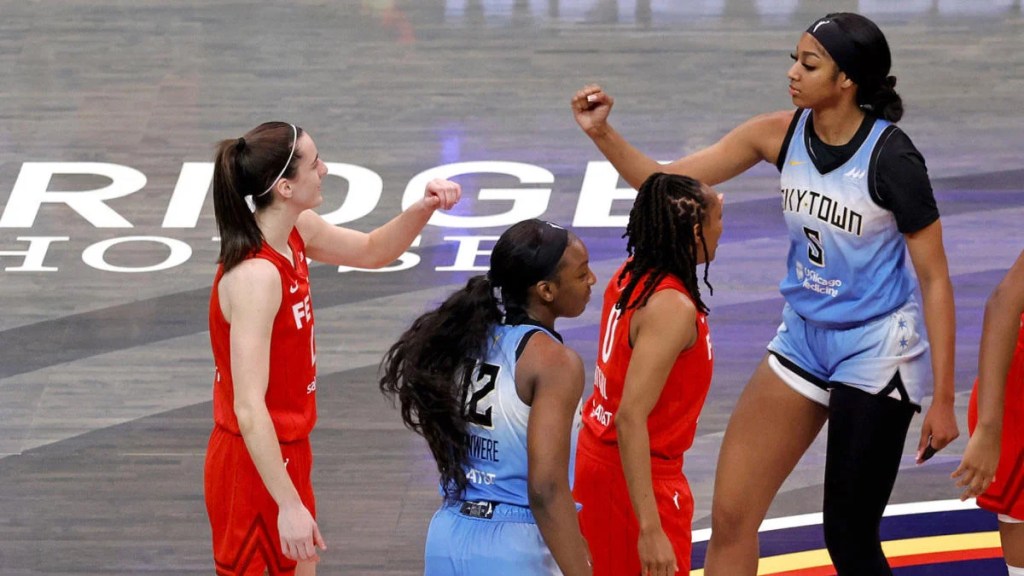
RGIII received backlash for comments, and I want to say they were about Angel Reese mostly. RGIII chimed in on the Angel Reese versus Caitlin Clark rivalry – which is largely manufactured by social media – by using themes to describe Reese with what many would call caricatures of black women. These are the allegations. Supposedly, RGIII even before this Angel Reese situation may have done some sort of caricature of black women, but I have not found anything, but who knows.
However, watching the following video by RGIII (the first video below), what he is saying is not bad at all. Maybe Angel Reese DOES hate Caitlin Clark, and if not a hate for her, but rather being associated with her? Even for the people supporting Angel Reese, just thinking about your personal life and think to a time where a person simply hated you because…they just did. These things exist. So, I do not see RGIII’s comments as being anti-black, though he his assuming things, but a lot of people turned it into RGIII being a “self-hating black man, notably because he has a white wife”. This of course unleashed psychopaths like Umar Johnson, whose only claim to fame is talking about race, and notably rallying against interracial marriages.
In the video, RGIII actually praises Aliyah Boston, who is a black woman, and even compares Angel Reese to NBA legend Isaiah Thomas of the Detroit Pistons.
But let’s entertain that RGIII was being unfair to Angel Reese.
The idea goes is that Angel Reese’s competitiveness, attitude, and swagger is seen as being “ghetto” or “ratchet” behavior, which are often negative stereotypes applied to black women for simply participating in competitive spaces, where one could argue the most competitive space is the daily grind of life in general.
RGIII essentially used the “Shaniqua” trope to describe Angel Reese’s on-court persona, where this trope is often depicted as a very loud, in your face, and “unproper” person, where properness often centers around adhering to what some may consider the culture of the majority, i.e., white people.
This is why many black people defended Angel Reese and I will also defend her on these grounds.
Angel has gotten a lot of hate, and even if she is not the greatest player of all time, in a sport like basketball (which I played growing up), to be honest, some of the most iconic players were what we consider to be “goons”, i.e., the enforcers. Goons are a part of basketball culture and mythology, and even if Reese is not a standard “goon”, or maybe she is not that all, the truth is her style is a strategic part of basketball play. Intimidation is often as vital as skill on the court. Angel has won awards such as Rookie of the Month in 2024, WBNA Player of the Week in 2024, and won accolades for her play in the WNBA All Star Game.
This will sound overly intellectual, but Angel is being defended by black people because they see her being unapologetically black, because blackness has been seen as the traditional lesser position to whiteness within American or Western society, where American or New World societies of note where often built upon a racial-colorist caste system framework.
But even though it is good to defend Angel on these grounds, people also have to understand that people may not like her, and race isn’t a part of the equation.
Race aside, some people simply don’t like her. They may not like her face, her smile, etc. It’s petty but it is what it is.
Multiple things can be true at the same time and people not treating reality as such is what is annoying to be frank. (1) Yes, RGIII could have made a tacky commentary on Angel Reese by inserting the Shaniqua stereotype, though I don’t hear him doing that in his video, (2) Angel Reese regardless of race may not be very likeable to many people on factors that aren’t racial in nature, (3) Some people may be criticizing Angel Reese because of veiled racism, (4) people will defend Angel Reese regardless of her actions and may have blinders on her actions because they see themselves in her, etc. There are even more things we could probably think of.
I understand Reese defenders. Being black, bold, confident, or even cocky are not bad characteristics, and the irony is that these characteristics are often mythologized in other American cultures, for example the mythology pertaining to Americal rural, frontier, and county culture, cowboys, what have you. Sure, people will say such archetypes often presents a type of stoicism or the “strong and silent type” (which could be debated), yet still, being confident is a virtue in American life due to its history of homesteading, exploration, conquests, capitalism, etc.
People are defending Reese because they feel she is the victim of a double-standard and cognitive dissonance, i.e., by cognitive dissonance that being the phycological term that describes discomfort or tension a person feels when their beliefs, values or attitudes conflict with their actions or new information. Angel emulates values many hold dear but because they seem them in her they up feeling repulsed about those ideals or that they see her an unworthy cupbearer of those virtues.
America hails certain behaviors as virtuous but sometimes when black women and men emulate those very virtues we hold dear, black people are then turned into indicators of being dishonorable, or that black people can’t quite master the refinery of these virtues to the degree to approval as proscribed by the white majority as far as the United States goes (side note: such anti-black sentiments can be found in non-European cultures as well, but often Black Critical Theorists forget this since their main source of analysis is often framed against white supremacy).
I call it the Denzel Effect. Denzel Washington exuded a type of cool, cocky masculinity that wasn’t always appreciated in film, but those same virtues found in let’s say a John Wayne (a noted racist by the way) are perceived differently.
Regardless, despite the Angel Reese versus Caitlin Clark drama, where I feel both women are role models for young girls across the globe to be active in team sports, and I suspect behind closed doors that both women have a respect for each other, the fact still remains that RGIII is being accused of pushing this “Shaniqua” trope on black women. However, I can’t find much evidence of this.
It is made worst – visually speaking – to many Pro-Reese types, because of RGIII’s marriage to a white woman, so the perception of RGIII pushing “Shaniqua” tropes, instantly makes him a target, where he is attacked for “not being black enough” or a “sell out”.
People reduced his criticism of Angel Reese towards him hating black women, which does not seem to be THE CASE AT ALL, but it can appear that way.
People used RGIII’s comments on sports between Angel and Caitlin Clark to spin-off an adjacent conversation relating to interracial relationships, which seems unnecessary, but also boring.
I say boring because it is easy click bait, especially in black circles to talk about Interracial relationships. I feel we have better things to talk about (e.g., learning about AI, how to invest money, to use tools, studying art, whatever, etc.), but often lots of black pop cultural discourse revolves around…. drama, and not actually learning skills to improve our lives. The main topics of black discourse are (1) black men fighting with black women, (2) interracial relationships, (3) accusing each other of being gay, (4) racism, slavery, and white people, and maybe a good dose of (5) conspiracy theories. Seriously. It seems very black spaces only talk about these things.
This is where two people who will be central to this paper come into play. One being NFL Veteran, Ryan Clark, and the other being YouTube content creator, FD Signifier.
Ryan Clark (not verbatim) stated that RGIII has a fetish for white women as he learned from his locker room experiences with RGIII (e.g., RGIII allegedly calling himself “the Milk Man”).
Clark also made an affirmative claim that black men who date outside their race will never understand a black woman because they are not married to one.
Clark got some push back, just for him to later show a photo of his first-born biracial daughter he bore with a white woman, to show that he was not being prejudiced, but some people claimed this move was the equivalent of a white person saying something racist and then saying “I am not racist. I have a black friend”.
My rebuttal to Ryan Clark is that even if RGIII allegedly has a fetishism for white women, first off that is an RGIII issue and not indicative of other people and their interracial relationships.
Sure, Clark did not outright say this, and this may not have been his intent, but he needs to be aware that many people who are his fans will take his words to come to such a conclusion because they do not support Interracial relationships and will do anything to discourage them from happening.
Two wrongs don’t make a right. Even if RGIII was wrong for his Angel Reese opinion (which I do not think he is wrong), and even if he is being wrong about his alleged “white fetishism”, it doesn’t make it right to reduce the lived experiences of others in interracial relationships, knowing the hurdles that interracial couples often face.
As stated, even if that was not Ryan Clark’s intent, I am simply holding him to the same standard he held RGIII too.
For example, RGIII did not explicitly talk about black women in a negative light, but rather people went extra and beyond, and extrapolated that he was demeaning black women.
Basically, people read too deep into what RGIII was saying and turned into a larger intersectional, i.e., “woke” conversation about race, sexuality, etc. So, even though Clark did not explicitly say that interracial relationships are wrong, one could read deeper into his words, same as he read deeper into RGIII’s words, and come to the conclusion that Clark is helping promote hatred towards people in interracial relationships.
Let’s entertain the idea that RGIII did generalize, but Clark just turned around and generalized himself with this claim that “black men who date outside their race, can’t understand black women”.
I felt Clark said this more so to wink to “Black Twitter” (which is a real thing but also a euphemism for majority online black spaces) to rally to his call, knowing that there is already a pre-existing disdain for interracial relationships within certain elements of the black community, which are exemplified by the recent infamy and fame of figures such as Umar Johnson (where memes of Umar are often used online to show disapproval of black men with white women, i.e., “snow bunnies”).
Clark essentially went low, then called upon others to back him up, knowing they were going to back him up regardless because of a disdain towards white women in some black circles. Clark realizes that in our modern “Buy Black” “Support Black” this-or-that era, which has merit, that a lot of black people will support him regardless of any flaws in his takes. I want black people to succeed just as much as anyone, but I also want it to be based on rationality, rather than pure “you’re with us, or against us” passion and emotionalism.
Clark was being Machiavellian to a degree. I suspect that he sees RGIII as part of his competition in the sports commentary industry, so Clark to vanquish RGIII, pulled the race card, so that RGIII cannot talk on black issues. Clark basically said (without saying) that RGIII is not qualified enough to talk about this, because he doesn’t have something I have (a black wife), so listen to me, Mr. Clark, see – I have a black wife, and ignore RGIII. It was something that ruthless middle managers in corporations do with each other as they jockey for more influence. This is all complicated further by the viral nature of online culture with algorithms, etc., which at this point seem to incentivize toxic conversations.
ON FETISHES
But when it comes to words like fetish, people often use the word fetish as a derogatory attack on people to insinuate that their attraction is a type of mental disease, perversion, brainwashing, etc.
The goal of anti-interracial people is to create as much discomfort, awkwardness, shame, etc., to force social compliance to rigid racial hierarchies, boundaries, borders, etc.
Haphazardly throwing around the word fetish helps inspire bigots who’s only prerogative is to paint interracial relationship in a pejorative light.
Even if RGIII has an actual fetish (which should have remained confidential locker room talk between teammates), it does not mean that others do, but the truth is that many people who are against interracial relationships often WANT to push this “fetish” trope as the only reasons interracial relationships exists.
On a separate note, why isn’t Ryan Clark being called out for revealing confidential talks from the locker room? If Clark can reveal this, what else will he reveal about others, or what will we learn about Mr. Clark?
But, back to using the word fetish to describe interracial relationships, it is a form sex shaming people into compliance, and even though I do not have any empirical evidence, from my qualitative experiences, I notice the trope that “interracial relationships are fetishes” is often pushed by white men (patriarchs) and black women (matriarchs), where these two groups can be seen as the de facto leaders of their racial groups for various reasons, and feel entitled to own their sexual counterparts as something akin to resources.
I agree with Clark in his defense of Angel Reese, and sure, maybe RGIII likely has some sort of fetish, but even if he as a fetish, that is RGIII’s prerogative.
However, to go a bit off track, is having a fetish a bad thing?
It seems like a very subjective thing. I believe all humans have fetishes, however, we as a society do consider some fetishes to be antisocial, i.e., against the limits of what is tolerable and acceptable to humans, and interestingly our morals can be viewed through “property law”. For example, we consider certain things antisocial if they go against children, animals, the mentally delayed, those with physical handicaps, etc., because these groups, especially children, have limitations on consenting and have limitations within their development. We also consider things to be antisocial that are truly irregular towards conducive, safe and/or honest human interactions such as sociopathy, psychopathy, narcissistic personality disorders, etc.
In the context of sexuality, some people have slight fetishes (i.e., sexual attractors they can live without) one could argue, and others have deeply rooted, conscious or unconscious, and required fetishes (i.e., sexual attractors needed to function sexually or even socially outside of the realms of sexuality).
From women in fishnet stockings or yoga pants, to men with chest hair, to high heels, to even dimples, people have a wide swath of things that could be considered a fetish, and sure, race or color, could be a type of one. But why is that a bad thing even if so? And even if so, for others, it does not mean that desiring a person or loving a person of another race qualifies as a fetish, except for the fact that people can argue that everything is subjective, and others will simply throw out the word fetish to spite those in interracial relationships.
For example, let’s play a logic game. Let’s say that Ryan Clark (and, also FD Signifier who I will get to later) will only date black women. Ok. Nothing wrong with that. That is their preference.
I see nothing wrong with that as long as people are not verbally expressing some sort of disdain for people who do counter to this, even though it is a person’s free speech to express things in this way.
So, for Clark or FD Signifier, I am sure there is something about their spouses that they fetishize. All human desire has some level of objectification, even if their (i.e., people like FD Signifier, etc.) rebuttal to this claim is that what they are actually desiring is the “subjectivity” of a person.
Such rebuttals seem to insinuate that subjectivity respects the empowered agency of the target of desire, whereas objectification is about reducing such agency for the unilateral pleasure of the targeting agent. Getting lost in the objectivity versus subjectivity debate seems unnecessary, so I won’t waste too much there.
So… let’s say that Clark, FD Signifier, or anyone who doesn’t engage in “Swirling” (which is a quasi-black euphemism for interracial relationships) desire their black wives, then I am sure there is something about their wives they fetishize, whether it is an action or a physical characteristic.
For example, black women are known for having “large buttocks” or being more voluptuous as in relation to other women such as white women. This truth, stereotype, what have you, is something embedded into Americal cross-racial discourse, e.g., black women saying white women have “flat asses”.
So, let’s say black men who only date black women desire their black woman’s curves because they see it as something better than what is available outside of their race. Is this not technically a fetish? Even emphasizing a desire around “beautiful black skin” or “fair white skin” could be considered fetish.
Where I am getting at is that it seems people who don’t like interracial relationships are fine with “intra-racial fetishism”, but not “interracial fetishism”, but the fact remains that one could argue that all desire has levels of fetishism, since objectification seems intrinsic to human consciousness.
I am no expert on Continental Philosophy (more concerning existentialism, phenomenology, ontology, etc.) or Analytical Philosophy (often concerning cogitation, logic, and linguistics), but the human propensity for objectification has both existential implications as well as implications concerning the very being of human cognition itself.
Essentially there is a reason we objectify things, fetishize things, etc., and it can be explained in rational, empiricist, and scientific means as well as through metaphysical quandary.
I am defining “fetishism” as the “pornification of inquiry” where we as observant sentient beings, and as objects in a world of objects, create a relationship as an observer towards an object that is being observed, where the very object being observed and the action of observing the thing, whatever it is, creates a para-social relationship, to the point of being required for the observer to function.
A fetish is simply a curiosity of things that is metabolized or internalized so much so by the observer that the observer is assisted in functioning when performing a task, but the degree of assistance varies from person to person (e.g., some may not be reliant on a fetish at all, whereas others may be dependent upon it). Sexual intercourse is a task, hence why we put so much emphasis on studying sexual fetishizes, but my definition can be applied outside the area of sexuality to pretty much any other aspect of human existence. But I can admit my definition in debatable, and has gaps, I am sure.
But, back to Clark, RGII, FD Signifier, etc., there is another logical flaw in Clark’s rebuttal to RGIII which is that Clark made an affirmative claim that black men who don’t marry black women cannot understand black women.
This is problematic to me because not all relationships need to be sexual to understand a person.
There are fraternal, paternal, etc., types of relationships. I am no Freudian psychologist, but my understanding is that Freud argued that a child’s, notably a boy’s first love, is his mother, hence the concept of Oedipus Complexes, and for females the concept of Electra Complexes.
Regardless, saying that marrying a black woman is the only way to understand a black woman is a form of purity testing, because it allows Clark, FD Signifier, et al., the ability to take a higher position when it comes to discussing black issues (even if their logic is flawed in any arguments), since a lot of black conversation and debates requires a level of approval from black women.
Essentially, Clark praising black women is appealing to the biases and desires of black women, so they are more likely to support his claims even if there’s logical flaws in his arguments because Clark is essentially fawning them.
This fawning strategy can be applied to any type of debate. It is effectively a strategy in debate. You are greasing the crowd by appealing to their internal desires, so they are more likely to believe your arguments. Another similar tactic at winning debates or winning “buy-in” from audiences is to use self-deprecation to disarm an audience, garner sympathy, protect the egos of “Alphas”, etc.
But that aside, many black men have relationships with their mothers, sisters, co-workers, extended family members, classmates, etc.
Saying that not marrying a black woman prohibits a person from understanding black women actually reduces the impact of other non-romantic types of relationships, where I would argue the most important relationship, that of a mother, is something that most black men will experience and gain a lot of their understanding about black women from.
Even for men who marry black women, a lot of what we learned is from our black maternal-like figures, since our mothers and grandmothers were, and were conversing with, black female culture, be it their own lived experiences and towards what they preferred to watch in the media, etc.
Having marriage to a black woman be the prerequisite in having a say in black conversations, actually widens the gap between black peoples, rather than bridging them together.
And, what about single people? Do single black men or single black women, not have any say because they aren’t in relationships?
I am simply pointing out the gaps in Clark’s claim which are reductionist.
But, if Clark can say that black men who date outside of their race do not understand black females then, then why can’t we say it in reverse for black women who date outside their race?
Are we really going to say that Venus Williams, who was crip walking at the Super Bowl during Kendrik Lamar’s performance, where Williams is from Compton California, is somehow not black for marrying a white man? Are we really going to argue that Eve from rap group Ruff Riders, is not black for marrying a white multi-millionaire? Are we really going to say that Alfree Woodard, known for playing black matriarch roles such as in Spike Lee’s Crooklyn does not understand black men because she is married to a white man? No.
The truth is that there is double-standard applied to black men because the truth seems to be that all groups on planet Earth, black women included, have some problem with black men due to the depictions and de-humanization of black men, first through white supremacy, but later though the hegemonic spreading of global capitalism (rooted historically in white supremacy) that spreads negative images about black men, where black men don’t control the mediums that spread negative images about them.
This double-standard of black men with white-women as opposed to black women with white men, or any other race with members of other races, can also be considered patriarchal, because what many people are saying, notably black people who don’t approve of interracial relationship, are insinuating that black men should be controlling their sexual opposites.
This type of patriarchy against interracial relationship can be observed in many black nationalist movements, where women often take a secondary role to patriarchal men. Better put, many advocates against interracial relationships, notably in black nationalist politics, are against interracial relationships because they feel men should be dominating their sexual counterparts of the same race.
This sentiment can be seen in the resurgent movement of polygamy within black nationalist circles, where such polygamist circles are often adjacent or firmly within Right Wing Men’s Rights (i.e., The Manosphere, or Red Pill) communities. For example, Umar Johnson, a known advocate against interracial relationships, and Brother Nathaniel, the leader of the black nationalist group, Israelites United in Christ (IUIC), advocates for polygamy, but notably for Brother Nathaniel, it is based in his interpretation of Biblical patriarchy over women.
The rebuttal to my arguments concerning this double-standard that falls more harshly on black men with white women, can be seen loosely in rhetoric by FD Signifier where he will say, “Well, black men date more disproportionately outside of their race than black women do. It’s not even close”.
My rebuttal in turn is that black men have been more so victimized by white supremacy because black men are seen more so as a physical threat to it, so black women actually with white men (which I support) can actually amplify the effects of white supremacy.
So, if white supremacy and patriarchy are the main culprits of most black inquiry, notably based on a dialectical way of thinking (i.e., analysis based on opposites, contradictions, etc.), then a black woman with a white man actually amplifies white supremacy, more so than any black man with a white woman.
But I don’t hate on black woman with white men. If anything as a black man I almost give a nod of “cool” approval, because that white man has shown himself as possibly loving, thus seeing as equal, the black community. I never see black women with non-white people as being “treasonous”, an act of betrayal, etc.
Being consistent to the logic of most black Critical Theory, I do have a point.
The truth is that white supremacy does not want black men with white women, whereas if a white man is with a person of another color, it is almost an exercising of white privilege because white men are often given a pass.
Even if a white supremacist does not like that a white man dates outside his race, they will not do anything about it because that white man is still exercising a type of privilege that other types of men of other races are denied. White supremacy is an ideology of power that is indifferent to equality. It is not based on fairness or equality but power. The white supremacist does not care so as long as the privileges and preferential double-standards of their system still favors them.
I hate to compare modern interracial relationships to slavery, because this a bad habit many modern Critical theorists have, but to make an example, think about a white plantation owner with a black woman, versus a black male slave with any white woman regardless of class. The penalty for the black man was always going to be castration, death, etc., whereas there was no consequence for white men.
I like to say that white men have free reign to “colonize p-ssy”, which historically is the case from black females’ slaves, native Africans such as those modern day South African (which created the mixed-race Colored demographic), to Asian woman, Indigenous Aboriginal Australians, etc. White men have doing whatever they want forever, but if black men do it, not only do they get shamed (or, killed) by white supremacy, but also by their sexual internal counterparts give them grief, etc.
Black men were literally killed for being white woman, whereas the penalty has never been the same for white men.
So, even if black men currently do date outside their race at higher levels, per Left Wing logic, the structural impact will never be the same as that of a black woman, essentially emboldening white supremacy and patriarchy.
Which is why it dangerous to reduce people’s love, emotions, etc., to intellectual frameworks. People simply use intellectualism to make their personal hates sound smarter than what they actually are.
For example, in media, black men with white women are often used to shame interracial relationships, by reducing black male-white female relationships to comically absurd fetishes. There is also the racist slogan of insinuating that white women with black men will be raising children in single parent households.
For example, there is the famous meme of Piper Perri, a pornographic actress before a group sex scene with black men, being used by various people to caricature female desires because most male insecurity involves female sexuality, so shaming women is a means of protecting the male ego, or “id”.
The meme or memes like them are about shaming women, black men, etc., but done so in a sinisterly playful way that gives the person who uses it plausible deniability that they aren’t insecure, because “it’s just a joke”, harmless fun, or postmodern pastiche.
This meme is often used not only to “make fun” and reduce black male-white female relationships for the benefit of male egos, but notably the male egos of non-black men in general.
Even the show Family Guy has made fun of white women preparing to be “gangbanged” by a group of black men.
At a certain point the use of such tropes tells more about the fears of society, with that being (A) black male sexuality being seen as more masculine, thus it poses a threat to the deification of white male honor, thus black male sexuality has to be shamed as naturally “evil”, “diseased”, “wild”, or degenerate, and (B) a fear about female sexual choice, where patriarchy reduces women to simple sexual objects for male use, but notably as incubators for sustained racial majority, i.e., ensuring more “pure white babies” are born to maintain racial dominance.
The irony is that white men, notably in the porn industry, have privilege, such as models being paid more to have sex with black men because of the perceived taboo and fears of hurting a woman’s career. However, such issues have been addressed or at least talked about as being problematic by many adult performers, so this issue is nothing new, and the adult industry seems more inclusive of non-white male voices than it did previously.
A person could easily make a meme of white men preparing to gangbang a black, Asian, or Hispanic woman, but you often don’t see these being shared throughout the zeitgeist, where part of our zeitgeist, does involve your run-of-the-mill (mostly non-black male) online trolls (for example, 4Chan or 8Chan culture, where these Chan-sites are often associated with Alt-Right and white supremacist politics).
These memes are even used by black people often within the Right-Wing oriented Manosphere, where figures such as Fresh and Fit of the Fresh and Fit Podcast, or even more moderate figure such as Aba and Preach, use tropes of “gangs of black men having sex with white women” to shame feminism, but also promote an irrational fear in young men that their women are likely to cheat/commit adultery on them.
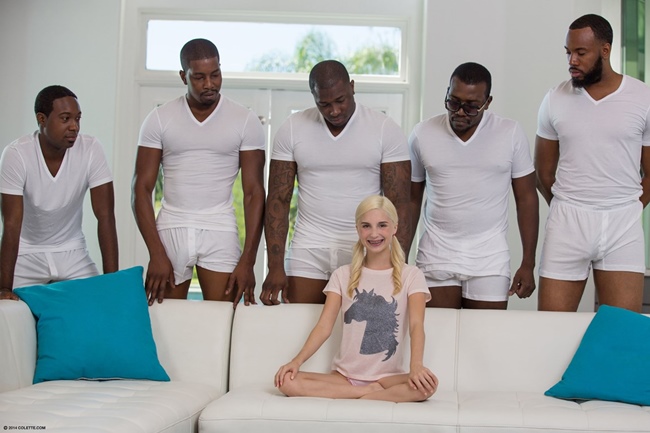
Interracial relationships between black men and white women if utilizing a Left-Wing framework is actually a revolutionary act one could argue by subverting white male patriarchy considering all of the historical violence and effort exercised towards preventing black male-white female relations. Thus, more interracial relationships is a sign of progressive change in society at large, even if intra-racial relationships are still the majority.
More irony is that the more accepting people are of interracial relationships, it could be argued as an acceptance of blackness overall, because the divide between seeing black and white as polar opposites is reduced.
More irony to the situation is that many tenants of Black Liberation politics which uses Left Wing frameworks often dissuades from positively acknowledging interracial relationships, because certain schools of Left Wing thought advocates for “Self Determination” – often as an extension of Anti and Post-Colonial thought.
Essentially, Left Wing thought can promote racial segregation, but instead of it being based on Right Wing “top down” hierarchal modes of segregation between races, the Left-Wing version of segregation is “flat” “non hierarchal” “intersectional”, etc.
Who would have thought that the Left Wing promotes…. Separate but Equal?
FG SIGNIFIER AGAIN PROVES HE’S INTERESTED IN AGITATION RATHER THAN GROWING AS A PERSON
FD Signifier for example in his video titled: “What are we going to do about these Coons“, to me expresses this yearning within certain Left Wing, notably Black nationalists’ circles. This video, FD chimes in on the RGIII comment drama, which to me isn’t much of drama at all, but goes to show how some black people will jump on anything to talk about race.
FD Signifier uses this recent video to segway back towards an earlier video with other creators he was on which alleged that you could tell if a black man dates a white woman by how well their hair is maintained, i.e., how fresh their cut is.
Somewhat funny, the truth is that FD was actually purity testing by trying to insinuate that only corny black men date outside their race, so he, of course is somehow naturally better?
I commented on his page that if you can judge a person’s hair cut as them being more likely to date a white woman, then can I say that you as a slightly pudgy black man, who looks like my mother with braids, can be predicted to be a Communist?
First off, as a black man, calling another black a Coon is absurd, but for people who are not black, I need to stress that certain things about black culture may seem like “anti-matter” to you. Black people often use these terms, which were and are still used by white supremacist/anti-black people in general (who can be non-white) against black people, as a means of black people reminding other black people they see as too comfortable with their dialectical foe (white people) that they are still black.
It is a reason why black people use the N word, though the N word is often used – allegedly – in an “endearing” way. Black people have coopted white supremacist language and some of it like the N word are used in endearing ways while other words are used to shame people as a means of reminding black people that they are black. Using such words equates to the linguistic form of the “Tall Poppy Syndrome”, i.e., a culture that “chops people” don’t to size so they never feel more special than that of the collective. For reasons across the spectrum, some petty, and some that could be based on some type “intellectual pragmatism”, are used to keep black people in their place.
FD Signifier, as a Black Nationalist, has a lot of blind spots in this analysis of black culture.
For example, in his video FD talks about how black military brats often get messed up and insecure about their race and turn into RGIII. This is partially true, but also debatable. Black children may suffer from issues of identity if not in an environment that affirming and accepting of what we consider to be traditional black culture, but FD almost has their belief that growing up in black environment guarantees you may wind up “messed up”. He seems to believe growing up around white people is the same as Native Americans forced in schools where they were forced to assimilate. His assumptions often seem to erase nuance and complexity.
Black children may feel the dilemma of fitting in with their more segregated black counterparts because they have been exposed to other cultures (fashion, music, lifestyles, subcultures, etc.), have more economic certainty, and live in statistically safer environments, etc.
What FD doesn’t understand as he tries to oversimplify things is that black military brats still have black parents who are often still connected to their black roots, with many having been enlisted from urban inner city black communities or rural black communities.
FD signifier talking about military brats, has some merit, but it also diminishes the truth that many black families in the military as still connected to their roots.
But F.D. not having served, having been a military brat, not being a two-parent household, and not living in a truly multiracial environment…assumes things.
As a person who served myself, grew up in the military, and is around the same age group as FD himself, I can attest that the military is…. pretty black.
That’s well known. The military often recruits from the poor classes and statistically, black people as far as wealth are in near last place (though we can argue about what is wealth, how studies were conducted, etc.).
Many black officers are from Historically Black Colleges and Universities which have esteemed ROTC programs such as Tuskegee with US Air Force ROTC or Morehouse with Navy ROTC.
Many black military members are also involved with Black Fraternal and Masonic organizations. FD when talking about RGIII did talk about anything of this because HE DOES NOT KNOW ANYTHING ABOUT THIS.
He assumes a lot of things, but his target audience are what I call “White liberals searching for black authenticity” with what I call “Take Me To Your Leader Mentality“, and woke – sometimes but not always black – people who more addicted to woke frameworks of thinking, which at this point as devolving in online shame culture to suffice for the fact the woke Left has failed in making actual real-world structural change. Something of course that FD has said he is incapable of solving or fixing.
And I say this as a military brat from a two-parent black household with an inner city raised mother and country “rural” raised father.
FD Signifier who seems to emphasis qualitative research like most Left-Wing sociologists, but I suspect that FD already has his conclusions in minds and wants his work, video essays, etc., to moonwalk or back up into those conclusions, so he has to have a degree of blind spots in his analysis to justify his preconceived presuppositions.
If I had to explain FD, he is a race-realist, dialectical materialist and Critical theorist, who has a palatable platform enough to not be relegated to the fringes of black nationalist discourse. A lot of what FD would say on race, I suspect a lot of white supremacists would agree with, because if self-determination means not being around black people, then they are for it. This is no different than George Lincoln Rockwell of the American Nazi Party working with the Nation of Islam, and even helping give seed money to N.O.I., black only farms in rural Georgia.
If FD can make an assumption on black military brats or black suburbanites, then I can make an assumption about his.
Coming from a single female parent household in the Chicagoland area, which is an area known for its history of Northern based racial segregation – when analyzing a person such as RGIII, Mr. Signifier has a propensity for assuming what it must have been like to have not been raised in explicitly black spaces.
FD deeply wants to believe without saying it directly that black people who aren’t raised in explicitly or majority black spaces like him seemed to be lacking in purity or authenticity, yet purity and authenticity are subjective things.
The irony is that he as a Leftist, would espouse ideas such as “everything being on a spectrum”, yet, when it comes to black lived experiences, he seems to not understand this, and even if so, his own personal biases make him uncomfortable in admitting that his vision of blackness is not the entire vision of it. I can hear it in his voice.
It makes you think that maybe even certain aspects of Left Wing (what we consider as liberal) politics are just a different shade of the same thing but used by those who actually controls things to create disunity amongst the general population. For example, Black Lives Matters is a concept I support, because I always understood that it meant “Black Lives Matters too”, and not “Black Lives Matters only”, yet the effects of BLM, for an array of incalculable reasons, did help re-solidify white supremacy, because such a bold slogan was seen by many people as explicitly a dismissal of their own misery, lives, etc., which weren’t in black bodies.
Even though the Left Wing is good intentioned in brining topics such as cultural appropriation, white privilege, patriarchy, imperialism, environmental racism, and gentrification to forefront of discourse, the Left Wing is also very bad, if not unapologetic, in the adverse effects of their messaging campaigns. Maybe this is because human emotion and feelings could be argued by some extreme Left-Wing voices (such as Marxist voices) as being…. bourgeoise and counter revolutionary. For such as theoretical person, feelings and emotions are often the constructs helping to prop up systems of oppression by prioritizing individual emotional comfort over the needs of the collective proletariat. And, let’s say, sure, this argument has merit, the fact still remains that it has consequences.
Despite the Far Left having pushed the needle forward in many good ways, and I would argue the Left Wing has “elevated consciousness” (notably a popularization and normalization of socialist analysis in American life), they have also enabled a complete opposite and dialectical reaction. MAGA for instance is essentially pro-imperialist, gentrification, and white identity politics, and the Left is now in a malaise, still arguing about if it is wise to go the intersectional route or the class-consciousness route. I would argue we’ve had enough intersectional conversations and should go to class consciousness because it seems the only method left in bringing on structural reform.
Better put, we have never truly tried a racially blind and unified, class-oriented movement, largely because of the infighting of the “intersectional-ist” faction. And many people may cringe at the words “racially blind”, but I am not saying “unaware”, i.e., unaware of the importance of applying intersectional analysis towards alleviating oppression, but rather…. we’ve talked enough already, and talking about identity politics has only given us heightened awareness, but not structural change.
I wouldn’t be surprised for example if Clark, FD Signifier, Umar Johnson, etc., were explicitly told by their black mothers to not date outside of their race. If so, then I guess they learned something about black women without needing to be married one.
End Notes
Disclaimer: I am tired of talking about race. However, there are many people online whose identities and career are explicitly based around race, and these people often need to be challenged. I consider myself something akin to a “radical abolitionist”, i.e., who is a Left-Wing progressive, however, I am cautious about the over usage of intersectional frameworks, however, as a person of color (but even if I were not one), I see value in intersectional thinking. However, ideology aside, on a person-to-person level, I think that many hateful or “troll like” figures hide behind ideology to sound smart, but really these are just…racist, prejudiced, etc., and some of these people can be on the Political Left, be they “Far Leftists” (Communists, Marxists, etc.), or milquetoast “Center Leftist” liberals. Ideology often veils desires, insecurity, biases, and people’s selfish will-to-power. We have to be honest that we all do this to an extent. I support Black liberation, empowerment, etc., because black people…deserve it considering how we as a people were literally designed to be the “Ying to the Yang” of white people (a concept I have talked about before), i.e., we as black people were manufactured to be an internalized foe to help justify, inspire, and motivate white supremacy as an ontological construct. We were designed to be hated and having been incubated in hatred (literally within the equivalent of prison conditions for centuries), we as a community do have deep rooted trauma, which we even as black people towards black people hurt each other with.
To really understand what I am saying in this post, we have to ask, “What is America to me?”. This will sound “brainy” or quasi-intellectual, but I think it will make sense to you.
The United States is built upon a post-colonial, psycho-sexual racial caste system, which emphasizes “racial dialectics” as a means of controlling and organizing the population in a way the serves the interests of the capitalist class. The capitalist class – once called the aristocratic and gentry class, but later euphemistically called “the one percent” – uses psychological warfare, notably around agitation-propaganda to create intersectional division, so economic class consciousness can never take hold to threaten the wealth of elites. For example, figures such as W.E.B. DuBois spoke about how the white poor often defended the white rich, because the white poor were given a “wage of whiteness”, i.e., social privileges above others, even if the white poor were voting against their own economic interests by supporting elites. Separately, what I mean by “psycho-sexual”, is not in some Freudian sense about childhood development, but rather a psychological system built upon sexual insecurities that are nuanced along racial lines, where the awkwardness created from this system helps to veil and protect the power and privileges of white patriarchy within European colonial nations. The USA is built upon a fear of black male sexuality and the control of white female sexuality. These two groups pose the largest threats to the existing white patriarchal order (side note: I am not hating on white men, but rather a system catered towards their needs at the expense of others), which is why there was so much historical emphasis on shaming and preventing these types of relationships. Ironically, within certain left-wing circles, more visually seen within Black Liberation politics, there is constant theme of talking about black male-white female relationships, which one could argue is about a fear of cultural erasure or “appropriation”, but in essence these types of Leftists are perpetuating the same hatred towards black male-white female relationships that are existent within white supremacy. Even though the arguments are coming from different angles, vantage points, ideologies, etc., the similarity is that both sides want to limit and discourage such relationships.
The United States is a post-colonial nation, however, we in contemporary times often have a hard time truly understanding that, largely I suspect because of our economic success which has even overpowered that of our previous colonial masters in the British. However, the same way how we in the West and USA understand that certain African nations are troubled because of the divide-and-conquer systems applied by the British, this same sort of divide-and-conquer mentality is too fundamental to the United States.
Main Ideas by Quinton Mitchell: (1) People try to reduce interracial relations to fetishes, but those same people are fetishizing within “intra-racial” relationships. For example, people will try to hate on black male-white female interracial relationships by calling them fetishes, however, if a person hails a “Black Queen” in for example a white male-black female relationship, then people often don’t use the fetish accusation. Further, people advocating for explicit intra-racial (same race) relationships, ironically use fetishes themselves. Further, I bring up the idea that all humans fetishize things and fetishizing may be central to desire to varying degrees. (2) Left Wing concepts such as Self-Determinism under Post-Colonial frames of thinking can lead to a flattened “Separate but Equal” type of segregation, that is not much different than the hierarchical “top down” segregation found on the Political Right. Which alludes to the idea that Left Wing and Right Wing ideologies, can both be used as systems-of-control to maintain pre-existing systems such as racial segregation (3) Tiger Woods Syndrome, a term coined by me, Quinton Mitchell, which is the social phenomena of black people to consider and shame things that are perceived as white, but then later incorporate these things into black culture once popularized by black cultural leaders (4) “The Colonization of P-ssy” (however, crude that may be, where the intended crudeness is meant relate to online colloquialisms, urchin speak, etc.) is a term I coined writing this which is about how white males don’t get criticized as harshly as non-white men, notably black men, for interracial relationships, and this privilege that white men have dates to the Age of Discovery, the colonial era, etc. (5) The Denzel Effect is a term that may not be original but one that I thought of out of the blue to talk about how black confidence is often seen as dishonorable, whereas white confidence can be seen as honorable. However, this effect doesn’t obfuscate from that the fact that people of any race can simply rub people the wrong way and color is not a factor. (6) Take Me to Your Leader Mentality, is a term which may not be original, but I came up with out of the blue when writing on subjects relating to race, so if this term does exist, I created it in a type of “no original idea really exist” type of randomness. However, I intend this term to mean how black intellectuals often consciously or unconsciously winds up being seen as the “de facto voices” of the black experience, but these leaders, often to forget to explain, defend, and champion different black lifestyles which aren’t seen as the standard type of black culture. White liberals for example try to find what they consider to be intellectually and aesthetically “the blackest” person they can find to explain things, while not realizing the cultural complexities within black culture, and these assigned “black leaders” often have their own biases, gaps in understanding, etc., when it comes to black lifestyles which aren’t their own individually speaking.
 Mitchell Research Group