(Please Donate) If you like content like this, please subscribe to by blog but also donations are more than welcomed. I am an independent blogger, thinker, etc., trying to better create and invest in this site. There are no subscription fees to my blog at the current time (it’s free until further notice), so donations are welcomed. Any amount is welcomed. Donations can be made to paypal.me/qmarcell87 at the following link:https://paypal.me/qmarcell87?locale.x=en_US
The “industry” since it can’t control everyone has to continue inclusion training and talks etc. Background checks, etc. I’m sure there’s many good people in the majority in that industry. It also highlights that adult content creators should be donating some of their income to progressive causes to hedge the possibility that bad actors might be using revenues for things that endanger the public.
Yet, Is democratized pornography funding parts of domestic terrorism? Maybe, Vice Media can pick up on this to do more research because I don’t have the time. Maybe if something were to come out about how a minuscule fraction of Only Fans or Camsoda or whatever are using profits to fund international or domestic terror, it would be silenced, because 1) who wants to kill the party for the millions of law-abiding people who use porn as a means of relieving stress from a world bent on “lean productivity” and hyper change, and 2) businesses won’t want their traffic hampered (governments might also like having the ability to “peek into personal behavior as well”, i.e., metadata being filtered my Mormons at NSA Utah Data Centers). The question of “Can domestic adult content fund domestic terror” isn’t out of the question, considering in earlier decades of adult content the mafia did have ties, meaning, also, that government snoops also had ties. Are we in an era where the pleasure and flashing lights of the industry has hidden the possibility that there is a small underworld where criminals (and, possibly even government agents) are involved in porn with the criminals using the easy money (relatively speaking) to fund various operations, and/or government investigators coming to investigate those criminals, yet, as we know in cases relating to “state evidence” that investigations can turn into decades long infiltration projects where the “Feds” cut deals with dangerous people on the hopes of capturing “more dangerous people”?
It would be stupid to attempt to fund domestic terror or international terror with pornography because the IP trail, payments, etc., yet, some goof balls might be tempted. However, one cannot control what one does with the money they make from employment.
Anyways, a Neo Nazi and porn actor, real name Paul Kryscuk, porn alias Pauley Harker, who has slept with women of all colors and religions (for titles such as Abuse Her, Facial Abuse, Latina Abuse, Arab Street Hookers, Ghetto Gaggers, etc., according to IAFD.com), sometimes in the most disparaging ways for fetish-oriented content, was arrested for interstate gun trafficking and for planning to murder protestors. He seems like just another idiot casualty of the post-Federal Reserve “ZOG” YouTube conspiracy universe, compounded by Ancient Alien History Channel grooming, sprinkling in some Vikings “badassery” (tying into the whole European “West is the Best” thing as a psy op) etc. Another, “conservative woke” guy who blames the Jews for everything, yet, while also having sex with Jewish women… Hm. Confusing. Not only does this event show an “anything goes” mentality regarding who is in the pornography industry (as long as you can “perform”), even though I am confident that gossip is a good way at vetting out bad actors, but it does sadly show that money takes more precedent than doing the right thing. Many people need the money (something I sympathize with); however, this article is not to shame sexual feminism or sex workers of any gender, but when our reality (paradigm – way of thinking) boils down to pure transactions, I can see how bad ideologies can feed off “the industry” (porn). But, before we got into this story, let me start with my beginning thoughts. As a disclaimer, this is not an indictment of the traditional adult entertainment industry which seems to be a very professional enterprise (finances, real estate, property, top audiovisual equipment, marketing, distribution, warehousing, costumes, hair stylists, make up, special effects, IT, website creation, award ceremonies, Halls of Fame, health testing, etc.) which has improved over time from something seedy (past tendencies of letting in drug abusers, outbreaks) into something also corporate/safe, nor a criticism of independent content creators.
His fellow performers probably had no idea about his beliefs. As far as they were concerned it was just another day at work, even though some of those days involved dog bowls, spitting in women’s faces, and general (well advanced level) jerk behavior. There’s also no way of knowing of when Mr. Harker’s beliefs changed, yet, there is the possibility he was a sociopath the entire time, living a secret life on set, but elsewhere bragging about this escapades those to want to see the collapse of civilization for some sort of “racial hierarchy paradise”. In a two party system, who do you think he voted for? Trump is the answer. Ding ding ding.
But, porn isn’t the issue. At this point of Hot Girls Wanted culture, porn seems also collegiate with schedules, testing, work, furnished apartments, chaperones etc. It’s really just some bad individuals I’m sure. Be they closeted Neo Nazis from God Knows Where (Orange County, Bakersfield, the Antelope Valley etc), to Crips or Bloods, to bikers, to even remnants of the mob, to even Zionists, or sprinkle in some Jihadist. Traditionally there’s money to be made in server hosting, pushing traffic, leasing mansions, payment systems, etc. But Only Fans has made it easier for predominately good people with some bad ones to make money.
I am not writing to judge people within sex work or kink but particularly for this paper, my focus is the pornography industry. I feel old. Sex, insecurity about sex, the alleged hipness of sexual experiences, years of bombardment of sexually charged content from 1990s wet t-shirt beer commercials, MTV Spring Break bikini dance contests hosted by Pauly Shore or Ed Lover, nineteen-eighties hair metal videos by Motely Crew with women in cages, gangster rap, to porn itself, to the punk rebelliousness of sexual feminism as it tries to achieve equality while chipping away at the “Id” of phallic patriarchy (seems like they won that war already in the West – just being honesty – I could be wrong), the existential crisis that sexually explicit content can cause – for better or worse, I prefer to say better – as it erodes and reshapes one’s preconceived notions of morality, are nothing new to me. Ok, people like to f-ck. Ok, there is a media or art form relating to sexuality to fulfill a human desire. Ok.
If anything, I am over it. There is nothing “kinky” or “he-he-he” about it. Yawn. Sex. Yawn. At this point the true “porn” is something that most people are lacking, i.e., a true human connection, stability, commitment. Yet, from the obscenest gonzo (well, what is available on Hub sites), to the most passionate plot centered porn, I feel society is so used to it that it’s not something “groundbreaking”, though I admit that being older I am trapped in my nostalgic era, i.e., I do not really follow new entertainers (I was the last generation of the DVD) and I have my “go to favorites” and favorite actresses. Typically, ladies from the nineteen nineties to the early two-thousands typically fading away after Sasha Grey (who I was not much of a fan of, to be honest, though I do value her role as a symbolic figure who really inserted the “nihilistic rebellion” of female sexuality more so into mainstream pornography, thus being a catalyst for women’s empowerment to arguable degrees).
If I am following someone new it is typically the safe (and sensual) category of the “MILF”, because I think mature women are attractive. Yet, I am a straight guy, so… I accept porn as a part of life. A public utility. The right to get off, to get a dopamine or serotonin hit, to fantasize. Though the medium is argued as crude, such as what I’m reading in Angela Carter’s The Sadien Woman and the Ideology of Pornography, there is something philosophical about porn and I am not being purposely erudite (high-brow) by staying that. You can consider the act of watching porn as a type of therapy. A mediation between self, the content, and questions pertaining of gender and society at large (not to forget all the various intersections or race, culture, income, class, etc.). I can easily see how pornography could be some topic of a French Philosopher analyzing semiotics, objects in relation to other objects and how meanings are derived, hyper-reality, etc. Don DeLillo said it best in his 1985 work, White Noise, in which he stated, if my memory is correct, “that technology is lust removed from nature”. Porn is a part of the human species. From Stone Age carvings of voluptuous women as virility fetishes found in European cave dwellings such as the Venus of Willendorf, to Japanese elaborate paintings of Geisha (awkwardly engaging in acts with squids), to Greek tapestries with women dancing with dildos, porn has always been with us and will always be. To me shame, is childish. Shame is barbaric. Shame is a way of control for people to make it appear as if their self-ascribed morality is somehow higher than that of others, or a way to even guilt trip another. The sinister impression in which mainstream media tries to push relating to pornography as something sinister in nature, something to make one feel queasy (what I call the Cohen Brother’s aura, i.e., that strange feeling you get watching their films where you feel helpless) as preconceived notions are challenged, is so tiring to me. We’ve been through this. Grow up.
I support the idea of pornography because I figure so many bodies have been thrown at the medium that to reverse course would mean to bound the species into repeating what has already been done. Every set, every actor, and every release has a story – some good, some bad. Each person has a story with some being traumatic leading to catastrophe while others are inspiring and empowering. To erase all that would be erasing our growth at articulating and understanding pornography, and thus at understanding our species in how we cognitively process sex, insecurity, fear, gender dynamics, etc. From an American standpoint we’re already at point of “being over the hump”. We’re past the Brady Bunch fear. What comes around, goes around. Rome gave way to the Dark Ages and Christendom, and that led to the modernity, and then so forth, so forth, so forth, so why erase and start over just to erase what can be learned from all that has been done? I totally reject the Puritanical view to sex (though emotions and fidelity do matter and are important) and if anything, the Puritanical unrealistic view to understanding human nature, while also not creating healthy outlets for sex (with a gender equal viewpoint), created the problems their ideological “Moral Right” descendants still preach. Yet, isn’t it ironic that the Right Wing preaches all this morality, yet, on its fringes lies a regressive, violent, fascist element, where some, as in the case of Pauley Harker engage in porn?
If anything, porn has been a tool for progressive change such as forcing reflection regarding the patriarchal ego to accept that women can willingly and voluntarily participate in acts that are contrary to one’s own moral beliefs, to showcasing the reality that people of different races have always been sexual with each other, or there is the fact that pornography is parallel to mainstream culture in that pornography’s various eras memorialize music, fashion, politics, etc. Pornography is like a cartoonish, visceral, hardcore, Precambrian mirror image of what is pent up on the surface above. It is similar to the medium of comedy in that comedy points out things that are obvious or analyzes possibilities which might not be so obvious, yet either/or, shocks the standard discourse, thus generating laughter, i.e., comedy like pornography, shocks us into our realness, hence once could say both have slight nihilistic tendencies, yet, what one calls nihilism, once can also argue as being something to nirvana (embracing impermanence, so we value our temporary time here in the living realm).
The urges that humans feel is eternal and complex. I would be lying to you if I did not state that I have not enjoyed watching pornography and I know quite a bit about it, similarly to how some people know about baseball statistics. It’s not a revolution thing to say. It’s casual sometimes, yet, a private thing. The history of porn in the USA spans from the seedy nickelodeons of the early twentieth century, to the stag films or post-war soft BDSM of Betty Paige in the forties and nineteen fifties, to New York amateur films of nineteen seventies New York, to the birth of the Hollywood-like productions of the seventies to the eighties (Deep Throat, The Devil In Miss Jones), to the invention of gonzo in the early nineties by John Stalgiano, to mid to late nineteen nineties “shock” Jerry Springer-esque Baywatch knock off exploitation genre such as that of JM Productions (always with a golem of a man bedding a double D platinum blonde model for the construction crew construct of American masculinity), to the zenith of the Golden Era with models like Jenna Jameson or Brianna Banks, to the early two-thousands Jackass-like WWE sex-competition style of porn with young women raised on Britney Spears (the hubris of unfettered capitalism of the early Bush Era translating into the proletariat aspiring for a better life in the shadows of the Hollywood Hills and Paris Hilton), to the quasi avant-garde movement with Sasha Grey’s reading of existentialism coinciding with a generation of millennials – the first generation raised with social media – free from college and living in cities during a Recession (living their own HBO drama series), to the Alt Witchy scene of Joanna Angel, to the acceptance of BDSM after the popularity of Fifty Shades of Grey (popularizing sites such as Kink), to the full actualization of democratized pornography with the invention of Hubs, Only Fans, “Link in Bio” within Instagram pages, etc., I’ve seen it all.
It is a personal and entertaining thing that people watch for an array of reasons from dealing with stress, dealing with horniness, boredom, curiosity, etc. Yet, America does still have a childish Brady Bunch morality relating to it, which is hypocritical considering the “mainstream economy” has used sexuality to push products for the capitalist machine. If anything conservatism is highly lowkey sexual, I mean just see all the IG bikini cowgirl models with Bible quotes shooting guns and still hung up that Obama won and who praise Trump.
I can honestly state that pornography helped me grow, but I do respect and like that it is “over there”, i.e., it’s not something I’m in but somewhere that I can travel to. Raised a Christian Protestant and made to feel guilty about sexual urges for fear damnation, to overcoming my young twenty’s feelings of misogyny as I learned to appreciate feminism (non-cringe), to simply learning to mind my own business and understand that people have their own preferences which might not be mine (yet, I have my own) but if there’s consent, safety, and pleasure, then go at it, have fun.
There are many strong women in the porn industry I respect such as legendary Nina Hartley, Joanna Angel, Ginger Lynn (who overcame a lot of personal trauma), etc. The types I would like to talk to about life in general rather that turning them into a sexual object. Women are more than sex, but sex being a straight male from them, is a joy. A real man accepts and acknowledges this. Yet, it seems that sex, being something that all humans crave, typically drowns out the more pressing issues at hand regarding feminism on an international scale, e.g., with the internet being global, the Western viewpoint of pornography which might be more nuanced, might not translate well to developing nations under the yoke of patriarchy which does use violence. For example, what a Western woman might find appealing might be helping to oppress women in developing nations living under older notions of gender roles, yet, this is not the Western woman’s fault, but just a reality of the complexity of the diverse world we live in.
But to the point of this paper. I was reading the news and saw a curious case about a male porn star who was caught in a gun running Neo Nazi ring in which this ring was plotting to kill Black Lives Matter protestors. Even if you do not personally agree with BLM (why you would not is beyond me), we must remember that Nazism is not only racist towards anyone not white (it’s pretty brutal towards white people as well considering the Nazis murdered plenty Germans and other Europeans) but is also sexist/misogynist, homophobic, transphobic, anti-free speech, anti-art, etc.
According to Joseph Wilkerson (2021) of New York Daily News, Paul Kryscuk, a male pornstar was arrested on interstate gun trafficking charges in a ring with three US Marines, in which Kryscuk, held video tapped training sessions near his Boise, Idaho home depicting themselves saying “Heil Hitler” under a Black Sun flag. I heard this story when it came out, but it faded away, but surfing around online, I stumbled upon a video by a site called “Abuse Her”. Not my type of stuff. It is pretty messed up content to be honest and I am surprised it is online. Women are spit upon, gagged, throw up in dog bowls, inserted roughly, slapped, choked, cry, etc.
Seeing people broken is not pleasurable. It is sadistic. Yet, has sadism from males become this sort of “top shelf” drug for some females? One way domination is not too appealing, personally. Sex is a symbiosis; however, I do feel that being men, there is a psychological satisfaction in slight dominance, i.e., leading the way. This site is like another borderline illegal series called Slap Happy featuring Brandon Irons who was known for his indifference and misogynistic comments. The genre of “revenge porn” is not something that I never got into, though I understand it has a following across genders. Morals aside, it is not my thing. Even the simulation of assault is unacceptable. To me, the angry “revenge” notion of porn is something a guy might go through in his twenties as he tries to succeed with the opposite sex (and fails), but it is something that one should grow out of, but even so, this level of content is unacceptable. It might also be something that women desire because the arena of pornography being a controlled spaces, lets women simulate something in a controllable way, they fear they might be exposed to without consent.
What is sad about Abuse Her is… these actresses, who are of all races and religions, probably had no clue about Paul Kryscuk political beliefs, and honestly were probably indifferent to varying degree, since pornography is about money mostly. Being a guy, I know the spectrum of men and there are a lot of dirt-bags out there, ladies. Straight up. Men who simply hate, mock, and disrespect women. However, I do understand that getting experiences is a part of the formula. But Paul Kryscuk not only performed with the stereotypical “fresh off the bus” type of model new to Los Angeles, but he worked with veteran actresses such as Nina Hartley who is Jewish.
But a Neo Nazi roughly having anal sex and ejaculating on women’s faces, particularly in content that is depicting male dominance and shaming women… is just sad, honestly. It is easy to blame the men collectively as being soulless, and for those with “souls” to be “simps” “betas”, etc., but f-cking ex-convicts with some skills at video editing (with notable spider web tattoos over their elbows), shows how indifferent people are, including the women. It would be easy to say this is all an example of patriarchy, but we must remember that these women voluntarily participated in this content, knowing the impact on the perception of females, feminism, etc. This is where the curiosity comes from, I believe when many people watch porn, but I am speaking for myself (but maybe you can relate). They (I) are asking themselves (myself) why? They ask themselves this to understand to toughen their mindset from chaos. Sure, not every woman has to be a feminist if she does not want to. Sure, actors are not responsible for the political beliefs of content creators or consumers, but still… at the end of the day, these men, particularly this Neo Nazi was able continue old legacy of white supremacy, i.e., white male entitlement regardless of how regressive their beliefs are, to have the pleasure of women of all races without criticism (though if people of other colors do the same thing the behavior is stigmatized), while also making most of the profits. These profits in this case likely were going towards supporting an underground economy of illegal guns meant for the purpose of killing liberals, progressives, leftists, minorities, etc. It sounds like Zoolander, but this is no laughing matter. It reminds me of the action movie Heat in which a character who is a Neo Nazi, murders a black sex worker after having sex with her.
Paul Kryscuk is the epitome of white supremacy, white cynicism, and white privilege, and he was able to be in an industry that attracts many young women – for various reasons, e.g., economic reasons, life experiences, etc., – on the notion of sexual feminism. Is sexual feminism exposing the people it claims to be supporting to mockery at the hands of people who outside of porn want to commit racial, sexual, religious, and gender-oriented violence? Granted, I do understand that I am attacking a broad concept by calling out sexual feminism in this specific regard. Many sex-positive feminists are adamant about self-respect. So, who I am angry at here?
I think it is more so anger at our society at large with it being a capitalist system that breeds disparity but also breeds insecurity as people are brainwashed into conspicuous consumption, seeing it as a gauge of economic mobility, yet this same capitalist system appropriates concepts like sexual feminism (of any counter culture) to hide its inherently exploitative core. I am sure there are many people who would do sex work for free, but to be honest, most do it for money. Money that is going towards expensive college education in a system where Big Business requires people to obtain it without Big Business offering much assistance. The money is going towards inflated real estate prices propped up by Central Banks, speculators, and gentrification. The money is going towards helping loved ones who might not have great healthcare insurance. The money is going towards feeding children in which women and/or couples (including men) do not have access to reproductive health/family planning services. But the money is also going to waste. Waste on items that lose value the moment they are purchased and in many cases were created from exploited labor elsewhere.
But, as a reminder, I am not shaming women.
Have we become so nihilistic and indifferent as a society that actors like Kryscuk can snake their way into arenas perceived as more liberal in nature and exploit others? I hate to write this as if I am shaming women, but women are past the point of ignorance or “I just didn’t know”. Kryscuk and his gang were spotted observing Black Lives Matter protests in Boise and this was during a time in the nation when extremist groups such as Boogaloo murdered two law enforcement officers, a militia in Michigan attempted a kidnapping on the female Governor, rising levels of hate crimes, etc. It seems our hyper capitalist, overly cerebral, interconnected reality has created something akin to the sinister tone underneath the seemingly comedic vibe of a postmodern author. We live in complete chaos, yet it is a chaos of necessity, in that people are doing what they have to do to survive in constructed systems built on exploiting us all. Humans laboring to survive in an indifferent world who barter our own integrity to get by in a country of abhorrent wealth disparity, corporatism, draconian law and order, gentrification, etc., but it all distills in culture wars, thus disuniting the proletariat. I do not blame women, but I do admit that it is incredibly sad.
But what I mean by sadness is not some emotion response, but rather something that reminds me at least that we truly are in a void. Some sort of plane between things that is beyond our mental comprehension. “Meat puppets”, biological robots, with the capacity to feel, who might back to the conclusion that we aren’t simply slaves to ourselves in a cold vast universe, feeding off each other’s energy, because we’re “sad”. Something I feel Rush Cohle from True Detective might muse on.
I see Abuse Her.com as a detriment to women’s empowerment, all the hard work, etc. There is this notion that fantasy is not reality, but the truth is fantasy is inescapable from reality. No matter how existential, angry, nihilistic, empowered a person is on their ‘do what thy whilst’ journey, the individual, in this case the performer regardless of gender or orientation, has no control over how people will see them and usurp their value for their own purposes. A person can literally be masturbating to a woman for free and still vote for initiatives that enslaves her.
Yet, what I have come to realize is that women to an extent see such degrading content as…empowering. Some sort of challenge against their worst fear, their philosophical and ideological antagonist. It’s not only a challenge but also a reverse sort of psychological warfare through a moral dilemma back into the face of those who watch it.
To be honest one reason I watch porn is to toughen myself up. But I do consider it as art whether it be a fun film set on some B-cult classic knock off or sci-fi oriented movie, to something that is truly well-written and thought provoking. Something private. Something for adults that adults can handle. It is odd I know to admit this, but to me it is as if I like to ponder that a person, I see on screen could be any person walking by me in the real world. What is funny is, this is the case. There is something empowering and progressive to know that this person on film is a person elsewhere. They have dreams, goals, aspirations. They are more dimensional than just a sex object, and as a result it humanizes the experience for me. I empathize and respect. Part of me wants to say to a female performer, is “I don’t judge you. If anything, you helped me grow”.
But what this Neo Nazi situation means to me is that the sex industry needs to be normalized. The more normalized it becomes the safer of a space it becomes. People can be better vetted for their personal beliefs. Revenues can be better taxed to help society. I have heard stories from strippers saying they cannot buy a house since banks want to see pay stubs and many establishments do not give checks, but it is all cash. This is a problem. Considering taxpayers bailed out banks but banks oddly still shame sex workers on the lowkey. Hub sites should pay performers for residuals. If a million people even pay one penny for a watch, and that video gets a million views, that could translate to income for past performers at $10,000.00. The imagine investing that money in a trust fund with compound interest. The industry should have criminal background investigations (I am sure the standard studios do), on top of contract agreements where racism, sexism, etc., are banned and violation means disbarment from work, and such individuals would be ousted though the social grapevine. Yet, for modern content creators out there, I want to say that I do respect you, but you do have great power, so protect yourself and vet those who give the privilege of your bodies.
Understanding issues facing African American Owned Businesses from Brand-Image to the Supply Chain
Applying Quality Management to African American Businesses
MGMT 691 Graduate Capstone Proposal
By Quinton M. Mitchell
M.S. Management (Operations Management) 2018
Embry-Riddle Aeronautical University (Worldwide Campus)
ABSTRACT
The purpose of this research paper is to (1) Explore any limitations to branding products or services created by African Americans as Black-Owned by conducting a literature review which analyzes scholars who argue for and against segregated economies, i.e., protected enclaves; (2) Understand consumer behavior differences between African Americans and other groups by understanding theories such as the Customized Communication Incongruity Theory by Arora & Wu (2012) and Socialization Theory by Ward (1987); (3) Explore how marketing and advertising affects African Americans and how diverse/positive marketing campaigns improves black success; (4) To show positive gains within the African American community but also to explore the hindrances to African American economic productivity such as higher insurance costs, lack of capital markets, sensitivity to economic conditions, etc., and (5) Discuss Supply Chain issues in African American businesses by using black-owned breweries for a test industry to implement concepts just as strategic alliances, best practices and/or to emulate practices such as those used by Japanese Keiretsu.
Table of Contents
Managerial Problem stated as a Research Question…………………………….…….5
Setting/Background……………………………………………………………………5-6
Research Activity……………………………………………………………………….6-7
Literature Review………………………………………………………………………7
To open the community or to close off the community?……………………………7-10
The underlying psychology of branding and marketing pertaining to African Americans…………………………………………………………………….10-12
Disparities between African American Owned Business and White Owned Businesses……………………………………………………………………12-16
How African Americans respond to brand image & issues regarding advertising and media portrayals…………………………………………………………………………….16-20
African Americans in the Supply Chain & the need for Strategic Alliances or Joint Ventures………………………………………………………………………………20-32
Is the Japanese Keiretsu model appropriate for African American Breweries? ….33-39
Figure 1. 2017 Top Black Owned Businesses by Black Enterprises…………….22
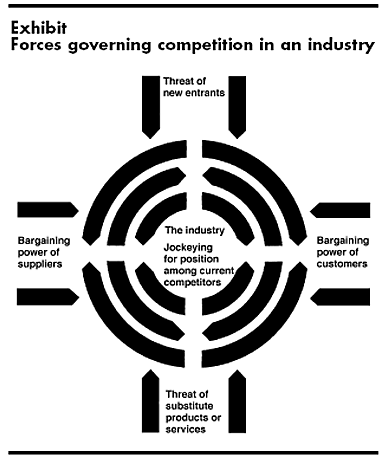
Figure 2. Michael Porter’s (1979) Five Force of Competition…….………………32
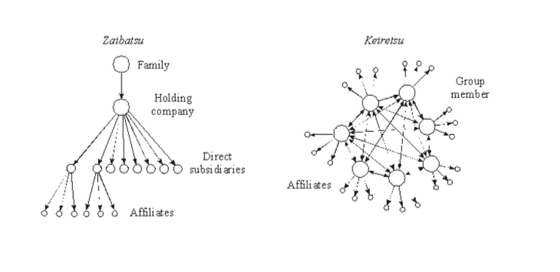
Figure 3. Zaibatsu vs Keiretsu by Yonekura (1985), cited by Grabowiecki (2012) …………33
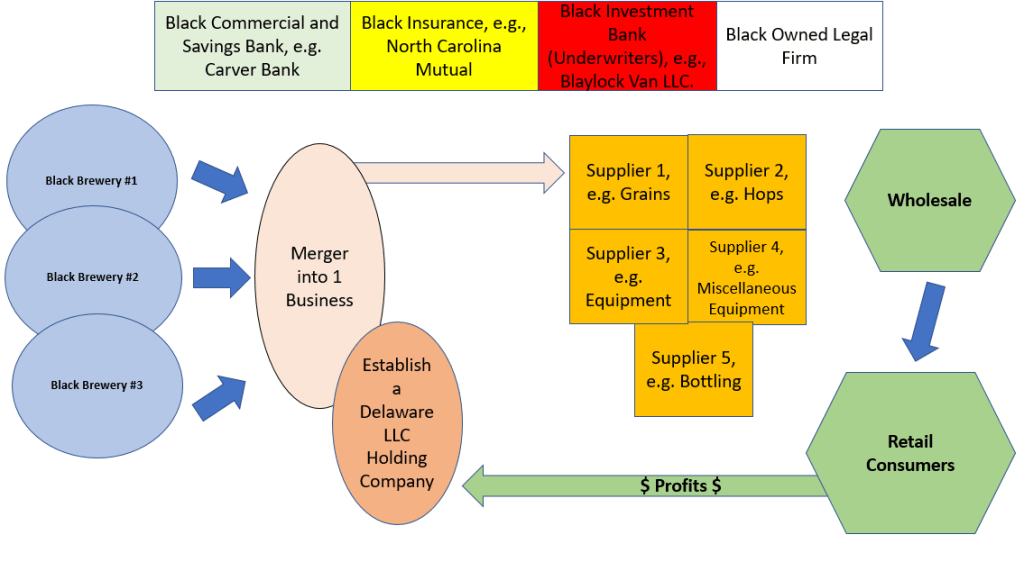
Figure 4. Theoretical Model for African American Brewery Consolidation………36
Keywords: African American, #business, #behavior
Managerial Problem stated as a Research Question:
Does the resurgence of labeling products as “Black Owned” has its limitations? Should African American owned businesses think bigger and take a risk by creating brand campaigns that targets a larger non-race specific consumer base? Should smaller African American owned firms join forces through concepts such as strategic alliances, joint-ventures, or even the Japanese concept of Keiretsu? Is it safe to view the black community as a singular entity, or does a complex intersectionality exists within the black-community, and, if so, which ideology, or which marriage of ideologies, is more effective at achieving sustained success for African Americans? In addition, can the establishment of a supply-chain network between African American owned businesses help improve visibility of brands, maximize economies-of-scale, improve service/item quality or value, and increase profitability?
I.Setting/Background:
African-American in business have a long history in the United States ranging from entrepreneurs or CEOs who have gone to build empires or sustain already established business empires; to running established firms who have made catered services and products towards African-Americans and the world at large, and the number of African-Americans winning managerial positions in name-brand American firms since the Civil Rights movement. Yet, Black-Owned businesses faces a plethora of issues ranging from access to credit, the risk-reward aspect of certain industries, and the fact that African-Americans, as with most Americans, have benefited positively from, while also being negatively impacted by the effects of globalism, the loss of labor protection, the hyper-competition of corporate multi-national companies.
In addition, Gillian B. White (2017) wrote an article that noted black CEO representation peaked in 2007 but has been slowly dwindling due to removal or retirement. As a result, I am arguing that black-owned businesses who market their products as “black owned” instead should market their products towards all consumers, regardless of the self-empowered notion of supporting black-owned businesses, because the level of product visibility and profitability will increase. Essentially, be black-owned, sure, and be proud of that, but market and win customers regardless of who they are. However, this paper is not an indictment of Black-Owned branding, but rather an argument that the call for branding products as such should of course be from a sense of empowerment, but not to the extreme of exclusivity which could have detrimental effects on capital accumulation and distribution of profits amongst the community. Why have one market, when you can compete with larger companies in multiple markets? To support Black-owned businesses and possibly improve the quality-of-life of certain African American communities, thinking bigger and expanding consumer bases can increase African American economic prosperity. For example, we know that Toyota is a brand of cars that is obviously made in Japan, and the brand is synonymous with quality, but the Japanese benefit from a clever branding strategy where the products does the talking for the culture. The goal of this paper is to provide recommendations to assist black-owned businesses, not from a stance of exclusion, but rather to further normalize products for all consumers regardless of race.
II. Research Activity:
A brief background into African American business ownership from a historical perspective will be presented. In addition, a historical view of race-centric marketing will be presented to strengthen the premise that race and marketing are often in unison. This historical perspective will lead up to my initial business problems facing the community and then I will follow up on conceptual ideas that could generate benefits. Giving dues when needed to the current landscape, I will then offer my recommendation for focusing on brand-image marketed towards a diverse consumer base, which in my opinion, can increase black economic output without labeling itself as “black-owned”, but if a firm decides to brand themselves as black-owned, which is justified considering the complex history of the United States, then there needs to be a strategic re-training of the thought process to challenge oneself to expand what new markets black Americans can or should participate in. Qualitative research will then be discussed to link the marketing of brands to the importance of the supply-chain.
Finally, a summary of the supply-chain as far as key aspects will be discussed and then I will construct a conceptual supply-chain or strategic alliance theory in which an African American business owner could formulate strategic ideas. The goal of this project is to emphasis strategic-thinking while loosely threading upon the quality management philosophies of early scholars such as Deming, Juran, and Crosby, to get Black-owned business owners to think more expansionist-minded, while simultaneously being inclusive towards all communities.
IV. Literature Review
A. To open the community or to close off the community?
Cummings (1999) presents a study comparing African American entrepreneurs conducting business in the ghetto’s protected- market versus the suburbs or larger Metropolitan Statistical Areas and argues that African American firms outperform when operating in larger non-segregated environments. Cummings (1999) provides a qualitative and quantitative study regarding the flaws of racially-segregated economies by touching upon the enclave-theory and protected market theory by referencing researchers such as Drake & Clayton (1945), Cummings (1980), and Light & Rosenthein (1995). In the study, Cummings (1999) states, “Although racial segregation may be a prime factor promoting ethnic and enclave enterprise, it simultaneously undermines business growth and development”. In addition, Cummings (1999) shares findings from Brimmer and Terrell (1971) who states that African American entrepreneurs who depend upon a segregated-protected market have high potential for failure. Moreover, when faced with desegregation and group dispersion, businesses that depend exclusively upon an enclave market are likely to fail (Brimmer and Terrell, 1971).
Rueben & Queen (2015) studied how African American owned businesses suffer adversely from unequal access to capital markets and the prevalence of institutional barriers. Although not universally appreciated, African Americans have a long history of entrepreneurial achievements against odds. African Americans are more likely to start a business, yet, are less likely to succeed (Rueben & Queen 2015). Rueben & Queen (2015) stated that the success of minority businesses to employ more workers and raise the productivity of workers is essential to U.S. economic growth, considering the U.S. labor forecasts (U.S. Bureau of Labor Statistics 2012, as cited by Rueben & Queen 2015), the 2025– 2050 outlook on the U.S. labor market is expected to grow slowly with most of growth coming from 55 million by minorities and immigrant workers. Further, despite these increases in the number of African American owned firms, African American entrepreneurs tend to participate in industry sectors with less capital requirements for start-up and expansion. However, some of these industries have lower revenue streams. Yet, when African American entrepreneurs operate in high revenue generating industries, their average annual revenue and average annual payroll per employee are significantly lower than their white counterparts (Rueben & Queen 2015).
The yearning to empower black businesses has led to a conflict in policy ideologies as presented by Cummings (1999). The enclave economy theory alludes to the positive outcomes associated with racially or ethnically segregated communities, but considering the criticisms presented by Tabb (1970) such as (1) smaller markets, (2) lower income consumers, (3) higher insurance rates, (4) inability to access credit, (5) higher rates of theft, and (6) limited access to capital, there are parties at be that wish to open the black community to larger markets but from the stance of community re-invigoration, yet not entirely from a segregated mentality. According to Cummings (1999), community-based development initiatives are activities inspired by or aimed at service social groups in a locality. In addition, community-based development initiatives also refer to those efforts organized by people who share a common urban geography (Blakely 1994).
Strategies that come from inwardly focused values and not economic realities are likely not going to make a competitive advantage (Barney & Hesterly, 2015, p 6). This touches upon my argument regarding the general trend in the growth – as far as a calling or social justice movement – of marketing products or services as Black-owned. There is nothing wrong with this, yet there are many assumptions and a diversity of ulterior motives that can occur when there is a calling for a segregate mentality. Such as, considering the social nature of human beings when classified, there can be a limit on the expressive modes – which can be profitable – that a group feels they can participate in. I call this a “culture-trap”, in which the standard or traditional culture is such a firm aspect of identity, that deviating to innovate for an individual, can have detrimental social and psychological effects. In addition, this “culture-trap” not only limits innovation, it can lead to issues such as brain-drain (when intellectuals leave the community in order to associate themselves with more supportive individuals), attrition (leaving the community), and the recycling effect of standard discourses when relating to issues effecting a community. Also, there have been clear examples of black-on-black business crimes or political corruption, in which the culprits have often used the calling for black segregation for their own financial and personal gains.
There seems to be a standard agreed upon set of values for African-Americans when consciously entering the business arena, i.e., a sense of liberation and self-empowerment, and although these yearnings are noble and arguably justified considering the sociopolitical and economic truths of African-American culture (slavery, segregation, red-lining, police profiling, etc.), yet the ultimate goal is, of course, to empower the group, yet it has to be based inevitably on an open-market, non-exclusive long-term agenda – with active but non-exclusive black participation – where products or services are focused on the bottom-line of profitability, penetrating new markets (both physical, i.e., foreign countries, but also unrealized cultural markets, i.e., cultural facets of American culture with black participation but that aren’t associated with black cultural as a whole) and the realization of a multicultural globalist reality based on a post-racialist idea or aspiration.
However, the claims provided by Cummings (1999), Rueben and Queen (2015), and Tabb (1970) are rebutted by Chaplain (2012) who argues that integration has destroyed the black economy. The black community lacked the requisite socio-cultural characteristics to develop a robust entrepreneurial tradition and, second, that integration, as an independent variable, destroyed black-owned business. Chapin (2012) studies the affects of government regulations which highly curtailed African American business growth and this provides more historical background on my study. Since insurance is a major part of entrepreneurship and running a business, Chapin (2012) study can shed light on the emotional reasons many African Americans are compelled to market their goods as black-owned and might give credence to the calling for black separatism. Yet, a major focus for business ownership growth and development in the African American community must be on the strategic expansion of the employer firms (Rueben & Queen 2015).
Chaplin (2012) seems to be of the vein of intellectuals who argue segregation as a benefit to African-Americans; however, Chaplin (2012) is sensitive to history, and only seems to be basing his premise on the fact that systemic injustice such as a society built on “white Affirmative-Action” had a detrimental effect on blacks, even though black communities formulated under this system and showed signs of progress. Yet, Cummings (1999) study on the undermining of business growth and Rueben & Queen (2015) study which shed light on the future growth of minority groups in the United States, I feel that there is a calling for creating a black-owned business mentality, yet, there is also the need for it not be exclusive. Essentially, we need more entrepreneurs and businesses owners, but the underlying motivation must be global and catering towards all people.
B. The underlying psychology of branding and marketing pertaining to African Americans
Jeffrey Steven Padoshen (2008) presents a compelling study into how African Americans value and apprise goods based off unique characteristics of their community. As “minority” groups such as African Americans and Latinos grow in overall proportion to America as a whole, particular attention must be placed on the understanding of their consumption characteristics (Padoshen, 2008). Padoshen (2008) presents a study that investigates word-of-mouth and brand loyalty within the context of durable-goods purchases in the African American community to see if there are effects on purchase decisions when a supplier was at one time linked to the slave trade, and if there’s a preference for purchasing products which come from black-owned companies. Padoshen (2008) provides a historical background into African American communication by referencing Thorp & Williams (2001) who argued that African American uprooting from their African homeland destroyed the means of communication. Further, Padoshen (2008) references Harris-Lacwell (2004) & Gothard (2001) who argued that oral-storytellers remedied these severed means of communications (Thorp &Williams, 2001) within the black community. Padoshen (2008) references Gothard (2001), Thorp & Williams (2001), & Harris-Lacwell (2004), & Miller & Kemp (2005) many times throughout his insightful study. Both Gothard (2001) and Miller & Kemp (2005) defined word-of-mouth communication within the context of the African American community – a major part of African American culture – as having four (4) distinct elements, which is trust, respect, open-voice, and black-to-black communication.
According to Padoshen (2008), African American culture is one in which greater distinctions are made between outsiders and insiders compared to Anglo-American culture (de Mooij, 1998) and significant weight is attached to personal qualities. For many African Americans, premium brand names and symbols are mechanisms that reflect the hard and long portrayal of higher aspirations (Miller and Kemp, 2005). Further, Miller & Kemp (2005) speaks into how African-Americans favor brand-names because it is reflecting a “badge” or “badge of honor”, particularly for a group who was largely relegated to be an outsider, thus, wearing brand-names helps to include these people into the overall larger culture. In addition, Padoshen (2008) states that African Americans have indicated that when purchasing automobiles, brand nameplate, looks and style are more important in their purchase decision than safety when compared to Anglo Americans (Packaged Facts, 2006).
Padoshen (2008) references one of his prior studies (Padoshen & Hunt, 2006) to support his claim that historical treatment of African Americans, similar that of Jews who suffered under the Holocaust, can have generational effects when buying products from sources who are equates with supporting or benefiting from the systemic injustices that kept that their people subjugated. The most important finding of Padoshen (2008) finding is that, African Americans indicate that they are no more trusting of the advice they receive in comparison with that of Anglo Americans. Padoshen (2008) research is an exceptional example of the dilemma facing most African Americans in my opinion, which is that studies – even if objective without any sort of racial bias – assumes a distinct racial and sociopolitical characteristic than that from the larger culture they are technically a part of. This bias, even if assumed on noble grounds to prevent an issue such as systemic injustice, can never lead to a full understanding of human nature. Essentially, we can define a group up to a point, but can never fully know a group, or even a group understanding itself entirely, which isn’t a bad thing – from a business perspective, this is new unrealized markets and ways towards profitability.
C. Disparities between African American Owned Business and White Owned Businesses
Tang & Smith (2013) conducted a study that researched African American business disparity in comparison with White-owned businesses regarding market segmentation, product differentiation, and competition, but their findings suggested that the difference was not statistically significant. Tang & Smith (2013) studied the largest African-American owned employer firms from 1998-2008, as published in Black Enterprise Magazine, in which businesses on the list must be at least 51 percent African American-owned if a private company, or African Americans must own at least 51 percent of the controlling shares if the company is publicly traded and be willing to voluntarily provide financial data. Yet, Tang & Smith (2013) admits a bias in their research as far as selection of candidates from the Black Enterprise Magazine, in that some of the firms on the list may be “front companies”, in that they are non-African American owned but registered as such and that certain actual African-American owned firms may not have given up financial data to maintain a non-disclosure position. From personal experience in government and corporate procurement, where seeking minority, woman-owned, or general small (no-racial assignment) businesses is a goal, I have found this misrepresentation of classification as something endemic in the procurement field.
Tang & Smith (2013) utilized a contingency (environmental)-view to study Black business disparity when compared to White-owned businesses, in which they cite Aldrich’s (1979) definition of a contingency-view as explaining variations in firm performance from the interaction of the organization and environment, in which environments affect firms through the process of making or withholding resources, and the top three environmental contingencies are complexity, volatility, and munificence. Munificence is defined as very liberal in giving or bestowing or characterized by great liberality or generosity (Munificent, n.d.). Tang & Smith (2013), summarizes their utilization of the contingency (environmental influenced)-view, by saying, “When the rest of America catches a cold, Black America gets the flu. In other words, declines and dips in environmental variables like income, GDP, and labor supply will have a greater negative impact on black businesses. The number and type of contingent environmental factors able to influence the performance of established African American firms is undoubtedly numerous.”
A large motivator in conducting their research, Tang & Smith (2013) cited Fairlie & Robb (2012) who stated that it is estimated that closing the revenue gap between minority and non-minority owned businesses would add $2.5 trillion to the US economic output, creating 11.8 more jobs in America; Fairlie & Robb (2008) who stated that performance disparity might stem from issues of start-up capital, owner’s education level, and prior business experience, and Keollinger et al (2007) who stated that African-Americans have lower personal wealth, greater difficulty in obtaining financing, less education, and lack of entrepreneurial legacy. Further, Tang & Smith (2013) cited research by Puryear et al. (2001) which found that African-American owned businesses were the only minority group to report medium gross sales significantly lower than their white comparison sample, and African-American businesses where the least success as rated by their owners. In addition, Tang & Smith (2013) states that some of the studies pertaining to performance disparity between African-American and majority-owned firms, focus almost exclusively on sale proprietors or entrepreneurial firms undergoing the start-up stage (e.g. Buckley, 2002; Puryear et al, 2001; Richtermeyer, 2002); However, the focus on more established business will likely shift from overcoming liability of newness and survivability to concepts such as market segmentation, product differentiation, and competition as the business moves through the typical life-cycle (Hofer, 1975 – as cited by Tang & Smith, 2013).
Overall, Tang & Smith (2013) concluded that (1) the complexity and volatility associated with one of the most difficult US business environments since the 1940s (the Global Recession, in my own words) may increase the performance disparity between established African American and White-owned firms; (2) that existing knowledge about African American entrepreneurial firm performance may not transfer to larger, more established African American businesses; (3) their findings do not suggest that emerging African American firms should avoid entering complex and volatile industries;(4) emerging African American businesses often operate in industries that are more favorable, marked by less complexity and volatility such as construction, wholesale trade, and manufacturing (US Department of Commerce Minority Business Development Agency, 2011), but these industries are characterized as relatively low growth industries (Tang & Smith, 2013); (5) a “strategic choice” approach would imply that despite unfavorable industry characteristics, African American businesses may be able to actively shape their future and control their environment (Child, 1972), responding to threats and opportunities created by environmental change by altering organizational strategies in ways that enhance performance (Pfeffer and Salancik, 1978; Porter, 1980). The task for African American businesses then becomes developing the capabilities or distinctive competencies needed to overcome isolating mechanisms and mitigate industry conditions (Tang & Smith, 2013).
It is on black community-leaders to be open-minded (challenging the culture-trap I referred to earlier and opening new ways of thinking, while community member simultaneously keep open-minds as to not be lead to narratives which might not account for the entire truth) considering Thorps & Williams (2001) claim that authentic leaders who “tell it like it is” have strong community influence as cited by Padoshen (2006); in the African-American community, greater distinctions are made between outsiders and insiders with weight attached to personal qualities (de Mooji, 1998 – as cited by Padoshen, 2008); brand names and symbols are signifiers of higher aspirations and are considered badges-of-honor (Miller & Kemp, 2005 – as cited by Padoshen, 2008), so much so that safety – at least relating to automobile purchases – is largely a non-impactful decision (Packaged Facts, 2006 – as cited by Padoshen, 2008); African-Americans are no more trusting than Anglo-Americans (Padoshen, 2008); closing the revenue-gap between whites and blacks would add $2.5 trillion to the US economic output (Fairlie & Robb, 2012 – as cited by Tang &Smith, 2013); African-Americans have lower personal wealth, greater difficulty in obtaining financing, less education, and lack of entrepreneurial legacy (Keollinger et al, 2007 – as cited by Tang & Smith, 2013); more established firms will shift from survivability and newness to market segmentation, product differentiation, and competitions (Hofer, 1975 – as cited by Tang & Smith, 2013); information on African-American start-up and entrepreneurial performance many not reach established African-American firms, the Global Recession had a negative impact on the African-American community, and African-American firms often operate in less volatile or complex industries with relatively slow growth (Tang & Smith, 2013; US Department of Commerce Minority Business Development Agency, 2011), yet, these unfavorable characteristics – speaking to volatile and complex markets – may be able to actively shape African-Americans futures (Childs, 1972 – as cited by Tang & Smith); the black church, barber-shop and beauty salons and other informal settings fosters open interaction (Gothard, 2001; Harris-Lacewell, 2004 & Miller & Kemp, 2004 – as cited by Padoshen, 2006 and 2008).
V. How African Americans respond to brand image & issues regarding advertising and media portrayals
Kristen Bialik (2018) of the Pew Research Center, noted that (1) more than 40 million blacks live in the United States, making up around 13% of the nation’s population according to 2016 Census Bureau estimates (US Census Bureau, 2016); (2) The share of blacks ages 25 and older who have completed four years of college or more has also roughly doubled during that span, from 12% in 1993 to 24% in 2017 (United States Census Bureau, 2017); (3) There were 4.2 million black immigrants living in the U.S. in 2016, up from 816,000 in 1980, according to a Pew Research Center analysis of census data, and recent growth in the black immigrant population has been fueled by African migration at 39% of the overall black immigrant population in 2016, up from 24% in 2000, but about half of all foreign-born blacks (49%) living in the U.S. in 2016 were from the Caribbean (Lopez & Radford, 2017, as cited by Bialik, 2018); (4) the wealth gap between blacks and whites decreased among lower-income families but increased among middle-income families. The Great Recession of 2007-2009 triggered a stark decline in wealth for U.S. families and further widened the already large wealth gap between white and black households (Konchhar & Cilluffo, 2017); (5) There has been a steady increase in the share of Americans who view racism as a big problem in the U.S. – especially among African Americans since 2009, when Barack Obama was elected. In 2017, about eight-in-ten blacks (81%) said racism is a big problem in society today, up from 44% eight years prior. By comparison, about half of whites (52%) said racism is a big problem in our society, up from 22% in 2009 (Neal, 2017), and (6) An overwhelming majority of blacks (92%) say whites benefit at least a fair amount from advantages that blacks do not have. This includes nearly seven-in-ten blacks (68%) who say whites benefit a great deal. By comparison, 46% of whites say whites benefit at least a fair amount from advantages in society that blacks do not have, with just 16% saying whites benefit a great deal (Oliphant, 2017).
Dimofte, Johansoon, & Bagozzi (2010) conducted a study based off a survey sample pool from an online panel of more than three million consumers in the U.S. where the pool was stated as being generally reflective of the overall American consumer base – seeking equal representation among factors such as gender equality and educational attainment, although the sample relating to African Americans had more African American female respondents and when relating to Hispanic Americans had more younger male Hispanic respondents. Dimofte, Johansoon, & Bagozzi (2010) then compared global brand recognition among diverse ethnic groups by basing their main concerns on Phinney’s (1996) definition of ethnicity and his first aspect of ethnicity which is cultural values, attitudes, and behaviors of groups.
Dimofte, Johansoon, & Bagozzi (2010) drew conclusions based from survey data analysis and a structural equation model which suggests that associations with global brands as a general category vary across ethnic groups, such as Caucasian consumers showing less of an appreciation of global brands, whereas African Americans and Hispanics show similar patterns to those of prior research such as that of O’Hara (1987) who suggests African Americans & Hispanics have more similarities to markets in lesser developed nations; the research of Alden, Steenfamp, and Batra (1999) who posited that most global brand findings are based on cross-national samples and that the global brand effect is particularly strong in less developed countries, and the research of Darley & Johnson (1993) who presented that African American marketplace behavior and attitudes toward advertising reflect those observed in less developed countries in Africa and Asia, including more positive attitude towards globalization. Furthermore, Dimofte, Johansoon, Bagozzi (2010), states, “U.S. consumers tend to be more diverse than in most mature market economies, with large ethnic-based market segments”, thus enabling Dimofte, Johansoon & Bagozzi (2010) to identify potential differences between Caucasian Americans and ethnic minority market segments.
Dimofte, Johansoon, & Bagozzi (2010), understanding the complex issues with gathering, organizing, defining, and measuring global brand research, admits that research on global brands is more limited (Keller, 2007). Minority groups are young on average than the rest of the U.S. population and thus are more attractive to marketers (Dimofte, Johansoon, & Bagozzi 2010). Further, O’Hara (1987) & Pitts et al. (1989) as cited by Dimofte, Johansoon, & Bagozzi (2010) states that African American segment has long been of special interest to marketers, with products adapted for their special needs, especially in cosmetics, personal care products, food, and print media.
Dimofte, Johansoon, & Bagozzi (2010) indicates that it is generally accepted that consumption behavior, especially a conspicuous brand choice, is to some extent reflective of individual identity and social aspirations, thus, choice of brand especially for product categories with social visibility, constitutes an expression of identity and achievement, or, in other words, self-expressive markers and identity forgers considering global-brands are well-known and widely recognized, which thus makes them more adept and effective at service a social function. Overall, Dimofte, Johansoon, & Bagozzi (2010) summarizes African American and Hispanics generally favored globalization; Caucasians did not think that global brands had higher quality, but Caucasians did feel global brands had consistent quality; African Americans and Hispanics perceive the prices of global brands as higher, but all three groups show a cognitive consistency that global brand is a relevant attribute, and that African Americans and Hispanics favor higher quality although the sale of higher quality goods are best marketed when the aspiration-factor is implied and not emphasized.
Arora & Wu (2012) conducted a study that researched how positive and negative stereotypes were found to impact ad-evoked feeling and brand equity, by theorizing that stereotypes through print advertising generates Customized Communication Incongruity. The results of the study conducted by Arora & Wu (2012) concluded that for positive stereotypes, both males and females prefer positive stereotypes, and positive stereotypes influenced ad-evoked feelings that influenced brand equity for both genders. Further, the Arora & Wu (2012) study concluded that brand loyalty and perceived quality dimensions of consumer-based brand equity were not significantly impacted by negative ad-evoked feelings, with males more agreeable of negative stereotype advertising than females, but both genders still generated negative ad-evoked feelings. The simplest way to summarize Arora & Wu’s (2012) theory of Customized Communication Incongruity, is when an individual sees an advertising that results in a mismatch or distortion of values or expectations. Thus, their study relating to racial stereotype-based advertising is meant to study how people react to media that is arguably stereotypical, and whether this response has effects on brand-value.
The Customized Communication Incongruity Theory by Arora & Wu (2012) builds off schema-based research provided Leoff (2002) who suggested that ads that do no match advertising expectations are more likely to draw consumers’ attention and proceed more extensively than ads that match advertising expectations, thus providing a way for brands to stand out. Advertisers have a strong influence on shaping consumer perceptions as advertisements can either help eradicate the negative perceptions of African Americans, or they can facilitate pervasive stereotypes, which may increase racism (Arora & Wu, 2012). In other words, ad campaigns that break stereotypes can spur continued interests. Arora & Wu (2012) cited Stevenson & Swayne (2011) whose research suggested that as of the late 90s, there were a small percentage of black models used in in magazine advertisements when compared to the general population. Further, Arora & Wu (2012) cites Cohen & Garcia (2005) who suggested that application of negative stereotypes of a racial group, with media as a reinforcement tool, brings discrimination and stigmatizations to the front, and media when based on stereotypes can have adverse effects to self-esteem, self-efficacy, and even level of achievements.
Fortenberry & McGoldrick (2011) conducted a study on outdoor advertising regarding African Americans and found that there are differences between white and black consumers’ receptiveness to outdoor billboard advertising. These differences are highly significant across each of the items within the scale of receptiveness, measuring awareness, influence on patronage, information conveyance, and overall attitude toward the medium. The receptiveness difference is at least in part a function of education and income, and the differences lose their significance only at the highest levels of both. Maybe surprisingly, the affluent black consumers without college education show higher levels of receptiveness (Fortenberry & McGoldrick 2011).
Yet, Fortenberry & McGoldrick (2011) cites Ward’s (1987) socialization theory, in order to find reasons for why college-educated affluent blacks mimic less receptiveness to billboards similar to that of their white counterparts and concluded that education socializes people to be more critical away from family and personal social bonds, and that the increased income generated by furthering education helps people migrate to areas where billboard advertising isn’t as common or accepted. Lastly, Fortenberry & McGoldrick (2011) cites Morris (1993) and Yoon (1995) who summarized that Black Americans demonstrated a greater degree of openness in discussing the influence of billboards within their society and supported the views that they have strong interest in material possessions.
Yuki Fujikoa (1999) conducted a study to show the effects of vicarious contact via television on stereotypes of African Americans among White and Japanese college students, in which the study provided some evidence that television messages had a significant impact on viewers’ perceptions when first-hand information was lacking. The study suggests that perceived positive portrayals of African Americans on television are effective in reducing negativity (Fujikoa 1999). It is more effective to reduce negative stereotypes of African Americans when we interact with many different African Americans who display counter-stereotypical behavior than when we interact with intimate African American friends (Fujikoa 1999). Since television can show a variety of positive African American models to a relatively large audience, television seems to have a great potential for stereotype reduction. Fujikoa (1999) cites Berg (1990) who stated that stereotypes are not necessarily negative, but they can destructive or bad when used by the dominant group to underscore majority-minority differences or to make some other (e.g. ethnic minority) groups inferior. Further, Fujikoa (1999) cites Berg (1990) who stated that interracial contact helps develop a mutual relationship between members of the two ethnic groups (e.g. White and African Americans), and we may expect an improvement in racial attitudes.
VI. African Americans in the Supply Chain & the need for Strategic Alliances or Joint Ventures
Yet, to reiterate, Rueben & Queen (2015) more than half of the 106,566 African-American (AA) owned employer firms (67,665 or 63.5 %) participate in only 5 of the 22 major North American Industry Classification System (NAICS) sectors: (1) Health Care/Social Assistance, (2) Professional/Scientific/Technical Services, (3) Retail Trade, (4) Administrative Support/Waste Management, and (5) Construction, yet these 5 industries are included in the top 10 revenue generating industries for all firms.
Black Enterprise Research (2016), of the organization Black Enterprise, which defines itself as a total media firm whose goal is providing premier business, investing, and wealth-building resources for African Americans, presented the following list of top-performing African-American firms.
Figure 1 – Black Enterprise Research List of Top African American Businesses by Revenue (2016)
According to the United States Census Bureau (2012) the North American Industry Classification System (NAICS) is the standard used by Federal statistical agencies in classifying business establishments for collecting, analyzing, and publishing statistical data related to the U.S. business economy. NAICS was developed under the auspices of the Office of Management and Budget (OMB), and adopted in 1997 to replace the Standard Industrial Classification (SIC) system (U.S. Census Bureau, 2012). NAICS codes from personal experience are important because from a government procurement standpoint, many solicitations are issued based on NAICS codes, so the more a firm has diverse NAICS codes, the more chance they have at being discovered by government contracting agencies, but also the higher possibility of the firm relating their company’s unique products of services to that of government issued solicitations. For example, while in the United States Air Force, while serving with the 325th Contracting Squadron at Tyndall Air Force, Florida, when soliciting for commercial items, equipment, commercial construction, IT products etc., I was required to find sources based on NAICS codes. If a firm didn’t have a NAICS code listed under their profile either in the Government-Point-of-Entry called Federal Business Opportunities or through another market research tool such as the Small Business Administration’s Dynamic Business Search (http://dsbs.sba.gov/dsbs/search/dsp_dsbs.cfm), then than firm might be overlooked.
A brief skim over the top twenty firms as provided by Black Enterprise Research (2016), it seems to align to the research provided by Rueben & Queen (2015) with Health Care/Social Assistance, Professional/Scientific/Technical Services, and Retail Trade (which I will caveat as including automotive parts sales and food services) being represented. Yet, from the view of any onlooker in this paper, there is something missing: there are no actual large name, visible brand names, or brand-name manufacturers on the list, i.e., Ford Motor Company, General Electric, Starbucks, etc.
This leads back to issues facing African-American firms such as (1) unequal access to capital markets and the prevalence of institutional barriers (Rueben & Queen, 2015), (2) issues of start-up capital, owner’s education level, and prior business experience (Fairlie & Robb, 8008 – as cited by Tang & Smith, 2013), and the reality of a historical treatment in which African-Americans entered the business arena when the United States was already on its way to de-industrialization and globalization, i.e., the cost and liability of being a large manufacturer were disadvantageous to African-Americans. So, it seems that African American firms are highly active either as suppliers within already established supply-chains that supplements larger manufacturers – either as multi-year contract suppliers through agreements with larger firms, or as stand-alone units that are smaller than more visible corporate entities such as Fortune 500 companies. African-American firms can generate profits, but as far as dominating markets in comparison with standard Fortune or S&P 500 firms, it seems that African-American firms are used by these firms to maintain smaller demographic specific markets (for example, Johnson and Johnson owing a firm that sells black hair-care products) or helping achieve their larger strategic-goals by making including them as suppliers within their supply-chains.
This insinuates that (1) winning long-term contracts with larger firms is vital and (2) overcoming capital-constraints and operating in a globalist reality is something that needs to be realized by Black business owners. The second statement, can be fulfilled either through government financing programs, such as grants, loans, or obtaining government contracts; private financing from large banks who have a goal of supporting minority-owned business; private financing through black-owned banks, such as Carver Federal Savings Bank (https://www.carverbank.com/), who theoretically can target or work with viable black-owned firms to issue credit for start-up firms or established firms while simultaneously expanding their reserves, and/or luring in foreign-direct investment through acceptable financial institutions, particularly in developing regions such as Africa in which the majority of black immigration to the United States are coming from.
Whitfield & Farrell (2010) conducted a study that suggested that African American executives were less likely to perceived constructive dimensions of organizational culture. Whitfield & Farrell (2010) references Gomez-Mejia & Palich (1999) who stated that a diversity inclusive corporate culture is said to improve innovation and adaptiveness in heterogeneous market segments faced by international companies, and Crook et al (2008) who stated that building diverse supply-chains is seen as an additional effective means of increasing a firm’s performance similar to employer diversity. Additionally, Whitfield & Farrell (2010) references the United States Small Business Association (2001) who stated that minority-owned businesses have been a growing segment of the U.S. economy, nearly doubling as a percentage of the economy from the mid-1990s to early 2000s, and Eroglu, Green Thornton, & Bellenger (2001) who stated that this growth has become a business necessity.
Whitefield & Farrell (2010), concludes their research by stating, “There is some cause for optimism among these findings of perceptual differences. Between the non-minority buyers and the African American supplier CEOs the significant difference is that these suppliers see the buyer culture as less constructive. The African American CEOs see less passive defensiveness and less aggressive defensiveness than the buyers. For the African American, the views are different from Caucasians but not extreme or opposite. The Hispanic minority CEOs perceptions are more divergent from the perceptions of Caucasian buyers. For the Hispanic supplier CEOs, the buying organization culture appears defensive to cultural diversity.” In summary, regardless of what color the supplier or buyer is, when purchasing firms that are white-owned or black-owned, or for suppliers who are black-owned or white-owned, there is an easier framework to conduct business.
Selecting a specific industry and developing a specific-supply chain model for a firm is theoretical for this paper. Speaking for the need to implement standard Supply-Chain concepts such as Enterprise Resource Planning systems (SAP, Peoplesoft, Oracle), utilizing third-party logistic firms, speaking to supply-chain concepts such as Statistical Delivery rates or Quality control, or issues of warehousing, doesn’t necessarily offer coherent strategies for improving African-American firms. Instead, the research I have pulled insinuates that African-American firms are profitable yet tend to operate in the role of supplier to larger firms, considering the capital constraints are often to daunting to be an effective large scale manufacturer or conglomerate, and/or African-American firms tend to operate as stand-alone entities functioning within the larger economy and catering towards customers either on a non-exclusive first-come first-serve basis regarding their products (restaurants, logistics companies, healthcare services, or IT services), or operation on an exclusive-basis in which products or services are catered towards unique cultural taste such as barbershops, cosmetics, etc.
For African-American owned firm to reach economies-of-scale – considering the institutional barriers, capital constraints and business realities – strategies such as strategic alliances or joint-ventures between African-American owned firms could be implemented to join forces thus facilitate maximizing economies-of-scale. This strategy could reconcile the realities of the modern American business environment which is defined by expensive labor costs, the potentiality of collective-bargaining or unionism, and free-trade in a globalist reality. By developing strategic alliances or joint-ventures between African-African firms, even if firms are unrelated to each other as far as the products or services they offer, this could help pool human and financial capital, limit tactic knowledge, facilitate mutual marketing of each other’s products, etc. Essentially, since African-Americans were introduced to the free-market of the mid-to-late twentieth century, when being a stand-alone manufacturer was becoming a more daunting task, African-American firms can combine forces, under single incorporation, in order to have more a visible and real impact on the economy. Former separate CEOs could then serve as board-members and by pooling together each other’s profitability under one roof this could help this theoretical firm get public financing which would then create more capital to expand into Afro-centric markets but also markets that aren’t racially exclusive. This compounding effect would not only have a social effect on the general public because people would be able to associate a large-scale firm with African-American success but could help create capital that could be targeted on innovation that would otherwise be non-existent if firms operated as stand-alone units.
For African American firms to reach the level of profitability that can have a global effect but also a community-empowering effect, the goal must be about winning a competitive advantage. A firm has a competitive advantage when it can create more economic value than rival firms (Barney & Hesterly, 2013, p 8). In addition, Barney & Hesterly (2013) states that competitive advantage is when a firm creates more economic value than rival firms, and economic value is simply the difference between the perceived benefits gained by a customer that purchases a firm’s products or services and that full economic cost of these products of services. In order words, the customer must think a product or service has more value (Benefits > Cost = Value) than that of competitors, but the firm is liable of sustaining this perception of higher value by providing quality services or products.
To achieve competitive advantages, not at the expense of other Black-owned businesses, African American firms may benefit through strategic alliances, joint-ventures, or the Japanese concept called Keiretsu. In a joint venture, the companies start and invest in a new company that is jointly owned by both parent companies (Marzec, 2016). A strategic alliance is a legal agreement between two or more companies to share access to their technology, trademarks, or other assets. A strategic alliance does not create a new company (Marzec, 2016).
Regarding the concept of Keiretsu, Minor, Patrick, & Wu (1995) referenced both The Economist (1991) which stated that the most inclusive definition for keiretsu is that they are families of firms with interlocking stakes in one another, and Cohen (1985) who stated that keiretsu were encouraged by guidance, tax incentives, financial guarantees, direct subsidies, and protection from foreign competition. Further, Minor, Patrick, & Wu (1995) explains that keiretsu were the descendants of the pre-war zaibatsu, which were vast mining-to-manufacturing conglomerates based on the banking system, but the zaibatsu were disbanded, yet restriction on cross-shareholding were lifted; One of the unique aspects of keiretsu is that from 20 per cent to 40 per cent of stock is owned by member companies of its own keiretsu, and 60-80 per cent of the keiretsu stock is never traded; Horizontal, or bank-centered, keiretsu bring companies together to work on long-term projects that would be financially impossible for a single firm. These projects often turn out to be highly profitable because foreign competitors cannot take advantage of such partnerships where antitrust laws are more stringent (Boarman, 1993), and the vertical, or supplier keiretsu, forms when major manufacturers, such as an automobile maker or manufacturer of household electrical appliances, contract with suppliers for sole sourcing in exchange for production agreements excluding other buyers. Japan’s keiretsu, Korea’s chaebol, and Mexico’s grupos have played an important role in their countries’ development since the Second World War. These industrial conglomerates, bound by family ties, long-standing friendships, common ownerships and interlocking directories, and closely allied with their national governments, have spawned and linked industrial clusters in agriculture, minerals, basic industry and manufacturing – raising national productivity and their nation’s international competitiveness (Minor, Patrick & Wu, 1991).
Regardless of the organizational structure of Black-owned firms there always needs to be an emphasis on quality. High-quality goods and services can provide an organization with a competitive advantage (Evans & Lindsay, 2014, p 4). Further, Evans & Lindsay (2014) summarizes the Three Gurus of Quality Management – Deming, Juran, and Crosby – by saying, “Despite their significant differences to implementing organizational change, the philosophies of Deming, Juran, and Crosby are more alike than different. Each view quality as imperative in the future competitiveness in global markets; makes top management commitment an absolute necessity; demonstrates that quality management practices will save, not cost money; places responsibility for quality on management, not workers; stresses the need for continuous, never-ending improvement; acknowledges the importance of the customer and strong management/worker partnerships; and recognizes the need for the difficulties associated with change the organizational culture” (p. 64).
Many of the African American firms on the Black Enterprise Research list, such as automotive parts suppliers, can be defined as contract manufacturers. According to Evans & Lindsey (2014) a contract manufacturer is an organization that performs manufacturing and/or purchasing and/or pushing need to produce a product or device not for itself, but as a service to another (Evans & Lindsay, 2014, p 43). This segment could be a good test to try out a strategic alliance, or, on a grander scale, a Keiretsu. Yet, in my own research, in I attempted to build an Excel spreadsheet based on the Black Enterprise Research (2016), to organize the data to find similar African American owned automotive part businesses. I did online searches into the businesses and conducted System for Award Management searches of the particular businesses’ registration and NAICS codes, but I felt the data of Black Enterprise Research (2016) wasn’t that viable for my model, however, it is valuable for basic information purposes.
As a result, I decided to propose an idea about what a black-owned Keiretsu in the brewing industry would look like. So, let’s talk about beer and wine – a favorite subject to many, even though there are other far more intensive fields (engineering, sciences, technology, high finances) that could have an impact, yet, I don’t have the technical acumen on these subjects, so any suggestions would be theoretical.
Brewers Association (2017) conducted a study that was based on two national surveys conducted by the Brewers Association on two national surveys: the annual Beer Industry Production Survey (BIPS) and the Brewery Operations Benchmarking Survey (BOS). The Craft Brewing Industry Contributed $67.8 Billion to the U.S. Economy in 2016, more than 456,000 Jobs
Small and independent American craft brewers contributed $67.8 billion to the U.S. economy in 2016. The figure is derived from the total impact of beer brewed by craft brewers as it moves through the three-tier system (breweries, wholesalers and retailers), as well as all non-beer products like food and merchandise that brewpub restaurants and brewery taprooms sell. The industry also provided more than 456,000 full-time equivalent jobs, with more than 128,000 jobs directly at breweries and brewpubs, including serving staff at brewpubs (Brewers Association, 2017).
Mark Snider (2016) of the USA Today did an article about the advancement of African Americans in craft brewing. Snider (2016) interviewed Kevin Blodger, of the Brewers Association, who chairs a diversity association at the organization, who stated, “While the numbers aren’t huge, I think there are more people of color starting to own breweries, work at breweries and be part of breweries. – there is not much advertising budget. It is a word of mouth thing, and if you look at the people that were originally involved in craft beer, it was white men. And we tend to associate with people that look like us.” Appealing to minorities will help sustain craft beer’s double-digit growth, which for several years has outpaced the comparatively flat overall U.S. beer market. Sales of craft beer rose 10%, or $23.5 billion, in 2016, amounting to a 21.9% share of the total market, the association says (Snider, 2016). Further, more blacks are imbibing craft beer. In 2016, African Americans made up 12% of weekly craft beer drinkers, up from 10% the year before, according to the Yankelovich Monitor survey (Snider, 2016). Interesting in the same article by Snider (2016), Garrett Oliver, an African American brew-master at the Brooklyn Brewery, stated, “why is craft brewing such a monoculture?”, yet, in the same article, Mark and Sharon Ridely – African American owners of Brass Tap Brewery (in predominately black Prince George County, Maryland – states that their brewery attracts a majority of out-of-town white customers from the nearby convention center but they do see a good minority population.
I personally feel that this all goes back to my argument of a “culture trap”. The overall culture of African Americans has not been exposed to the potential profitability of the craft-beer market. So, Mr. Garrett’s frustration might not be a systemic issue as far as blatant discrimination or disallowing black beer-brands, but more so traditional marketing towards African Americans has led them away from the industry. This possibility is both an internal and external issue that cannot be easily boiled down as discrimination, considering consumers are largely responsible for driving sales. Essentially, if they don’t know, they simply don’t know, or if it’s not popular – considering the arguments from researchers presented earlier in this paper – they may not choose to participate or buy craft-beers because it’s not seen as a status-symbol, etc.
Anheuser Busch InBev NV (AB InBev) is a Belgium-based company engaged in the brewers’ industry. The Company owns a portfolio of over 200 beer brands. The Company’s brand portfolio includes global brands, such as Budweiser, Corona and Stella Artois; international brands, including Beck’s, Leffe and Hoegaarden, and local champions, such as Bud Light, Skol, Brahma, Antarctica, Quilmes, Victoria, Modelo Especial, Michelob Ultra, Harbin, Sedrin, Klinskoye, Sibirskaya Korona, Chernigivske, Cass and Jupiler. The Company’s soft drinks business consists of both its own production and agreements with PepsiCo related to bottling and distribution arrangements between its various subsidiaries and PepsiCo. Ambev, which is a subsidiary of the Company, is a PepsiCo bottler. Brands that are distributed under these agreements are Pepsi, 7UP and Gatorade (Reuters, n.d.).
After reading that last paragraph, it easy to see the sheer reach of AB InBev from shelf-space to what we see every single day, from daily sports games to major sporting events such as the Super Bowl, NASCAR, Stanley Cup, PGA master’s Tour, NBA Finals, etc. With rise of the Hispanic population in the United States – which a great thing that helps fulfill the American Dream – I have noticed a rise in beer sales catered towards Hispanic-Americans from Modelo, Pacifico, and Tecate. This is great, but I do notice that it might be another example of a missed opportunity for African-Americans who either assume themselves entirely to be represented within the larger context of society, or to simply not think that this market is for them. Owning a space within the beer industry can have a positive economic effect not only on the black community, largely considering that to many black leaders in urban communities that alcohol or other products are sold within the community by outsiders.
Yet, based on the example of Anheuser Busch InBev NV (AB InBev), the sheer scale of large corporations makes it harder for smaller businesses, i.e., corporations can prevent new entrants into markets with new entrants being a concept presented by Michael Porter (1979). The five forces of competition by Porter (1979) include (1) Threats of new entrants, (2) Bargaining power of suppliers, (3) Bargaining power of customers, (4) Threats of substitute products or services, and (5) Jockeying for position among current competitors in the industry under question. According to Porter (1979) the weaker the forces collectively, however, the greater the opportunity for superior performance. Further, Porter (1979) states, the seriousness of the threat of entry depends on the barriers present and on the reaction from existing competitors that entrants can expect.
If barriers to entry are high and newcomers can expect sharp retaliation from the entrenched competitors, obviously the newcomers will not pose a serious threat of entering (Porter, 1979). Regarding barriers of entry which relates to the threat of new entrants (which would be a consolidated black brewing business for my model), Porter (1979) provides six major sources for barrier of entry which are (1) Economies of Scale, (2) Product Differentiation, (3) Capital Requirements, (4) Cost disadvantages independent of size, (5) Access to distribution channels, and (6) Government Policy. Interestingly, the second major source for barriers of entry as provided by Porter (1979) which is Productive Differentiation relates to the beer industry, with Porter (1979) stating, it is perhaps the most important entry barrier in soft drinks, over-the-counter drugs, cosmetics, investment banking, and public accounting. To create high fences around their businesses, brewers couple brand identification with economies of scale in production, distribution, and marketing (Porter, 1979).
The Porter’s (1979) theory relates to the Tabb (1970) statement regarding African American businesses in which Tabb (1970) stated inability to access credit and limited access to capital as being a hindrances. Capital Requirements are Porter’s (1979) third major source of barrier to entry. Essentially, African American breweries must hurdle over larger firms’ brand-identification that is bolstered by their economies of scale, distribution, and marketing, but also African American firms need better access to capital. However, Porter’s (1979) sixth major source of barrier of entry which is Government Policy, might be to the advantage of African American owned firms (breweries within my example), by utilizing Equal Opportunity regulations under the Civil Rights Act to challenge practices in retailing such as “pay-to-play rules”, which can help African American firms fight for shelf space which is vital in brand identification. Further, Government Policy such as Small Business Administration loans might be an asset to minority ran businesses or breweries.
FIGURE 2 – Michael Porters (1979) Five Competitive Forces
Bray (2016) stated that shareholders of SABMiller and Anheuser-Busch InBev on Wednesday approved a deal valued at more than $100 billion to create a giant in the beer industry that would control some of the world’s best-known brands, including Budweiser, Corona, Hoegaarden, Leffe and Stella Artois. The takeover of SABMiller by its larger rival, Anheuser-Busch InBev, was approved by shareholders despite objections from some SABMiller investors. The combined company would account for 27 percent of beer sales worldwide and would have annual revenue of about $55 billion. The deal would also give Anheuser-Busch InBev, already the world’s largest brewer, a substantial operation in Africa, where it has little presence, and greater dominance in Latin America (Bray, 2016).
VII. Is the Japanese Keiretsu model appropriate for African American Breweries?
The beer market, as pertaining to African Americans could benefits from a Keiretsu model. If there are already large corporations – arguable white-owned – even though the intention of these large partnerships, strategic alliances, or corporations built on buyouts exists, then maybe African American owned breweries should join forces to compete. Imagine a scenario where black-owned breweries, self-made home-brewers (who could be outlets for market research by testing their beer directly with the public, friends, or even at church festivities), and bottlers came together, either by combining forces, by mergers and acquisitions thus alleviating Economics of Scale and possibility limitations to Capital Requirements as provided by Porter (1979), etc. On top of this, imagine these firms coordinating over warehousing space (which feeds into the supply-chain concept of Just-In-Time ordering and 3PLs – Third Party Logistic companies), entering into joint contracts with bottling companies where they could possibly get advantageous pricing for buying more volume, entering into future’s contracts with hops or grain suppliers, sharing workers from brewers or people in offices who do administration work, but, most importantly – yet, not essential – is all of this were coordinated through a black-owned bank who could issue loans and help expand reserves. Yet, even though I do feel this idea could work, yet, when regarding matters of black-owned banking as unifying factor to issue new debt or underwrite equity on the investment side of things, there are some concerns, which are presented below.
FIGURE 3 – Zaibatus vs Keiretsu by Yonekura (1985), cited by Grabowiecki (2012)
Grabowiecki (2019) provides information relating to keiretsu by mentioning that there are two types of keiretsu with the first being horizontal (Kinyu, i.e., financial based), non-hierarchical types (descending from prewar zaibatsu and generally associated with trading houses, e.g., Sogo Shosha), less tightly coordinated, which are connected by credit relations with a common bank and give preferential treatment to partners or joint ventures. Further Grabowiecki (2019) states that Vertical (Shihon, i.e., capital) keiretsu, on the other hand, are networks of subsidiaries operating within large corporations and subordinated to them by means of capital and long-term production-distribution relations (Grabowiecki, p. 182); has a pyramidal structure of shareholding and of personnel transfers (from core company to first-tier suppliers, from first-tier to second-tier, and so on) (Grabowiecki, p. 183) and clearly centralized executive managers (Grabowiecki, p. 186, para. 3).
Further, Grabowiecki (2019) references Gerlach & Lincoln (2004) and Flath (2005) by stating where the vertical keiretsu operates within an industry, broadly defined, the horizontal keiretsu consists of firms from virtually every major industry in the economy, with especially strong representation in the key industries of the postwar high-growth period that was the era of its greatest strength (heavy industry, petrochemicals, materials processing, and banking and trading (p. 182). There are only six horizontal keiretsu which are Mitsui, Mitsubishi, Sumitomo, Fuji, Sanwa, and Dai-Ichi Kangyo (Grabowiecki, p. 182-183 who cites Lynn & Rao, 1995).
In other words, a horizontal keiretsu is a type of conglomerate or a large business who has their hands within many industries, sometimes unrelated industries, and the first firm, personally, that comes to mind is General Electric. General Electric has multiple business-lines ranging from traditional lighting, healthcare, aviation, power, and renewable energy. General Electric (GE) is an example of a firm pursuing an unrelated diversification strategy, in which Barney & Hesterly (2016) states that when less than seventy percent of a firm’s revenues are generated in a single-product market and when a firm’s businesses share few, if any, common attributes, then that firm is pursuing a strategy of unrelated corporate diversification.
Yet, since most African American owned breweries likely lack equity or the presence of underwritten shares (stock, bonds, commercial paper, notes, debentures), the concept of keiretsu, specifically that of a vertical capital driven type, would not work. However, the keiretsu precursor in the zaibatsu would. Keiretsu, formal joint ventures, and strategic alliances seem more in line with larger more established firms, but a “micro-zaibatsu” could prove promising. Interestingly, a horizontal keiretsu on a micro-scale would work better where now separate African American owned breweries would form a “family”, zaibatsu, or “cartel”, set up a holding company in a state such as Delaware for tax-purposes, but the parent company would do coordination of operations, supplier relations, marketing, wholesaling, advertising, etc. The profits from retail would flow into in the holding company.
FIGURE 4 – Theoretical Model for African American Brewery Consolidation by Quinton Mitchell (author of this paper)
Sharon Nunn (2017) stated that the number of black-owned banks operating in the U.S. has been dropping steadily for the past 15 years and fell to 23 this year, the lowest level in recent history, according to the Federal Deposit Insurance Corp. That has left many African American communities short of access to capital and traditional financial services, according to some banking experts. The 2008 recession hit the black banking sector especially hard, and if the current rate of closures of about two a year, as well as the industry-wide reluctance or inability to start banks, continues, black-owned banks could disappear entirely within the next eight to 12 years. Such banks comprise just a sliver of the overall U.S. financial sector, with collective assets of $5.5 billion, versus $16.3 trillion in the industry overall (Nunn, 2017). Yet, Nicholas Lash, a professor at the Loyola University Chicago, emphasized the decline of black-owned banks as being slightly insignificant presented by Nunn (2017), stated, “Size-wise they’ve been small. – So, their total impact on black communities cannot be very, very large.”. I find these last set of statements interesting but true. Let’s be honest, most Black Americans bank at everyday – white, if you wish to call them that – banks, which is also indicative of how much embedded African-Americans are already into the standard way of American life, from student loans, mortgages, investment banking, credit cards, etc.
This further calls the argument for black separatism into question, with the largest argument being that African Americans are already…Americans embedded with in a system, as with many others regardless of group. Yet, like my argument about furthering strategic-alliances, joint-ventures, or, in my opinion of Keiretsu, it also seems that black-owned banks need to join forces considering the completing fact stated by Nunn (2017), which is, “A prolonged period of low interest rates and intense competition, as bigger banks slowly move into under-served areas, have combined to contribute to the black banking sector’s decline, even after the recession’s end.”
Tanasia Kenney (2016), of Atlanta Black Star, presented five black breweries: (1) Black Frog Brewery of Toledo, Ohio, founded by United States Armed Services veteran, Chris Harris – which has marketability across racial spectrums considering the military veteran status, [http://www.blackfrogbrewery.com/]; (2) Cajun Fire Brewing Company of New Orleans, [http://www.drinkcajunfire.com/home.html]; (3) Harlem Brewing Company, [http://www.harlembrewing.com/]; (4) Harlem Blue Brewery [http://www.harlemblue.com], and (5) 18th Street Brewery of Gary, Indiana [http://www.18thstreetbrewery.com/]. Further, as detailed by Snider (2018), there is Brass Trap Brewery of Prince George County, Maryland, the Brooklyn Brewery, and Baltimore’s Union Craft Brewery. In addition, there is a black-owned winery based out of the famous Napa Valley, California, called the Brown Estate.
Higgins, Toms, & Uddin (2016) presented a study into the British beer industry regarding the industry’s usage of tie-arrangements, and the effects of risks and allocation of surplus between brewer and tenant. Further, Higgin, Toms, & Uddin (2016) studied how the British employed a model in the 1990s that was defined by vertical integration controlled by larger brewers over estates of tenants or directly-manage pubs, where the manger is technically an employee of the brewer and is only salary but does not incur most of the risk, however, doesn’t benefit from most of the profits. Yet, this model was challenged by regulators and brewers had to divest portions of their “tied estates” aka pubs or retailers. The new model brought a hybrid-systems where tenants managed pubs and licensees were paid based on percentages of property owned and beer sales margins (Higgins, Toms & Uddin, 2016). In other words, pubs, and retailers instead of being direct fronts from brewers at the end of their value or supply chain, instead gained a level of autonomy, to win more profits, but also, they incurred more the possibility of risk which could hurt profits.
Hybrids facilitate cooperation and reduces transaction cost (Higgins, Toms, & Uddins, 2016). Long-term inter-dependencies and relations contracting occurs in hybrid contexts that are neither hierarchical nor purely market based; personal relationships, reputation, and trust can also be important and counteract the purely cost driven motives that might underpin network governance (Higgins, Toms, & Uddins, 2016). Lastly, Higgins, Toms & Uddins (2016) states that sharing human capital binds networks together and improves their performance, as does the products technical specifications, thereby creating process improvements, and product development opportunities.
Imagine if these companies somehow worked together, while simultaneously operating like a Keiretsu (entering mutual contracts as far as marketing, distribution, bottling, information sharing, and warehousing), but having their finances controlled – at least partially at first – by a black-owned bank. Imagine a beer and wine conglomerate called…John Henry Beverages Global, which is a beer conglomerate, founded by black entrepreneurs, with initial funding and underwriting performed by a black-bank with supplementary financing from traditional banks (Bank of America, J.P. Morgan Chase – who would only be willing to voucher for debt only after profitability forecast are shown – but who could benefit on assisting a minority firm). A collective of breweries who hold cross-shares in each other but is marketed as an all-inclusive beer and wine holdings group that caters to all Americans (marketing itself upon on the Black American experience that inspired the nation as a whole – i.e., the Legend of John Henry which has an aura of hard-work in the face of adversity). Additionally, products can be sold in emerging markets, such as Africa where in certain nations beer is popular and sports such as soccer has a large following which offers an advertising and sponsorship opportunity.
According to Maureen O’Hare (2017), Nigeria overtook Ireland as the world’s second largest Guinness market, and Cameroon is the fourth-biggest market for Guinness and the beer is also brewed in Kenya, Uganda, and Namibia. Africa, with its $13 billion beer market, is the biggest source of beer sales for the owners of Guinness, the British multinational Diageo.
VIII. Conclusion
Labeling a business as black-owned is not a bad move at all, considering the historical plight against African Americans. For example, African Americans did not have fair voting rights for 77% of the time the USA has been an officially independent nation. Trans-Atlantic slavery existed from the late fifteen-hundreds to the late eighteen-hundreds. 1776 (though September 17, 1787 was the official signing of the Constitution) to 2020 is 244 years. 1776 to 1965 (the year the Civil Rights Act was signed) is 189 years. 189/244 is .7745 or 77.45%, meaning African Americans since a declaration of American independence did not have voting rights for almost 80% of the time we have been officially in existence. Yet, the first recorded African slaves were brought to Jamestown, Virginia in 1619 after being abducted from Angola (The History Channel, an A&E Network, 2020). 2020 from 1619 is 401 years and 1619 to 1965 is 346 years. 346/401 is .862 or 86.2%. Thus, for only 55 years since 1965 (my father was born in 1959), African Americans have been able to have a political say in the 401-year history of what we become the official United States of America. You can further add weight to these numbers/percentages by adding this following fact by O’Donnell (2019) who stated that by 1890, the top 1 percent of the U.S. population owned 51 percent of all wealth. The top 12 percent owned an astounding 86 percent. The lower 44 percent of U.S. population—almost half the country—owned just 1.2 percent (O’Donnell, 2019). The sheer weight of not having voting rights mixed with the sheer volume of wealth owned by a few white hands, and adding on additional European immigration (Hispanic included depending on how they identify) and brutal Jim Crow Laws has resulted in the African American community statistically being left behind, and, sadly social ostracized for it. Lastly, add the fact that African Americans since the 1900 to 1990 only made up 11.6 to 12.1% of the population, yet, in 1910 – the Jim Crow Era – 90% of African Americans lived in the American South (Bennet, Martin & Debarros, 1993, Census.gov, p.2).
Yet, even when facing the residual effects of the past which still lingers on, the ability for the African American community to incubate wealth and prosperity is a noble task which must be taken seriously, e.g., promoting self-confidence in academic environments which values African American history/achievement and continuing to support Civil Rights legislation over fair access to federal contracts, minority small business set-asides, and equal opportunity regarding employment/job recruitment. However, the black community must not only incubate wealth, but it must also have an open-economy model which continues to gain loyal consumers across racial lines, national boundaries, etc. The claims that segregation was better for African Americans might have some truth to it but the economic scale I would argue would always be limited with that approach.
IX. Annotated Bibliography
Arora, A. S., & Wu, J. (2012). How can you activate ‘incongruence’ in ‘customized communications’ through african-american stereotypes? measuring ‘customized communication incongruity’ in advertising. Journal of Marketing Development and Competitiveness, 6(5), 83-106. Retrieved from http://search.proquest.com.ezproxy.libproxy.db.erau.edu/docview/1316073349?accountid=27203
Bennett, C. E., Martin, B. M., & Debarros, K. (1993, September). We the Americans: Blacks [PDF]. Washington, D.C.: U.S. Government Printing Office on behalf of the U.S. Department of Commerce, Economics & Statistics Administration, Bureau of the Census. Retrieved from https://www.census.gov/prod/cen1990/wepeople/we-1.pdf
Davis, J. F. (2016). Routledge studies in the history of marketing: Pioneering African American women in the advertising business: Biographies of MAD black WOMEN Taylor and Francis.
Dimofte, C. V., Johansson, J. K., & Bagozzi, R. P. (2010). Global brands in the united states: How consumer ethnicity mediates the global brand effect. Journal of International Marketing, 18(3), 81-106. 10.1509/jimk.18.3.81
Evans, J., & Lindsay, W. (2014). Customer Focus. In Managing for Quality and Performance
Excellence (9th ed., p. 148). Mason, OH: South-Western, Cengage Learning.
Higgins, D., Toms, S., & Uddin, M. (2016). Vertical monopoly power, profit, and risk: The British beer industry, c.1970-c.2004. Business History, 58(5), 667-693. doi:10.1080/00076791.2015.1041381
Minor, M. S., Patrick, J. M., & Wu, W. (1995). Conglomerates in the world economy: Comparing keiretsu, chaebol and grupos. Cross Cultural Management: An International Journal, 2(4), 35-45. doi:10.1108/eb008399
Reuben, L. J., & Queen, P. E. (2015). Capital constraints and industry mix implications for African American business success. The Review of Black Political Economy, 42(4), 355-378. 10.1007/s12114-015-9210-9
Smith, D. A., & Tang, Z. (2013). The growth performance of top African American businesses. Management Decision, 51(1), 163-172. 10.1108/00251741311291364
Steven Podoshen, J. (2008). The African American consumer revisited: Brand loyalty, word-of-mouth, and the effects of the black experience. Journal of Consumer Marketing, 25(4), 211-222. 10.1108/07363760810882407
Disclaimer: THIS IS NOT FINANCIAL ADVICE. I AM NOT A FIANCIAL ADVISOR.
THIS IS A VERY OLD POST THAT FOR SOME REASON REVERTED BACK TO A DRAFT. THIS WAS PUBLISHED SOMETIME MAYBE AROUND 2019 OR 2020.
I simply made this because I am fascinated in how the world works. What is going on, etc. What is happening in industry or discovering industries that I did not know exists. This is not financial advice. In no way am I telling or trying to convince any reader of this post (or any watcher of any video about this post), to buy or sell stocks or any other financial instrument associated with these or related companies. Once again, this is not financial advice. Please seek professional financial consultation. I am not a professional financial advisor, stockbroker, bond trader, estate planner, or any related occupation. The purpose of this post (or videos I create related to it) is for educational purposes and to enhance historic awareness based on my own independent research, which I so happen to be sharing in the public domain. Always seek professional financial advice. My current understanding of certain terms or acronyms might not be accurate.
Definitions: Grey Market (https://www.investopedia.com/terms/g/greymarket.asp), Unsponsored ADR, i.e., Unsponsored American Deposit Receipts, (https://www.investopedia.com/terms/u/unsponsoredadr.asp), ADRs, i.e., American Deposit Receipts (https://www.investopedia.com/terms/a/adr.asp), OTC, i.e., Over-the-Counter (Pink Sheet equities) https://www.investopedia.com/terms/o/otc.asp ** Note: Many of the firms listed in this post are sold on the NASDAQ, NYSE, London Stock Exchange, Euronext Paris, etc., however, many foreign companies can typically only be bought in the USA via the OTC market but also on exchanges, usually but not always via ADRs, Unsponsored ADRs, SHS, i.e., shares, or ORD, i.e., ordinary shares, etc.) Consult a financial expert more information (see my disclaimer statement).
Forward: There is a common trend here which is the technetronic sphere, i.e., where the supply chain surrounding defense, telecommunications particularly satellites, etc. These industries are vital for the emerging 5G revolution but also simply keeping the world connected. The definition of technetronic is an adjective meaning pertaining to or characterized by cultural changes brought about by advances in technology, electronics, and communications: a technetronic era. The word itself shines light on Zbigniew Brzezinski’s 1970 book, Between Two Ages: America’s Role in the Technetronic Era., which states according to Goodreads.com (n.d.), “The technetronic era involves the gradual appearance of a more controlled society. Such a society would be dominated by an elite, unrestrained by traditional values. Soon it will be possible to assert almost continuous surveillance over every citizen and maintain up-to-date complete files containing even the most personal information about the citizen. These files will be subject to instantaneous retrieval by the authorities.”, and “In the technetronic society the trend would seem to be towards the aggregation of the individual support of millions of uncoordinated citizens, easily within the reach of magnetic and attractive personalities exploiting the latest communications techniques to manipulate emotions and control reason.”
MAXWELL STRATEGY (MEDIA AND IT/SOFTWARE): (DIRECT) Apollo Management Group (NYSE: APO) , RELX PLC, i.e., Reed Elsevier (LSE: REL), Viacom CBS (Nasdaq Class A: VIACA; Nasdaq Class B: VIAC; S&P 500 component (VIAC); Russell 1000 Index component (VIACA), Reach PLC (LSE: RCH), Future PLC (LSE: FUTR), Pearson PLC (NYSE: PSO), Benesse Corporation (BSEFF, BSEFY). (INDIRECT) Comcast (NASDAQ: CMCSA), Adobe Inc.(NASDAQ: ADBE), Autodesk (NASAD: ADSK), and Microsoft (NASDAQ: MSFT), Disney(NYSE: DIS), (NASDAQ: FOXA and FOX)
This is the Maxwell Strategy at Market Close on 10/28/2020. Note, the markets overall were read and this list is for informational purposes. Note: I am not a financial adviser. In no way am I liable for your own financial decisions.
GEC MACRONI STRATEGY: Ericsson as ERIC and ERIXF (acquired parts of Marconi Communications, i.e., Marconi PLC., and Ericsson owns the name rights), Telent (acquired parts of Marconi Communications, i.e., Marconi PLC), BAE Systems as BASY and BAESF (British Aerospace bough General Electric Company’s, GEC, defense arm to create BAE Systems), TransDigm as TDG (acquired Esterline Technologies which is subsidiary, in which Esterline Technologies was parent to CMC Electronics, i.e., Canadian Marconi Company), Alstom S.A. as ALSMY (formed when parts of GEC merged with Alstom), Osram (formed from GEC and Osram falls are ams AG as AMSSY and AUKUF), Otis as OTIS (acquired parts of GEC. Interesting fact that Otis bought parts of United Technologies which appears in the Bolshwing Fthenakis section), Cobham (Marconi Instruments was sold to IFR Systems which was then sold to Aeroflex but then sold to Cobham but then parts of this were sold by Cobham to Viavi Solutions as VIAV which interestingly makes sensors for Microsoft connect and Microsoft will appear in the Maxwell and Bolschwing Fthenakis section, but Cobham was bought by private equity firm Advent International), Leonardo SpA (via GEC’s radar merger with Leonardo’s as FINMY and FINMF predecessor, Finmeccanica).
This is the GEC Marconi Strategy at Market Close on 10/28/2020. Note, the markets overall were read and this list is for informational purposes. Note: I am not a financial adviser. In no way am I liable for your own financial decisions. The Markets at Closing Bell on 10/28/2020. The market had a lot to deal with such as COVID-19, the Election, etc.
BOLSCHWING & FTHENAKIS STRATEGY (IT, DEFENCE, PHAMRA, MATERIALS, AERONAUTICS EQUIPMENT SUCH AS TRANSPONDERS, ETC.): (Pfizer, stock symbol PFE), (Cabot Corporation. NYSE symbol CBT), (Lockheed Martin, stock symbol LM), (Martin Marietta Materials, symbol MLM), (London Stock Exchange, EXPN but as EXPGY and EXGPF), ZF Friedrichshafen (owned by the Zeppelin Foundation), Northrop Grumman (NYSE symbol NOC), and Goodrich Corporation (sold to United Technologies Corporation UTX [sold to Raytheon and other parts rolled off into Otis Worldwide Corporation, OTIS, and Carrier Global Corporation, CARR], and the tire division sold to Michelin, where Michelin’s stock symbols are SCA on Euronext Paris and MGDDY and MGDDF in the USA), (NSYE symbol JPM), (First National Bank of Boston was acquired by Bank of America, NYSE BAC), (Royal Dutch Shell, NYSE symbol RDS.A and RDS.B), (Elbit Systems, NASDAQ Symbol: ESLT), (ON Semiconductor, NASDAQ: ON), (International Telephone and Telegraph, NYSE symbol ITT), (LGHarris, NYSE stock symbol is LHX), (Xylem Inc, NYSE symbol is XYL), (Telefonica S.A., NYSE symbol TEF), (AT&T, stock symbol, T), (Thales North America, THLLY and THELF), (SAIC, i.e., Science Applications International Corp, NYSE as SAIC), PricewaterhouseCoopers (private – one the Big 4 accounting firms), Aerospace Engineering, Sunhillo Corporation (not listed: https://www.sunhillo.com/), Comsearch (not listed: https://www.comsearch.com/), (MCS of Tampa, i.e., Mission Critical Systems, not listedhttp://missioncriticalsolutions.net/), (Pragmatics, not listed, https://www.pragmatics.com/), (Washington Consulting Group, not listed, https://washcg.com/), (Aviation Communications and Surveillance Systems, i.e., ACSS, a joint venture between LGHarris and Thales), (Sandia Aerospace, not listed, https://sandia.aero/), and (NCR Corporation, stock symbol NCR)
HOWARD HUGHES STRATEGY (SATELLITE COMMUNICATIONS, REAL ESTATE, DEFENSE, MANUFACTURED FINISHED PARTS AND INDUSTRIAL EQUIPMENT):Raytheon (NYSE, RTX), AT&T (NYSE, T), Delta (NYSE, DAL), L3 Harris (LHX), Boeing (NYSE, BA), American Airlines AAL (absorbed TWA), GM, Baker Hughes (NYSE, BKR), (Palomar Technologies, not listed, https://www.palomartechnologies.com/), (Nexstar Media Group, NASDAQ NXST), Venetian and Sands Casinos (NYSE, LVS), (Intelsat, OTC Pink, INTEQ),Howard Hughes Corporation(NYSE, HHC), (Echostar, NASDAQ, SATS) and (Dish Network, which operates Boost Mobile in the USA, NASDAQ as DISH) via parts of Hughes Network Systems, (Ligado Networks, formerly Skyterra, formerly Hughes Network Systems, which is not listed, https://ligado.com/). Orange S.A., via Globecast which owned Hughes Sports Network before being re-acquired in 2003 by Joseph M. Cohen and in 2013, HSN merged with Switch TV which provides equipment for video and audio services for sports broadcasting** These don’t even include the private equity firms who might control portions of his former companies.
PART 1: COMPANIES STILL IN EXISTENCE WHICH HAD TIES TO ROBERT MAXWELL
Main Companies today: (Directly) Apollo Management Group (NYSE: APO) , RELX PLC, i.e., Reed Elsevier (LSE: REL), Viacom CBS (Nasdaq Class A: VIACA; Nasdaq Class B: VIAC; S&P 500 component (VIAC); Russell 1000 Index component (VIACA), Reach PLC (LSE: RCH), Future PLC (LSE: FUTR), Pearson PLC (NYSE: PSO), Benesse Corporation (BSEFF, BSEFY)
(Indirectly, i.e., attempted buys which failed by Maxwell or illicit use of software, etc.) Comcast (NASDAQ: CMCSA) which acquired Armstad under its Sky Group in which Armstad was owned by Sinclair Research and Maxwell attempted to but their PC division, Adobe Inc. (NASDAQ: ADBE), Autodesk (NASAD: ADSK), and Microsoft (NASDAQ: MSFT) via Maxwell’s Mirror Groups illicit use of their software. Disney(NYSE: DIS) via their acquisition of 21st Century Fox of Fox (NASDAQ: FOXA and FOX) owned by Rupert Murdoch in which Murdoch successfully acquired the News of the World paper from the Carr Family over Maxwell.
Maxwell Communication Corporation > in 1991 after his death the assets were sold to McGraw Hill which is one of the Big 3 Educational Book Publishers (now owned by Apollo Management Group), Reed Elsevier, and Simon & Schuster (subsidiary of Viacom CBS).
The Mirror Group, i.e., Pergmaon Holdings > The Mirror Group was a newspaper and media firm which owned the Daily Mail and Daily Mirror, which were founded in the early twentieth century by Lord Rothermere and his brother Lord Northcliffe. Lord Rothermere was British fascists and elite who may have ties to the infamous Cliveden Set of Lady Astor who purportedly had sympathies for Hitler and Lord Rothermere had relations with Nazi spy, Stephanie Hohenlohe, where Stephanie herself was reported as being of Jewish ancestry and sired a child with a member of the Habsburg Family thus making her a few degrees of separation removed from the events that led to Word War I with the assassination of Archduke Franz Ferdinand and WW2 such as the Neville Chamberlain appeasement of Hitler. Interestingly, loosely linking the Maxwell’s interests in technology, in the 1980s over 25 scientists in Europe working for GEC Marconi died under mysterious circumstances working on the Star Wars Program, i.e., the Strategic Defense Initiative, which fell under Secretary of Defense Caspar Weinberger under Ronald Reagan. Weinberger would later go to set up the Rothermere American Institute in…. Oxford with Bill Clinton, a former Rhodes Scholar. So…. Maxwell’s were based in Oxford even owning Oxford United, Oxford has a strong legacy of intel agents with MI5, Caspar Weinberger sets up a policy think tank in Oxford, and Robert Maxwell acquired papers created by the Lords Rothermere where their name was used by Caspar Weinberger… The Mirror Group now goes by Reach PLC which publishes over 83 print publications. In 1991 the company was due to be investigated via an Anton Piller order for alleged theft of software from companies including Adobe Inc., Autodesk, and Microsoft., Action was delayed as it coincided with the death of Robert Maxwell. https://www.independent.co.uk/news/science/pc-pirates-who-sail-the-software-seas-rogue-programs-are-bad-news-for-supplier-and-user-alike-warns-1556890.html
IPC Media > bought in 1987 by Maxwell > became TI Media which is now owned by Future PLC which publishes more than 50 magazines in fields such as video games, technology, films, music, photography, home, and knowledge.
Pentice Hall > is an American major educational publisher owned by Pearson plc. Pearson plc purchased the education division of Simon & Schuster (including Prentice Hall and Allyn & Bacon) from Viacom.
Berlitz Corporation > is a Japanese-owned language education and leadership training company, which is based in Princeton, New Jersey. The company was founded in 1878 by Maximilian Berlitz in Providence, Rhode Island in the United States. Berlitz Corporation is now a member of the Benesse Group (also known has Benesse Corporation or Benesse Holdings Company), a Japanese company, with more than 547 company-owned and franchised locations in more than 70 countries
MTV Europe > Maxwell owned a 50% stake in MTV Europe (meaning ties to the music industry of course). MTV is now owned by ViacomCBS Domestic Media Networks falling under Viacom CBS in the same division hilariously as Mirage Studios which gave us Teenage Mutant Ninja Turtles.
Sinclair Research > Sinclair was kind of like the Apple of the UK. Maxwell attempted to buy their personal computer division in 1985 through his Pergamon company but the deal was aborted in 1985 > Sinclair Research was later sold to Amstrad which falls under Sky Group which falls under Comcast (which owns NBCUniversal, etc.) and Armstad’s current role is making satellite receivers since Sky was able to in-source this needed equipment thus cutting out middle-men in hardware, which is a similar business model that Comcast employs itself, i.e., owns hardware but also media content. But Armstad just exists as name, not really a company anymore. https://www.itpro.co.uk/121394/end-of-an-era-as-sky-buys-amstrad
PART 2:GEC MARCONI STRATEGY. THE MYSTERIOUS STAR WARS SCIENTISTS’ DEATHS OF THE 1980S WORKING ON THE STRATEGIC DEFENSE INITIATIVE WITH GEC MARCONI IN WESTERN EUROPE
PART 3A: OTTO VON BOLSCHWING, A NAZI, TIES TO SILICON VALLEY. UNDERSTANDING TCI (TRANS-INTERNATIONAL COMPUTER INVESTMENT CORPORATION’S) TIES TO NAZIS, THE CIA, AND MANY STILL EXISTING COMPANIES IN INDUSTRIALS, CHEMICALS, AND THE AEROSPACE DEFENSE INDUSTRY.
TCI Corporation is one of the earliest companies to be involved in the military transfer of technology to private business via relationships such as joint ventures which helped to lay the foundation for Silicon Valley. TCI corporation essentially was involved with GPS (Geo-spatial Positioning Systems) and the internet, but associated companies viaOtto Von Bolschwing’s business ties, spanned specialties such as aerial cameras, lunar and outer-orbit cameras such as those made by Fairchild Corporation, ITT’s vast conglomerate ties, Pfizer pharmaceuticals, Cabot Corporations carbon materials, but also these corporate ties link what was going on in Silicon Valley to NASA, Jack Parson’s Jet Propulsion Lab, Howard Hughes’ vast array of companies, and even Elon Musk’s SpaceX company. This is the “grid”. The satellites, cameras, internet, research centers, silicon chip manufacturers, etc. It is also important to note that Venrock Capital (Venture Rockefeller) via Laurence Rockefeller (who was obsessed with UFOs and donated to Princeton’s Paranormal Engineering Anomalies Research Lab) donated the seed money to Apple and Intel. It sounds fantastical but it is true.
According to OpenCorporates.com (n.d.) the Trans-International Computer Investment Corporation, was founded on 15 May 1969 (Company Number: 713126) and was registered in Delaware. Delaware is important because it was a Delaware Corporation which is a type of tax-loophole where businesses register in Delaware but can operate business anywhere in the United States but not pay taxes. Instead, they pay a franchise tax to the state of Delaware. Many Delaware Corporations are nothing more than PO Mailboxes, but the businesses set up their incorporation, trademarks, etc., with these boxes, but the real business making money elsewhere is considered subservient to the “mailbox”. It is very confusing, but it works.
Der Spiegel (2011) stated, “In 1965, Barbie was recruited by the West German foreign intelligence agency Bundesnachrichtendienst (BND), under the codename “Adler” (Eagle) and the registration number V-43118. His initial monthly salary of 500 Deutsche Mark was transferred in May 1966 to an account of the Chartered Bank of London in San Francisco. During his time with the BND, Barbie made at least 35 reports to the BND headquarters in Pullach”. Further, Klaus Barbie according to Wolfe (2001) stated that in 1947, Barbie was recruited as an agent for the 66th Detachment of the U.S. Army Counterintelligence Corps (CIC) and the CIC asserted that Barbie knew too much about the network of German spies the CIC had planted in various European communist organizations, and were suspicious of communist influence within the French government, but their protection of Barbie may have been as much to avoid the embarrassment of having recruited him in the first place (end quote). “Vom Nazi-Verbrecher zum BND-Agenten”. Der Spiegel (in German). 19 January 2011. Retrieved 22 January 2011.
The next quotes are from Pete Carey (1981) of the San Jose Mercury News, (1) “In December 1953, von Bolschwing applied to immigrate to the United States, and on February 2, 1954, he arrived in this country. After obtaining several menial jobs, he became a citizen in 1959 and his career took a sudden upward turn”, (2) “He became an assistant to the director of international marketing at Warner Lambert Pharmaceuticals Co., developing close ties to the company’s president, the late Elmer Bobst, and its honorary board chairman, former New Jersey Gov. Alfred Driscoll, according to a close associate.”, (3) “By the mid 1960’s, von Bolschwing had become an executive with Cabot Manufacturing. As chief financial officer for its German subsidiary, he developed a $50 million carbon black for Cabot in Germany, (4) “The deal was financed through Thomas Franzioli, senior vice president for the First National Bank of Boston, Franzioli recalls that von Bolschwing then branched out on his own”, (5) In March 1969 von Bolschwing got a job in high technology. He was retained as an international business consultant by TCI, the Sacramento firm. The company planned to commercialize on technology development in the Silicon Valley and used a few years earlier to monitor troop movements in the 1967 Arab-Israeli war according to the firm’s founder, Oswlad S. Williams.
TCI’s subsidiaries in Palo Alto and Mountain View, Advanced Information Systems and International Imaging Systems, were developing a high-volume computer network for business and a navigation system for oil tankers using satellite communications, Williams said.”, (6) “His contacts include officials of the German branch of Chase Manhattan Bank and an owner of the Berliner Handels Gesellschaft in Frankfurt, one of Europe’s largest banks, the memo said.”, (7) “TCI’s high powered directors – one was J. Paul Getty Jr. son of the oil billionaire – thought enough of von Bolschwing to make him the firm’s president in 1970.”, (8) ““He seems like a very polite and cultured person,” said Walter F. Leverton, former vice president for satellite systems of the Aero-space Corp. Leverton sat on the board of TCI.”, (9) “Justice Newsom, who traveled as a TCI attorney with von Bolschwing in Europe in 1969–70, and said von Bolschwing alluded to wartime work for the Americans.”, (10) “Emanuel Fthenakis (Fairchild Corp. senior vice president.), who had resigned an International Telephone and Telegraph vice-presidency to sign with TCI, also traveled with von Bolschwing in Europe, meeting his banking and industry contacts.”, (11) “Records and interviews with TCI officials indicate that Helene von Damm, President Regan’s Austrian born, deputy assistant, translated some German contracts for TCI and invested $1,000 in it while she was than Gov. Regan’s secretary in Sacramento.”, (12) “In 1970 TCI ran into trouble with the Department of Corporations, Several major stockholders were syndicating its stock, selling it to small investors in Sacramento. The Department of Corporations suspended trading in TCI stock, and in 1972 the Sacramento District Attorney’s office prosecuted several stockholders, calling it “possibly the biggest stock fraud in California history.””
PART 3B: ANALYSIS OF BUSINESS, CORPORATION AND BANKING TIES. WHERE ARE THE COMPANIES?
Warner–Lambert, associated with Otto Von Bolschwing (now Pfizer, stock symbol PFE) was an American pharmaceutical company. Formerly two separate entities, the first company was started in 1856, when William R. Warner founded a drug store in Philadelphia. Warner went on to invent a tablet coating process gaining him a place in the Smithsonian Institution. The second half of the name came from Jordan Wheat Lambert, founder of the Lambert Pharmaceutical Company of St. Louis, famous for Listerine. The two companies merged in 1955, to form Warner–Lambert. In February 2000, Pfizer bought Warner Lambert along with all its subsidiary companies.
Cabot Manufacturing associated with Otto Von Bolschwing (now Cabot Corporation. NYSE symbol CBT) is a chemical company specializing in carbon black, ink jet colorants, aqueous inkjet colorants (which it created), and aerogels, etc., and it was founded by Godfrey Lowell Cabot, whose grand-dad was Samuel Cabot Jr. (1784–1863) who was an American businessman in the early-nineteenth-century China Trade, a member of the wealthy and prominent Cabot family. It’s important to note that China Trade was the Opium Trade, and families associated with this were the Forbes Family (Presidential candidate and Secretary of State, John Forbes Kerry is of this family), but also the Russell Family where William Huntingdon Russell founded Skull & Bones at Yale, and the Russell Trust is managed by Brown Brothers Harriman & Co. Website. Cabot specialized in Carbon black which is mainly used as a reinforcing filler in tires and other rubber products. In plastics, paints, and inks, carbon black is used as a color pigment. It is a material produced by the incomplete combustion of heavy petroleum (Oil. Who owned oil? Rockefellers, Getty’s, 7 Sisters, etc., i.e., oil is needed for most products and these creates the industrial cabals) products such as FCC tar, coal tar, or ethylene cracking tar.
The Aerospace Corporation(nonprofit), i.e., The Ramo-Woodbridge Corporation (TRW) associated with Otto Von Bolschwing is an American California nonprofit corporation that operates a federally funded research and development center (FFRDC) headquartered in El Segundo, California. This company was involved in the ICBM Atlas Project, NASA Project Mercury on getting astronauts into space before Russia but also the Gemini Program coming before the famous Apollo Mission, the Titan Program with Martin Marietta (later Lockheed Martin, stock symbol LM, with the material based department, Martin Marietta Materials, symbol MLM, being spun off as its own company). The corporation provides technical guidance and advice on all aspects of space missions to military, civil, and commercial customers. As the FFRDC for national-security space, Aerospace works closely with organizations such as the United States Air Force Space and Missile Systems Center (SMC) and the National Reconnaissance Office (NRO) to provide “objective technical analyses and assessments for space programs that serve the national interest”. Although SMC and NRO are the primary customers, Aerospace also performs work for civil agencies as well as international organizations and governments in the national interest. The Aerospace Corporation traces roots to the Ramo-Wooldridge Corporation (went by TRW) and this company was founded in 1901 and it lasted for more than a century until being acquired by Northrop Grumman in 2002. TRW worked with Hughes Aircraft linking this to Howard Hughes. Overton (2013), stated, “Bill Gates, who got his first big break—while only 15—debugging grid control software for TRW.”(Microsoft, stock symbol, It spawned a variety of corporations, including Pacific Semiconductors, The Aerospace Corporation, Bunker-Ramo and Experian (London Stock Exchange, EXPN). Its automotive businesses were sold off by Northrop Grumman as TRW Automotive, which is now part of ZF Friedrichshafen. TRW veterans were instrumental in the founding of corporations like SpaceX. In summary this company, not to be confused with the still existing Aerospace Corporation, still lives as TRW Automotive owned by ZF Friedrichshafen (owned by the Zepplin Foundation), Northrop Grumman (NYSE symbol NOC), and Goodrich Corporation (sold to United Technologies Corporation, and the tire division sold to Michelin, stock symbols, UTX and SCA on Euronext Paris, and MGDDY and MGDDF in the USA)
Berliner Handels Gesellschaft associated with Otto Von Bolschwing was a German industrial bank associated with the Nazis and the Reichmark which after WW2 merged Frankfurt Bank to create the still existing private bank of BHF-Bank, known as Oddo BHF Aktiengesellschaft in Frankfurt.
Chase Manhattan Bankis now owned by JP Morgan as JP Morgan Chase (NSYE symbol JPM)
First National Bank of Boston was acquired by Bank of America (BAC)
Fairchild Corporationassociated with Otto Von Bolschwing was as an aerospace company which was Fairchild-Hiller Corporation which became Fairchild Industries before Fairchild Corporation. The company invented the aerial camera such as the Fairchild F-1 Aerial Camera. Also, the Fairchild Lunar Mapping Camera (also known as the Metric Camera) for NASA. The camera was carried on Apollo 15, 16, and 17 and took photos from lunar orbit throughout the missions. Over 7,000 individual frames were captured by the Lunar Mapping Cameras, which resulted in the coverage of approximately 20% of the lunar surface. Fairchild Aircraft built the A-10 Thunderbolt and today the company exists as Israeli-based, Elbit Systems (NASDAQ Symbol: ESLT). Sherman Fairchild founded the company and his Fairchild Camera & Instrument Corporation; Semiconductor Division company played a defining role in the development of Silicon Valley. He held over 30 patents for products ranging from the silicon semiconductor to the 8-mm home sound motion-picture camera. Fairchild is also responsible for inventing the first synchronized camera shutter and flash as well as developing new technologies for aerial cameras that were later used on the Apollo Missions. Fairchild Camera & Instrument Corporation; Semiconductor Division is now ON Semiconductor (NASDAQ: ON)
International Telephone and Telegraph (NYSE symbol ITT)associated with Otto Von Bolschwing is a conglomerate spanning multiple industries from telecommunication, night vision googles, etc. It’s brand Exelis was bought by Harris Corporation which is now LGHarris (NYSE stock symbol is LHX) which is the 6th largest defense contractor specializing in provider that produces C6ISR systems and products, wireless equipment, tactical radios, avionics and electronic systems, night vision equipment, and both terrestrial and spaceborne antennas for use in the government, defense, and commercial sectors. They specialize in surveillance solutions, microwave weaponry, and electronic warfare. ITT’s spin off Xylem Inc. (NYSE symbol is XYL) is a large American water technology provider, enabling customers worldwide to transport, treat, test and efficiently use water in public utility, residential, commercial, agricultural and industrial settings. Essentially it creates the technology and tools used a sewage treatment plants such as submersible pumps which includes sewage treatment plants, seawater handling, firefighting (since it is flame retardant cable), water well and deep well drilling, offshore drilling rigs, artificial lifts, mine dewatering, and irrigation systems.
ITT was associated with Otto VonBolschwing via Emanuel Fthenakis (Fairchild Corp. senior vice president.), who had resigned an International Telephone and Telegraph vice-presidency to sign with TCI. ITT had ties to Nazis and Right-Wing regimes. As for the Nazis, On August 3, 1933, Hitler received in one of the first meetings with US businessmen Sosthenes Behn, then the CEO of ITT, and his German representative, Henry Mann. According to Sampson (1973), “ITT, through its subsidiary C. Lorenz AG, owned 25% of Focke-Wulf, the German aircraft manufacturer, builder of some of the most successful Luftwaffe fighter aircraft. In the 1960s, ITT Corporation won $27 million in compensation for damage inflicted on its share of the Focke-Wulf plant by Allied bombing during World War II.” 1970, ITT owned 70% of CTC (the Chilean Telephone Company, now Movistar Chile). Movistar is owned by Telefonica S.A. (NYSE symbol TEF). Democracy Now (2013) in a conversation stated the following, “ITT owned the telephone companies in Chile, owned the Sheraton Hotel. They were a very aggressive company in Latin America. And they decided they should have their own foreign policy, and they started pushing for meetings with the—with the CIA. It helped that they had on their board of directors a former CIA director, John McCone. And he was able to gain access to the CIA rather easily. There were more than 40 meetings between CIA officials and ITT officials.”.
Demerjian (2007) stated, “In 2007, ITT was awarded a $207 million initial contract by the Federal Aviation Administration (FAA) to lead a team to develop and deploy the Automatic Dependent Surveillance – Broadcast (ADS-B) system. ADS-B is a key component of the FAA’s NextGen air traffic control modernization program intended to increase safety and efficiency to meet the growing needs of air transportation. ITT is responsible for overall system integration and engineering and under contract options will operate and maintain the system after deployment through September 2025. The ITT team includes its partners AT&T (stock symbol, T), Thales North America, WSI, SAIC, PricewaterhouseCoopers (private – one the Big 4 accounting firms), Aerospace Engineering, Sunhillo, Comsearch, MCS of Tampa, Pragmatics, Washington Consulting Group, Aviation Communications and Surveillance Systems (ACSS), Sandia Aerospace and NCR Corporation (stock symbol NCR).”
PART 4: POWERFUL COMPANIES THAT EXIST FROM HOWARD HUGHES COMPANIES
Powerful companies that exists today that absorbed Howard Hughes’ companies/divisions are Raytheon (Hughes Aircraft which helped build the Galileo telescope, air-to-air missiles, NASA Lunar equipment, H-4 Hercules, stinger missiles), AT&T and DirectTV (Hughes Electronics), ACDelco (parts of Hughes Electronics after GM bought them)Delta (Hughes Airwest), L3 Harris (Hughes Microwave Tube Division), Boeing (Hughes Helicopter), Baker Hughes (Hughes Tool Company), Palomar Technologies (Howard Aircraft Technology Products Division creating Automated Wire and Die Bonder equipment), Nextstar Media Group (acquired Hughes’ radio station, KLAS-TV, a CBS affiliate station), Venetian and Sands Casinos (the former Hughes properties were in part acquired by Sheldon Adelson, i.e., Trump’s megadonor), and Howard Hughes Corporation (a real-estate firm that builds master planned communities). Intelsat, (OTC Pink, ITEQ) via Hughes Electronics, but Hughes Electronics and the former company PanAmSat agreed to merge their fixed satellite services with Hughes Electronics as majority shareholder, but this evolved into Intelsat. (Echostar, NASDAQ, SATS) and (Dish Network, which owns Boost Mobile, NASDAQ, as DISH) descend from Hughes Network Systems, i.e., Hughes Communications. Hughes Network Systems, is a wholly owned subsidiary of Echostar today with Hughes’ focusing on Satellite high speed internet services typically helping government but also the developing world. Hughes Network System’s manufacturers BGAN (Broadband Global Area Network) Terminals such as the Hughes 9202. (Ligado Networks, formerly Skyterra, formerly Hughes Network Systems, which is not listed, https://ligado.com/)
Why are all of these pundits coming from Canada? Seriously…. They’re all Canadian. It’s always the ones you least expect… Jordan Peterson, Steven Crowder, Gavin McInnes, Stefan Molyneux, Nina Kouprianova, Ezra Levant, Laurent Southern, and the movie poster to Canadian Bacon (1995) by Michael Moore
Is the film Canadian Bacon by Michael Moore prophetic? Was it on to something without even realizing it? South Park by Matt Stone and Trey Parker even has its comedic take on Canadians. But, in reality…why are all these Right-Wing pundits…Canadian? Seriously? Have we become so cynical that people who want to do harm to the United States simply have to partake in our cynicism and disbelief? Laugh with us? There was the curious case of Anna Chapman along with nine others back in 2010 who were caught as being Russian spies and were given back to Russia in a spy exchange at an Austrian Airport (Sources: Russia spies plead guilty in US amid swap rumors by the BBC, 8 July 2010; The secrets of Anna Chapman by the BBC, 28 March 2011). We all should know the odd case of Maria Butina in the GOP NRA scandal. The agenda that is most prevalent to me right now, at least a piece of it, is how Right-Wing Canadian pundits that have gained influence in American politics but these people are simply the proxies of an international Zionist cabal spanning MAGA in the USA, the British Right Wing, Israel, and Russia. Trust me… I know that last sentence sounds silly. It will be called that. But I assure you, if you have not heard of people like Lauren Southern, Gavin McInnes, or Stefan Molyneux and their effects on American populism, you are the one who is out of touch. The global phenomenon of the Right Wing revolution isn’t organic but is actually a constructed movement unbeknownst to those who participate (you’re average Trump rally attendee), to build up mobilization for the defense of Israel and to link a newly rebranded traditionalist Russia with the West and USA on conservatism (whiteness).
The film Canadian Bacon I saw as a kid in the mid-nineties, and it did not leave much of an impact. Yet, I am watching it right as I write this. Be warned the film is full of 90s cheese (which is rather enjoyable in the dark times of late 2020) with some grunge music playing by people who are way too old to be listening to it (trying to capture the 90s Fugazi college crowd?), and a black character even drops the 90s phrase, “Can we all just get along”. Yet, brilliantly in satire fashion, akin to that of Don DeLillo’s 1985 book White Noise, Moore uses absurdity and hyperrealism to capture the time immediately after the Fall of the Soviet Union (I was a child) in which the USA was figuring out where to go considering there was no major enemies and the USA throughout the nineties enjoyed relative peace despite defense contractors trying to figure out how to create new revenue streams (sometimes going as far as fraud). It features a ragtag bunch of local cops (John Candy, Rhea Pearlman, Bill Nunn, etc.) who help foil a plot to start a new arms race. The film begins with the closure of a factory owned by a major defense contractor named Hacker Industries in a blue-collar community near Niagara Falls.
The film deals with the conflict of employment in the time of peace considering many US jobs are based within the Military Industrial Complex. The president of Hacker Industries working with a Washington insider, the President’s National Security Advisor Stuart Smiley (played by Kevin Pollack), tries to stir contempt to help boost the arms industry, even though the President (played by Alan Alda) wants peace. However, the President later meets with the Russian President, named Vladimir of course, to reignite Cold War tensions to help boost his popularity and employment numbers. The Russian President jokingly states that Russia is now concerned with state-of-the-art plumbing equipment and America should not be sore winners. The Cold War was costly to Russia. Later on after their plan to reignite war with Russia falls through, General Dick Panzer (played by Rip Torn) while conducting a briefing in the war-room (alluding to the Dr. Strangelove war room) goes through a list of enemies spanning Mao Zedong, Ho Chi Min, and even floats the ideas of an alien invasion. The President floats the idea of international terrorism (an ominous reference considering the Council of National Policy in real life was prepping for the Global War on Terrorism, and other Hollywood films, like True Lies, foreshadowed the emphasis on the Middle East) but Rip Thorn states that terrorist are just a bunch of people blowing themselves up in rental cars. The President then floats the idea of Canada.
The President’s National Security Advisor later consults a veteran CIA agent named Gus (who is still salty about the Cuban Missile Crisis and Korean War) who argues that Canada is the enemy. While strolling a hallway to talk in private, a hallway adorned with photos such as that of Henry Kissinger, Gus and Stuart have a conversation: “You remember the big New York blackout?” “Yea” “Caused by a Canadian hydroelectric plant, Niagara Falls. The Canucks claims it was a faulty transmitter, we have reason to suspect otherwise…” “Why is that?” “These Canadians suffer from a serious inferiority complex. That’s why they built this (whipping out a photo of the Canadian National Tower). World’s tallest free-standing tower. Our scientist cannot figure out what it is for. Canadians are always dreaming up a lot of ways to ruin our lives. The metric system, Celsius, Neil Young…Jesus. We admired them… Clean streets, no crime, no minorities” “How’d they pull that?” “No slavery…. Their entire government is run by socialist” “But it’s not the real stuff”, Stuart responds, before Gus continues, “No no no…that is where you are wrong…they’ve always had these tendencies”. Stuart reads a newspaper cutout, “Capitalism must be destroyed in all its forms? What is this??”, before Gus interjects, “We think they are a little weird with the socialism stuff… They provide free healthcare, education…. free condoms!”. Later, back at the war council room, the President and his staff float the idea of labeling Canada an enemy. One advisor, an African American man, states, “Hell, they’re whiter than we are!”. Yet, the President agrees to manufacture consent against the Canadians, later slipping the story to the media who starts their campaign of muckraking, Charlie Rose-like panel discussions, CSPAN knockoff updates, etc.
Gus later appears with a CIA team posing as Canadians to blow up a power-plant, but the power station is of course being guarded by John Candy and his crew. The event goes viral and causes the American public to believe the elaborate rouse even more.
A funny line so far is when a character, Kabral Jabar, played by Bill Nunn, while attending an auction of surplus military gear of a recently closed plant owned by Hacker Dynamics (maybe a ploy on General Dynamics, though the logo does reflect Lockheed Martin, Raytheon, etc.), says, “Listen, can we get out of here? All these guns and white people have me feeling nervous”, but John Candy playing Sheriff Bud Boomer, says, “Can you knock it off with the white stuff. You got me looking at em funny”. The fact Michael Moore gave Candy’s character the surname of Boomer obviously alludes to the Baby Boomers but considering this was the nineteen-nineties the term Boomer wasn’t used then as it is now, e.g., a term meant to prove the Baby Boomer’s general sense of selfishness and ambivalence to everything while simultaneously having the need for authority such as surface level politics, cops, simplistic dynamics of good guys versus bad buys, religion, etc.
But the plot of Canadian Bacon aside… There is something sinister coming from Canada in our reality.
The next stuff is serious. I am not…joking.
Canada used to send us quirky comedians. People who came from a higher latitude of the English speaking realm that we assumed had a natural predilection for left-wing, center-left, or moderate politics – granted they do have an important rural heritage as well – considering their single-payer healthcare system, the general perception of cleanliness, a general acceptance of cosmopolitanism, bilingualism, the fact that most of their population centers around urban areas doting the various provinces, and unlike Americans, the Canadians kept closer to their British roots which in itself is seen as more well-read, artistic, capable of understanding the “abstract”, and parliamentarian in nature. The Canadians or Canadiens are our slightly smarter younger sibling who stayed closer to our “parents” as we rebelled to be free but ended up like David Hasselhoff eating a cheeseburger off the floor in a drunken stupor or a film like Robocop makes so much sense it deserves a statue in Detroit.
Americas always saw Canada as the better place to the North with its own unique quirks. Nasally accents and using words like gee, or an over usage oh, or phases like don’t ya know. Something innocent about it. Yet, in recent times, especially in the times that led up to Trump America, I must admit that things have changed about Canada’s export of entertainers. They are all Right-Wingers and often extreme Right-Wingers. This isn’t the era of Jim Carey, John Candy, Mike Myers, Catherine O’Hara, Eugene Levy, etc., but rather we got a ragtag incendiary bunch comprising Steven Crowder, Lauren Southern, Gavin McInnes, Jordan B. Peterson, Nina Kouprianova (Richard B. Spencer’s allegedly – I believe her – abused ex-wife), Stefan Molyneux, and Ezra Levant (a Jewish-Canadian Right Wing Zionist) with his “Breitbart of Canada” media outlet in Rebel Media (an outlet that has hosted controversial figures such as Alex Jones and was linked to helping organize the United the Right Rally in Charlottesville, VA). I am sorry but Ezra Levant looks a lot like the main character from the Cohen Brother’s A Serious Man. Just saying. Is the United States being invaded by Canada? It sounds funny, it sounds like a movie-plot straight out of South Park or Canadian Bacon, but I am not joking even though it is amusing but…not. It is quite easy to do. We in the United States scrutinize people from South of the Border but is the same treatment given to those North of the border, and if not, gee I wonder why?
How clever of an idea when you think about it. Culturally similar nations with a predominately white population which can at times be reactionary to change, in right-wing politics at least, especially that which challenges the notions of conscious and subconscious supremacy (immigration, gender equality, people of color in lead roles, etc.). If the United States were to be invaded, sure, it could come from South of the Border with Mexico, or be from some shadowy terrorist cell, but we often don’t see Canada in the same light, even though the chances of espionage or infiltration is much higher with our Canadian sibling. It is not the Canadian government that is the issue, but rather non-state actors who are betrothed to a well-funded religious-political agenda that spans the United States, U.K. and Commonwealth, Israel, and Russia. More to come on this later.
Gavin McInnes, formerly of Canadian media outlet Vice Media (which interestingly has links to the Manhattan Institute founded by former CIA head, William Casey, via Vice’s former correspondent, Raihan Salam and this institute also has ties to PayPal founder, Peter Thiel – an ardent Trump supporter and owner of the infamous IT firm, Palantir), represents the Oi! Oi! Right Wing takeover of the British late-seventies punk scene and he uses the prevalence of political correctness, “wokeness”, and the elevation of marginalized groups to turn conservatism into “punk” against the mainstream. McInnes created the Proud Boys harkening back to the right-wing street thugs of the National Front in Margaret Thatcher’s right-wing 1980s England. The Proud Boys, supposedly started as a joke by McInnes, despite being known in the public sphere for years were elevated even further in Trump’s debate against Biden in which Trump stated, “Stand back and stand by” when asked about if Trump would denounce white supremacy, specifically when asked about the Proud Boys. The Proud Boys employ a strategy of surface level silliness to divert attention away from their chauvinistic West is the Best ideology. The Proud Boys require a beat-down initiation in which a man must read off as many as ten breakfast cereals while getting beat up. It seems childish and borderline like suppressed homoeroticism (considering McInnes has made-out with Milo Yiannopoulos) or MGTOW behavior (Men Gone Their Own Way) especially with the prevalence of nude male Greek statues representing logos within the Alt-right sphere of thought. The Proud Boys are a sausage fest of angry males who need identity. This playful silliness is not just common to the Proud Boys who have documented cases of using violence, but also Boogaloo, who took that name from a nineteen-eighties pop cultural reference, who gained notoriety when US Air Force Sergeant Steven Carrillo was indicted for the murder of two deputies in North California in 2020 using the Black Lives Matter protests as cover and a means of inciting a race war.
Lauren Southern and Nina Kouprianova with their “fraulein” looks aer the anti-feminists who represents femininity’s subservience to masculinity yet are outspoken in favor for militaristic masculinity protecting the “race” – a notion notable in the Right Wing [Note: Nina Kouprianova has been interviewed by vlogger, Jay Dyer, who converted to Orthodox Christianity, i.e., the main religion of Russia, and most of his work are directed at the United States and not at the current events happening in Russia. Dyer to me seems to have an affinity with “people groups”, i.e., differences as being ordain in his words by God). Lauren Southern not only went to South Africa to show a biased view of the racial situation in South Africa such as proliferating the white farmer murders (something Trump has tweeted about) but she has also flown to Russia to interview Alt-Right Anti-American intellectual Aleksandr Dugin.
Jordan B. Peterson and Stefan Molyneux represent an intellectual basis for Darwinism with concepts like “fitness”, “Bell Curves”, the strongest survives, etc., which are notable tropes of the Right Wing even though it hides in high-brow discussions of capitalism, intelligence, systems theories, i.e., alluding to the natural tendency to form social hierarchies which in and of itself insinuates a rejection of egalitarianism, etc. Steven Crowder represents the “bro” of the bunch. A frat boy beer drinking mentality which tries to out masculine you and harkens back to the days where the white male viewpoint of reality, including criticisms of others, dominated the landscape.
The fact that many are comedians helps deliver their messages into the public because they can simply state, “I’m just telling a joke”, so there is a level of solipsism and postmodernism in their tactics, where postmodernism comes into the mix because of the prevalence of memes, vlogs, and conspiracy theories/”true history” videos spanning or touching upon Indo-European studies (a gateway into Aryan studies such as the videos created by British Alt-Right vlogger, Survive the Jive), rejection of peer-reviewed and intensive studies such as the Out of Africa Theory in exchange for fringe theories such as Hyperborea, aliens (where aliens only seem to help people of color and not Europeans), etc., in the digital landscape. Postmodernism simply put (if it can be) is when the world has no reference of what the truth actually is, so truth is utterly subjective and an existential process, and the notion of objective truths or grand-narratives are false. Postmodernism was first a reaction to the atrocities of the right-wing after World War II, but now it seems like it’s being cleverly used by conservatives to deconstruct the new accepted truths of modern human rights, diversity, gender equality, etc. These types of individuals in the right-wing sphere in which I am speaking of broaden their base by being elevated on even more popular outlets such as the Joe Rogan Experience. Yet, whenever this side is called out, they can default to victim status by making it appear those who are fed up with traditionalism, patriarchy, racism, etc., are in effect nothing more than “commies”, “fascists”, “Marxist radicals” or “Social Justice Warriors” who are simply shaming white boys and women who love them. To stir this atmosphere of them being the oppressed or muzzled victims, any time a person is de-platformed they cry fascism, even though their very own ideology is the basis of fascism. They are playing games is where I am getting at. Using amorphisms and ambiguity to Trojan Horse their regressive ideology into the mainstream.
I’ve said this before but we truly live in the era of the Postmodern Conservative who uses deception tactics to de-evolve the modern liberal state back into a conservative homogenous state, but it claims to detest postmodernism in the vein of people like Pat Buchanan who popularized “Cultural Marxism”, despite utilizing postmodernism (asymmetric, shapeshifting, “what is truth?” – tactics, etc.) as a tool for its own agenda. Ironically, Donald Trump himself could be compared to Max Headroom, a Canadian character of a former Canadian TV show, where Max Headroom is a digital avatar and Trump in effect is the same with his use of the online arena to bypass the political process and stir up conspiracy theories to protect himself. The right-wing conspiracy culture that led up to Trump was the clay which gave us a Golem like Trump. Interestingly, certain portions of the Alt-Right, those more in line with the quasi-Nazi Occult elements, have even stated that they are using “magic” or magick when they troll online, i.e., they are willing their wants into existence using meme warfare.
In relation to the Russian elements regarding my “Canadian Cabal” theory, 541,810 people in 2016 claimed Ukrainian descent, there were 622,445 people in 2016 who claim Russian or partial Russian descent in Canada, and in 2016 about 20,710 people claimed Belarusian descent in Canada. In 2016, Canada had a population over 35 million (compared to the United States with is around 300+ million). The number of people of Eastern European descent might not stand out as being significant, but for a much smaller nation than the USA, the amount of cultural influence cannot be calculated. As far as cultural influence all it takes is one person or a few to gain a large audience to disseminate and proliferate messages. Further, it’s much easier to “fit in” with their American counterparts, especially those in the Right-Wing, which is an arena spanning household “normal” center-Right politics all the way to fringe Nazism, the John Birch Society, the Tea Party Movement, Christian Extremists, Traditionalist Mormons who practice polygamy, Qanon, the Rise Above Movement, Boogaloo (which resulted in the murders of two law officers where the assailant wrote Boogaloo in blood at a crime scene – yet, our media unfairly characterizes the Black Lives Matter movement as terrorists), the Right Wing occult (Order of Nine Angels, Atomwaffen SS, etc.), race realists, etc.
I am not saying espionage is happening from the Canadian government necessarily since they are US allies, but rather individual actors have the ability to infiltrate and change the culture of the United States by appealing to a sense of sameness. The United States could clamp down on these individual actors if they wanted to such as scrutinizing their visa status, look to see if they’re paying taxes, etc., but considering it is Trump America and he needs these people, it seems the Department of Justice is more concerned with a Hoover like condemnation of the left than it is protecting the USA from actual domestic and international agents who just so happen to be “good ole white boys”.
Most of the people I named are conservative and they speak on American politics more than they do Canadian politics. Is this not strange? Do American conservatives even call them out on this? No. Why? Because the white conservative base of America is so lost in fear than they will take anyone that looks like them and tells them exactly what they want to hear. This fear has created not only a business opportunity for entertainers but also a world-shifting opportunity for influencers who are attached to the agendas of larger and shadowy organizations, which I feel links to the controversies surrounding Trump. Most of these pundits are Trump supporters, even if they cannot vote in American elections. These pundits to me are in the web that spans Russia-gate (Israeli-Russian Gate), Trump, the Alt Right, and the US-UK & Israeli Zionist connection.
So, let me explain my beliefs based on that last statement I made. Russia was not alone in influencing the 2016 election, but rather Israel had the technological means and cultural connections within the United States to help sway the election in favor for Trump. For example, the Republican Jewish Coalition with people like Eliot Brody brought up in the Mueller investigation. Israel was displeased with the Obama Administration for abstaining on a United Nation’s vote over Israeli settlements on disputed Palestinian lands. This abstain vote by Obama resulted in a toxic backlash against his administration especially in the Israeli press and thinking that Hillary would follow suit with the Obama Administration’s policy (and that of previous American administrations who preferred to broker peace between Israel and Palestine), the Israeli lobby backed Trump, despite saving face and managing relations on both side of the political spectrum, particularly by denouncing antisemitism even though many people on the right are Jewish. So, in order to get the majority of the USA, which is white, to back Trump, the US Zionist and Israeli lobby spanning politics, media, alternative media (podcasting such as Ben Shapiro, Alex Jones, even Joe Rogan during his phase of platforming Alt-Right guests), Wall Street, and Washington insiders, effectively created and elevated the Alt-Right. This strategy has in part helped to metastasize into movements such as Qanon, which might still seem harmless to the average American, but people running for Congressional seats are openly pushing Qanon, Islamophobia, Pizzagate, and “Holly-Weird” theories. It could be argued that Qanon is a cult but a cult for the internet age and it preys on the vulnerabilities of those in conservative politics. Qanon has a Zionist undertone to it, which therefore not only feeds into a support of Israel but also Western conservatism. It sounds strange by Qanon could be what helps turn the United States into something akin to the Handmaid’s Tale. A radical religious reactionary state where the courts are run by Noahide worshiping judges. Noahide is a form of Jewish proselytizing to non-Jews in which non-Jews are encouraged to worship the Jews as the Chosen people and to follow the Noahide Laws issued by Jewish clerics.
This reactionary Right Wing (predominately white) movement is filled with the fringe of conservatism (as we saw at Charlottesville) and is protecting Israel even if many of the people in this arena are not cognizant of it. I say this because many people in this arena have antisemitic beliefs but even antisemitic beliefs can be used by Zionist to increase their power. For example, appealing to a Christian Crusader “Dues Vult” mentality in defense of the Holy Land is essentially getting WASP Christians with Punisher skull tattoos, subscriptions to Soldier of Fortune, and a habit of dropping N-bombs while playing Call of Duty, to defend Israel, but these people must be convinced that they still are the majority, in supremacy, or are in jeopardy of being replaced. Basically, certain factions of the Zionist lobby are willing to fund Nazis as a diversion to what they’re doing but also to build a “street team” for Trump, but really Trump is an ally of Israel who will do what they want which can be seen in Trump naming Jerusalem the capital of Israel, landmarks being named after Donald Trump, the annexation of the Golan Heights in the wake of the Syrian War, leaving the United Nations Human Rights Commission, and leaving ambiguity around the contested Dome on the Rock between Jews and Muslims (which is where the Kusher relationship with the Saudis comes into play since the Saudis are the landlords or trustees of the property).
All these Right-Wing Canadians will shame minorities, the LGBTQ community, welfare, etc., but you notice they never talk about Jews. It is not that I want them to, but rather, they are all Zionists or tied to some sort of Zionist organization. They are the cover for the Zionist lobby simply put there to mobilize the majority that leans right into doing that lobby’s bidding. The marriage between White Supremacy and Jewish Zionism is not new and can trace roots in part back to the United Kingdom in the nineteenth century where there were British movements such as British Israelism where white Britons felt they were the chosen people in order to justify the British Empire. This grand origin story mythology is common among most empires or aspiring empires such as the Nazis trying to trace roots to Central Asia or India largely because they simply wanted that land, or even to the United States with notions like Manifest Destiny. Religions such as Mormonism were created during Manifest Destiny and used Zionist undertones to demonize Native Americans so they could take their land and bolster their own credibility (I do not hate modern, every day, and normal Mormons by the way).
The British elite establishment and the Jews who became prominent in the United Kingdom created a symbiotic relationship, and many prominent imperial administrators were Jewish such as Benjamin Disraeli, and, yes, the Rothchild Dynasty (responsible for helping acquire the Suez Canal, raising capital against Napoleon, treasurers of the Bank of England, etc.).
This symbiotic relationship or marriage of “mafias” resulted in the basis for the establishment of Israel in which the British helped the Jews acquire Palestine after World War I when King George defeated his cousin, Kaiser Wilhelm’s, allies in the Ottoman Turks who owned the area. Further, even though it is debatable, King George and the British Establishment with the help of American financiers, may have supported the Bolsheviks in order to overthrow the Czar of Russia in order to obtain the lucrative oil fields of the Caucuses. This symbiotic relationship surrounding being “Chosen”, i.e., supremacy, bled into the United States and Commonwealth nations thus influencing the treatment of the indigenous First Peoples and people of color in these regions (such as African-Americans with slavery which was argued with a misinterpretation of the Bible such as the Mark of Cain, Aborigines, Indians of the Asian Subcontinent, Africans in colonial Africa, etc.). The Rothchild’s did fund Cecil Rhodes’ DeBeer Diamonds in Africa and it is well known Rhodes was a Mason and racist, where Masonry in itself, at least that of the English realm has Judeo-Christian undertones.
Manifest Destiny in the United States was simply White Zionism similarly to how the British Empire was White Zionism, but the Zionism aspect is what links them to the Jews, even though these factions at times are in conflict (Waspy elitism of the Anglo-American establishment or the condescending tones that some Jews have of gentiles), but their working relationship as far as global control outweighs the negatives. In effect, these two groups of white Gentiles and white Jews can effectively merge with each other and have time and time again throughout history, even within some old European noble families such as Sophie von Hohenlohe (who spied for the Nazis) or Prince Rupert Lowenstein (the Rolling Stones former manager). Even though the common average white person or Jewish person might not mix as much, when you get to the upper echelons of power, then what’s ethnicity when all that matter is money?
It is my personal belief that all the weird events that happened from 2016 to 2020 in the present were simply this cabal coming to light for the first time to most Americans. The curtains had fallen and the system went into clean-up trying to get ahead of stories by pretending they were actually covering the stories in full, even though they were simply doing what a street hustler does when they play a “shell game”, i.e., moving around cups with a ball underneath it and making people wage money on where the ball actually is (sometimes the ball being taken away with a contraption so no one wins). For example, the Bronfman Clan of NXVIUM with their ties to the United Nations (via Sara Bronfman’s husband Basit Igtet who negotiated a peace deal in Libya after Hillary’s Benghazi situation), Edgar Senior’s ties to the World Jewish Coalition (where he advocated for improved Russian and Israeli relations) and Edgar Junior’s ties to the music industry; Jeffrey Epstein and Ghislaine Maxwell’s ties to the British Royal Family and even the Iranian Contra era with characters spanning William Barr as a CIA operative around Reagan’s White House, John Kerry as a blue-blood old money Senator, Robert Mueller (classmate of Kerry) as a young investigator who worked on Iran Contra, Judge Robert Morgenthau (a relative to the Bronfman Clan), Adnan Khashoggi (uncle to killed journalist Jamal Khashoggi and Princess Diana’s lover, Dodi Fayed), the Clintons and the Trumps. This is deep stuff.
The Israeli lobby, at least that led by Benjamin Netanyahu (he does face opposition in Israel) and his allies in the USA and English speaking Commonwealth (various non-profits, social clubs, etc.), understand that hiding behind hyper-Republicanism of the majority in the United States is the best way to keep the light off of them and since Right-Wing politics are often Christian or Judeo-Christian in nature, this religious crux is a helpful variable that increases the power of this strategy. They can appeal to sense of Revelations, Armageddon, Holy War against Muslims, etc.
Ok, so keep all that in mind, but what about Russia? The truth is that Russia and Israel are closer than what most Americans realize. In the Cold War, the United States utilized Christianity and Zionism as a means of psychological warfare to differentiate ourselves from the godless Soviets. The truth is many Israelis and American/Canadian Jews, or Jews of the Commonwealth are of Eastern European “Pale Settlement” or Russian Jewish descent. Prominent Canadian billionaire, Edgar Bronfman Sr., of the Seagram’s Dynasty, is the father of Claire and Sara Bronfman (incriminated in the NXVIUM scandal), younger brother to Phyllis Lambert (who bailed Ira Einhorn, the Unicorn Killer, out of jail before he pulled a Roman Polanski and fled the USA), and father to Edgar Junior (music mogul with links to Jeffrey Epstein), was the president of the World Jewish Coalition (WJC) and promoted Russian emigration to Israel. Edgar Bronfman, Sr., who was a racist (disapproving his son’s marriage to an African American woman, foreshadowing to me the racist rant of LA Clipper’s owner Donald Sterling), advocated for increasing Israeli and Russian ties. Israel is the crux between the USA/West and the East typified in Russia, and Israel can leverage those multi-national bonds to its favor if the policy of one deviate away from Israel’s own ambitions (consolidating its borders to that of the Kingdom of David and bring forth their messiah, the Mashiach). As an analogy, Israel has positioned itself to the be the woman that two powerful suitors are courting and play them off each other, even though the future of this strategy is for all to…share Israel or Israel to control both, as the Russians and the Americans by way of the Republicans (the party you would least expect) try to join forces. A White Zionist alliance where the Israelis are the heart of the operation.
So, in 2016, Russia did have a major reason to favor the election of Donald Trump considering the sanctions they faced due to their invasion of Crimea and their tendency to generally annoy the United States by them conducting a “parallel policy” to the USA, e.g., if the USA has issue with Venezuela or Syria, then Russia steps in to show they are friends to these nations in the face of “American Imperialism”. Trump had done business in Russia, ex-Soviets turned businessmen had conducted business out Trump’s properties, Trump has links to many ex-Soviets in one way or another (Tevfik Arif, Tamir Sapir, Lev Leviev, etc.), many people in his cabinet had ties to Russia such as Rexx Tillerson for Exxon Mobil, Michael Flynn was called into suspicion, Rand Paul delivered correspondence to Moscow for Trump, and Mitch McConnell and other prominent Republicans have ties to Leonard Blvatnik etc.
The fact that Melania Trump is of Slovenian descent and Trump’s first wife, Ivana Trump, is of Czech descent, both former Soviet nations (which in and of itself is not a problem, i.e., they shouldn’t be shamed for this), I could imagine Donald Trump has a large following in former Soviet States as far as the media, tabloids, and news. Nations such as Hungary, Austria, Germany even (especially in the former Soviet Eastern part of the country which is under-developed in relation to the Western part of the nation), etc., has seen a rise in Right-Wing populist politics emulating the success of Donald Trump, and Russia sees this Right-Wing Revolution as good since they have ditched the Soviet style and in exchange are marketing themselves as Orthodox traditionalists against the depravity of liberal democracies, modernity, secularism, human rights, etc. This Right-Wing revolution in Eastern Europe which benefits Russia in its “rebranding campaign” can weaken the primacy of the United States by threatening NATO and calling into question the usefulness of the United Nations (the United Nations has always been a target of Right-Wing organizations such as the John Birch Society which helped coin concepts such as a one-world government. Interesting fact is that the Neo-Nazis in America trace roots back to an internal conflict within the John Birch Society in which a Revilo P. Oliver left the organization because he claimed the JBS was becoming too Jewish, which, even though I reject Nazism and white supremacy, he may have had a point considering post-war Neo-conservatism had many notable Jews such as Henry Kissinger, Barry Goldwater, Milton Friedman, etc.).
In conclusion, Canada is awesome. It is still seen as an example of a modern and developed nation that fosters diversity, education, public investments, and a rational well-balanced foreign policy. Yet, all of that aside, many Right-Wing pundits are coming from Canada. This to me is no coincidence but rather proof of a larger cabal using these low-level actors, podcasters, and vloggers, to infiltrate the United States political arena by appealing to a sense of sameness and being the “online street team” for Trump. The question is will American conservatives start to call it out, or are they so enthralled with the insanity of Trumpism, that they will take support from any source no matter how nefarious it truly is?
What is the difference between the many cop deaths shown on TV and a snuff film?
This paper is for Elijah McClain, George Floyd, Trayvon Martin, Daunte Wright, Kurt Reinhold, Tamir Rice, Breonna Taylor, Tyre Nichols, Alton Sterling, Eric Garner, Sandra Bland, Jacob Blake, Michael Brown, Kristiana Coignard (White), Terence Crutcher, Philando Castile, Botham Jean, Amadou Diallo, Rayshard Brooks, Sean Monterrosa (Latinx), Walter Scott, Samuel DuBose, Manuel Ellis, Zachary Hammond (White), Ricardo Hayes, Aiyana Stanley Jones, Michael Lee Marshall, Marc Ramos, Kathryn Johnston, Rayshard Brooks, Atatiana Jefferson, Isiah Murrietta-Golding, Sureshbhai Patel (Asian – Indian Subcontinent) etc. These names include black, white, AAPI, and Hispanic but there are too many names to mention.
Who would have thought that the lyrics of the band Tool would be a great way to analyze racial injustice?
Or, who would have thought that the sheer terror presented in Pulp Fiction’s pawn shop scene would be a microcosm of the terror that underlies our very feet within the real world – both past and present?
Tool released their album, Undertow in 1993. I remember being a kid during the ,glorious” days of the 1990s watching MTV, maybe it was on Beavis and Butthead, and seeing Tool’s music video for Prison Sex. It did not terrify me surprisingly, but it did leave a lasting mark as far as Tool’s ability to take things into realms that are dreamlike or nightmarish, or later what I would learn would be called the Jungian. Music at this point was taking on more of a darker sensibility post-Nirvana with bands like the Smashing Pumpkins, Nine Inch Nails, etc. Tool was my first introduction to Industrial-type metal, which was later reinforced by my discovery of Nine Inch Nails, especially with their music video Closer around 1996. The next year after Tool’s Undertow was released, I remember being a kid and overhearing Entertainment Tonight and they were talking about Spike Lee having issue with Quentin Tarantino’s new film, called Pulp Fiction, largely for the liberal use of n-word. I was aware of Spike Lee of course since my parents were film fans and I was alive in the late-80s to early 90s Black Revival of the arts (It’s a Different World, Roc, Do the Right Thing, the works of Robert Townsend, etc.), i.e., we had plenty of Jet magazines stashed around the house.
I did not know much about Tarantino and never really considered him a big director in the early to mid-nineties, because this was at a point where a director was simply a director, i.e., I didn’t see things as art yet since I was just a child. The only film that reminded me of Tarantino up to that point (I may have seen snippets of True Romance at my grandmother’s house in Miami), was the film Swingers by Jon Favreau, in which Tarantino is only referenced. The film by Favreau depicts a crew of young white horny males in Los Angeles searching for action, work, love, etc. They all party and live in apartments, but there is a poster of Reservoir Dogs within one of them, and one of the main characters who gets into a parking lot altercation draws a gun to the rebuke of his friends played by Favreau and Vince Vaughn. Essentially, early Tarantino represented film for angry white boys. A type of power fantasy for white males to envision themselves as hustlers, heist man, crooks, not taking junk. Fantasy about liberally dropping n-bombs and making dirty jokes in midnight diners about the color of this or that waitresses’ pubic hair. We have to remember that Tarantino did come on the scene as gangster rap had already won popularity, so with black males of rough backgrounds now seen as in vogue, and it’s almost as if Tarantino knew he had a market in the alternative. Masculinity wasn’t simply The Marlboro Man or Arnold Schwarzenegger but men like Tupac where Tupac in our racist past would be called a “mouthy n-word” or Denzel Washington would’ve been called an “uppity n-word” or a black dandy for simply breaking boundaries. Hell, even up to this day we see students busted For blackface, NBA owners caught dropping n-bombs, etc. Yet, in the film Swingers by Favreau, one of the men who attempt to fight Patrick Van Horn’s character (named Sue) is depicted as a white hip hop poser, insinuating that white adoption of black culture was prominent which it was, but to many it was seen as odd or out of place.
However, in recent times, well, the early 2000s, Tarantino has actively tried to eradicate his older perception as the “angry white boy director” with his Revenge Trilogy such as Kill Bill featuring a female lead, Django Unchained featuring an African American lead, and Inglorious Bastards featuring Jewish men in roles of strength and strong, developed, non-sexualized female characters. Including Jackie Brown with Pam Grier and even Randy Brooks as Holdaway in Reservoir Dogs, one can see an admiration that Tarantino has for black actors within American cinema, despite the truth that most black actors up until recent times were often caricature or side-pieces. It was not that Tarantino was racist per se, but rather he was recycling tropes of American cinema which were regressive (a nice word), yet, his defenses to his earlier works did display a lack in his understanding of why people reacted which is arguably a sign of…privilege. But, to get that out of the way, in this piece in no way am I considering Tarantino to be racist at all and he is not the central focus. He simply had growing to do, which we all do.
I didn’t see Pulp Fiction which was released in 1994 until way later in high school around 2003, and only because a girl I sat next to in chemistry class, stated she saw it on TV and it was crazy. Curious, I saw it, and it was crazy. This was before I would later fall into a fascination with postmodernism be it Don DeLillo, the works of Cronenberg, etc. After seeing Pulp Fiction, I saw the infamous scene of the rape in the pawn shop by Zed on Marsellus Wallace. But, now in 2020, seeing George Floyd call for his mother, while this smaller white male sits on his neck, instantly recalled Tool’s song Prison Sex. “Shit, blood and cum on my hands”, “Do unto others what has been done to me. Do unto others what has been done to you”, “I’ve got my hands bound. My head down, my eyes closed”, “You look so precious”, “Released in this sodomy”, “You’re breathing so I guess you’re still alive”. A white male cop taking pleasure in exerting his power over a black male while the black male calls for his mother. Effectively, the cops took the notion of calling a black man “boy” to the next level and all for the public to see.
Scene from Prison Sex by Tool
Even in George’s death, the sadness that people felt when they saw the scene but also heard those words, effectively stripped George of his honor, his masculinity, and forever left the image of him as a helpless victim with no means of fighting back legally, which makes something already tragic into something even more sinister. For example, when it comes Nazis, the terrifying thing is not simply how they came to be and all the atrocities they did, but rather how in a sense…they got away with it. Even in death, their power lingered as people tried to cope with their humanity. White supremacy in all its forms sees the world though a clinical, materialist, Darwinist struggle to survive, and it realizes that time is the greatest alibi, so the more damage or assault it can do, the more legacy it can leave. They do not want to just kill; they want to haunt. That is where their power comes from. The ability to make “sexy” their cruelty by turning it into legend which therefore time and time again will be analyzed in literature, film, TV, etc. This concept was explored by Don DeLillo in his 1986 National Book Award winner, White Noise, in which the protagonist, Jack Gladney, is a professor of Hitler Studies at a small liberal arts school in a pop culture department, which was done by DeLillo to explore how we assign objects (people, events, etc.), different meanings over time. DeLillo was right. Think about it. All one must do is turn on History Channel or History Channel 2 and find a documentary on Hitler such as Hitler’s Mega Weapons, Nazis and the Occult, or Hitler’s Sex Life. Essentially, we have turned a monster into an immortal pop culture celebrity, thus, it should not surprise you that decade after decade, a few people take his atrocities not as atrocities but rather as achievements. As a black man, I have heard at parties, “Hitler was a bad guy but…he had some good ideas”.
There are many similarities between the Pawn Shop scene in Quentin Tarantino’s Pulp Fiction and the death of George Floyd in Minneapolis, Minnesota in 2020. First off, George Floyd and Ving Rhames, obviously are two large muscular black males, thus they can create a sense of fear in others, which is unfair, but unfortunately how the iconography of the black male has been presented within American, Western, and even Asian societies. Secondly, both men suffered assaults with one obviously in reality and the other on film, yet, both men’s assailants were white males with Derek Michael Chauvin as a real life police officer whereas Zed in Pulp Fiction played by Peter Greene is a security guard. They instantly have positions of power, with Chauvin having real power and protection based on the law, whereas Zed has power in an almost pathetic way, yet, his “mall cop status” is still symbolic of the quest to dominate. Zed represents the angry white male, typically blue collar or low-income who fear what they perceive as competition. If Zed were a real person, he would vote for Donald Trump.
Both men, one real and one fictional, both represent power, with Derek Chauvin representing power through the notion of law and order, whereas Zed’s sense of power comes from sex and domination. But is there a difference? A white male cop dominating what he might perceive as his sexual threat. Cops are people. They watch CNN, Tucker Carlson on Fox News, were conditioned to vote Republican or Democrat, surf sub-Reddits, leave comments we might regret on social media, show up to work drunk, watch pornography (gauging penis sizes since masculinity has been reduced to nothing more than this in our postmodernist world or getting angry if they stumble on the “interracial” section), scroll through Instagram, etc.
It is my personal belief that the failures of our society are largely because we simply do not call out the reasons for the actions underlying the atrocities. Simple: fear, sex, power, needing attention, etc. That would be too easy to simply call it like it is. What am I about to say next is in no way meant to shame female sexuality, agency, and/or power. Rather, I am simply pointing to how sex and fascism are correlated and how it hides in our midst. For example, if you are familiar with Instagram it is not hard to find the hundreds of thousands if not millions (as it seems) models which post daily. Hyper-sexual, out of reach, depictions stimulating sexual desires for the droves of bored males equally as lost regarding purpose in our postmodern landscape which has now been defined by gender dynamics, intersectionality, the pressures of globalism, wealth disparity in a society fueled by conspicuous consumption, etc. However, within this category there is what I call the Freulein industry, i.e., sexually provocative women who are conservative and simply seem to be there to promote sexual stimulation for the support of supremacy. The reality is that the USA is of Germanic origins with German’s accounting for many of the white population, but Anglo-Saxon culture (English) is a branch of Germanic culture, thus, it seems safe to say that our white culture has many roots within the Germanic frame of thought, its aesthetics, etc. Something that would be interesting to explore another time. Regardless, these models use a mix of conservatism, country music, militarism, guns, Pro-Trump rhetoric, doses of cultural appropriation (sexually charged hip hop music), but all of this, to them at least, is justified by simply leaving a Biblical quote underneath their OnlyFans link. This sort of sexual stimulation is meant to embolden the “white knight mentality”, i.e., to breed for and defend the Western “white” race, and women simply are there to serve men by offering a type of reward for good and noble service. It is also an attempt at winning the race for being the most desired, because the most desired in theory becomes the most protected. This mythology making linked to sexuality is nothing new, and arguably has been deployed by groups such as the Nazis, who in turn were appropriating dark age and medieval notions of masculinity and femininity as they revolted against the modern age (while ironically using modernist practices to assault people). Yet, it is 2020, which just goes to prove that human nature has changed but hasn’t, and despite these people operating in code through the concept of sexually stimulating content, they are in fact aware of their intended audiences and overall “agenda”.
I am no Freudian scholar but based on “pop cultural and academic osmosis”, I feel it is safe to say that Freud simply reduced our activity to sexual behavior, or, rather sex was central to his analysis. From what I know of the time in which Freud existed, the Austrian intellectual scene in which he inhabited, gave us many pre-modernist or modernist thinkers who foresaw the sexual undertones and tension soon to come within the unfolding complex landscape of early democratic experiments, the consequences of industrialization, the liberation of females, and the permeation of the Scientific Method into all facets of life. I mean, Leopold von Sacher-Masoch, whose last name the term Masochism comes from was active during the times of Freud, Richard Freiherr von Krafft-Ebing and Isidor Isaak Sadger (with the later compounding the terms of sadism and masochism utilized by Krafft into the term S&M). Masoch interestingly wrote Venus in Furs (1870), which interestingly inspired the song by the Velvet Underground & Nico (Fact: Nico was a racist), whom were under the tutelage of Andy Warhol, who in turn popularized “pop art”, which is a trope within postmodernism, where postmodernism – despite what a neoconservative will argue – is a consequence of capitalism as it bled into its post-capitalist phase. Masosch was alive during the time of Freud, Jung, etc., but this Austrian Renaissance also produced later thinkers such as Otto Weininger who wrote Sex and Character (1903) which speaks about the Madonna-Whore complex (adding in some self-hating Anti-Semitism and plenty of misogyny), Franz Kafka, Stefan Zweig, etc. As far the S is S&M it comes from the infamous Marquis de Sade, who was a libertine writer before the French Revolution. As a noble of the French nobility he was able to use his position of power to engage in sexual debauchery including reported kidnapping, rape, molestation, drugging, etc. Ironically, de Sade despite being imprison at the Bastille was later a member of France’s National Convention as a delegate, and some could say Sade’s writings were existentialism before existentialism and taken to its sexual extremes, and themes such as this were explored by modern horror and LGBT author, Clive Barker, in his novel, The Hellbound Heart (1986), later adapted into the film Hellraiser (1987).
Back to Pulp Fiction and the George Floyd death, both Derek’s and Zed’s power overlap with Zed simply being the hyperreal avatar of the white supremacist police state of a waning capitalist society where the underlying anima of such a state is a harsh hierarchical order built upon ideologies that promote domination and submission (patriarchy, racial segregation, worker exploitation, militarism for the benefit of economic elites, etc.). Regardless of politics or sex, the underlying notion is power and this Darwinist viewpoint is exemplified in the notion of policing in the United States which itself was built upon a racial caste system, or, what I like to call a psycho-sexual-racial caste system. I insert the “psycho-sexual” into the term because fear of the black male in a white male dominated society, often dealt with sexuality such fear of the black male “violating” white purity, fear of miscegenation or racial mixing, etc.
Basically, it is all about competition and monopolizing resources to make survival easier under this racial Darwinist viewpoint, but the underlying reason is arguably insecurity and fear, which ironically is not superior at all.
Pulp Fiction is a key example of postmodern fiction. It employs an irregular plot structure, distorts our notions of time, blurs high art with low art such as infusing dialogue and world-building with pop culture references (almost to the point where it could be argued all the characters are simply inhabiting a comic book, i.e., pulp is a genre of comic), distorts the viewers notion of stability by mixing seemingly safe environments with very dangerous criminal underbellies creating a feeling where the characters are mere mortals under the cruel games of “the gods” (something I notice when watching Cohen Brothers’ films, e.g., Fargo or Burn After Reading, or a similar concept such as that of H.P. Lovecraft’s notion of cosmic horror, e.g., humans are insignificant players in a larger cosmic game), and plays with psychoanalysis relating to power dynamics in a relativistic or nihilistic universe typically through depictions of sexual fetishism, e.g., in the novel, White Noise (1987), where the main character, Jack Gladney, has a fetish for his wife’s leggings which makes him fantasize about masculinity in antiquity, or, the protagonist in Vladimir Nabokov’s Lolita (1955) – an example work of the cracking of modernity into postmodernity – who has an obsession with prepubescent females, or, the infamous scene of coprophagia in Thomas Pynchon’s Gravity’s Rainbow (just one of the many types of fetishes depicted in the novel, e.g., sex slaves, orgies, etc.).
Postmodernism is basically what it sounds like, i.e., “after modernity”, which, in other words, is a study of when humanity reaches its apex after the successes of modernity (and its failures). Society finds itself at the end of its logical conclusion, thus becoming consumed by a reality which ceases taking on an objective truth(s) and takes on a subjective, multi-dimensional, relativistic sentiment. There is no truth. This is not an original point I am making, but the show Seinfeld in a lite sense is a nihilist show, i.e., it is a show about nothing filled with characters, in an advanced civilization, lost in some comedic tragedy getting into random adventures. Postmodernity is when a machine becomes so efficient and reaches an apex that it starts to make copies of itself and people can’t distinguish between what is real or what is not, or what is original or what is a knock-off, which is a theme explored in Philip K. Dick’s The Man in the High Castle (1962), or even the film, TheMatrix by the Wachowski Sisters, which in itself was influenced by real-life French thinker Jean Baudrillard’s Simulacra and Simulation (1981).
Other common notions, tropes, or pastiches of postmodernism is a sense of transgression, a tendency to merge things such as in “postmodernist era science fiction” with the notion of cyborgs or mutants (Robocop by Paul Verohoeven – released 1987), punk (anarchy, dystopia), cynicism, pseudo-science posing as hard sciences since what is science? (aliens, mind reading, tabloids, conspiracy theories), cyberpunk which is a punk sentiment in a technologically advanced world dominated by corporations (Neuromancer by William Gibson – published 1984), informational overload, things that are nuclear (we’re so advanced we created weapons that can destroy us ten times over), and the deification of symbols largely from capitalist systems (Mickey Mouse is arguably as revered as Jesus on the Cross as far as recognizability), etc. Symbols and semiotics are an important part of the postmodernist condition and could be argued as the key signifier of a society entering or being within a postmodern epoch. For example, the concept of memes, can only be understood in theory if one has a reference of what is being shown, thus a meme requires a deep level of understanding and juxtaposition against other objects, but there’s so many worldviews that the symbol can take on multiple meanings, or, if someone were to unearth a meme somehow in the far future they wouldn’t be able to properly understand it without reference to something else. A meme is not simply a picture, but really an agglomeration of multiple reference points, often only understood or with significance at a given moment in time.
Since postmodernism rejects objective truth claims thus making it relativistic and/or nihilistic in nature, postmodernism arguably falls under existential philosophy of the Continental School (Descartes, Spinoza, Schopenhauer, Kierkegaard, Heidegger, Sartre, Camus, etc.). Existential philosophy itself doubts an objective view of reality, such as Sartre’s statement that existence precedes essence, and this existential umbrella of thought might deal with simplistic notions of doubt or angst, whereas extreme versions bleed into solipsism. People inhabiting postmodern societies are effectively bots reduced to Darwinist power dynamics inhabiting a reality of simulations, so because we’re so far removed from our natures, despite our advancements, we end up transgressing simply to reattach to nature, hence the propensity of “hardcore” content within our current landscape albeit pornography, blood sport, empirical managerial sciences which are simply fancy ways of saying the strongest survives, etc. Further, since there is no soul, humans instead are reliant alone upon their cognition, i.e., their egos, but since reality has no truth, the general sense of the zeitgeist ceases being solid but rather takes on something neurotic, jittery, or schizophrenic. In a postmodernist world, we are nothing more than base material without free will languishing under illusions, who can be evolved or forged into new objects, and are reduced to simply fulfilling our base desires of keeping our material in existence, but lacking any real explanation of why we exists since any truth is beyond our cognitive capabilities.
My whole breakdown of postmodernism, at least to the degree I can understand it (a true postmodernist would reject any claim of definition), is important to the Pawn Shop scene in Pulp Fiction. A Pawn Shop is a heap of collected artifacts (nostalgia) but also currently valuable things (technology, equipment, etc.) so it contains an anachronistic element, i.e., it has objects from different decades and eras, and the value of such goods are relative to whomever wishes to buy them, or even the seller of said objects who can create value in an ad hoc fashion by simply gouging the price to create the perception of a higher intrinsic value. Objects are disregarded, dreams are sold away, and value is created on whim. Pawn Shops are also predatory in nature in that people give up their items for loans, but many people are already suffering from economic hardship. So, when one is entering into a Pawn Shop, they are really entering into a capitalist space with postmodern potential. It is like how in the Man in the High Castle (1962) by Philip K. Dick, the character Robert Childan has an antique shop full of American regalia but some of his items are forgeries, but to the buyer they can’t differentiate.
The Pawn Shop is the orphanage or burial ground of capitalism. Capitalism creates the simulation by glossing its existence over with empirical data, but underneath the surface is nothing more than Precambrian desire to survive or dominate. It reduces humanity into material chasing material to make more material, and since material is separate from the concepts of the spiritual, capitalism, similarly to Marxism both reduce humanity to concepts such as power, dynamics, intersections, etc. We are mere material within the flux of time and space without any real understanding of why we are here, but capitalism romantically dolls up Darwinism to promote the individual, whereas Marxism romantically dolls up Darwinism to promote the collective.
The Pawn Shop in Pulp Fiction is a microcosm of the USA which produces capitalist junk, but the owner and Zed represent the white supremacist underbelly of this ideology, hence, it is not a surprise that Zed picks Marsellus to be assaulted. Zed himself craves power but the power he was able to obtain as a security guard is basically a knock-off of real power, so not having power, he’s wired to dominate to compensate, and his identity being central, which is his race, gender, position, and etc., attempts to dominate any antithesis to his identity whenever it presents itself. To me the fact that Zed picked Marsellus first to be raped means that race of course plays a larger role in his insecurity relating to power, but since one gets physical gratification from sex, Zed also represents a desire for what it is he is not. It is no different than a tribal chieftain wanting the head of a worthy enemy or how a cannibal wants to consume a person to obtain their symbolic power or essence. Interestingly, Bruce Willis’ character was not actually sparred from assault, but rather he simply got away, but despite Zed’s meaningless game of “einy meeny miny moe”, Bruce was spared most likely because of his privilege, but only temporarily. Butch (Bruce Willis) easily could’ve left the Pawn Shop after killing the Gimp, by reducing Marsellus’ fate to the strongest survives, but instead finds honor in himself and a common humanity with Marsellus to save him. Butch thus was not a bystander but an active participant in fighting against the injustices of Zed and Maynard (white supremacy in a capitalist wasteland obsessed with power, domination, and race). Butch did his part by challenging this “system” which gave Marsellus enough time to avenge himself.
So, let us relate this to our world with police and the general population. Marcellus and Butch are both under threat by Zed and Maynard, similarly to how both the white and black populations are subject to police abuse, yet, the disproportionate level of abuse that Marsellus experienced over Butch, to me is similar to the disproportionate levels of violence against black Americans when dealing with police. Zed representing police and Maynard represents the white supremacy that enables Zed (the Confederate Flag in the shop), and the place of the assaults – the Pawn Shop – is symbolic of a capitalist wasteland which seems to be the fate of the USA as disparity and tensions rise. Maynard’s sexual gratification by watching Zed assault Marsellus is symbolic of how people watch police murders on TV. Many people support the police under the concept of law and order, or in Zed terms… BDSM. For example, during the Ferguson Riots, I vividly remember the police flaunting their power, wearing eerie paramilitary uniforms – faces covered – as they posed for closeups and rolled MRAPs (tanks) down streets. It was like the postmodern equivalent of putting down a “slave revolt” as millions of white eyes watched in fear from suburbia as their “boys in blue” kept them, their property, their money, etc., safe. What is the difference between the many cop deaths shown on TV and a snuff film? Further, white supremacy often displays hyper-masculinity, often most of the time as being homophobic, yet, Zed and Maynard’s closeted homosexuality is expunged through their violence. Their very acts seems to mean that besides being hypocrites (and rapists), that supremacy poses as one thing, denying certain elements, but deeply desires what is rejects on the surface.
Butch and Marsellus are in the same dilemma but Marsellus suffers because of his identity, and instead Butch chooses not to save himself, in which the opportunity to save himself was afforded by his privilege. This is like white protestors or activists assisting African Americans, Hispanics, etc., in standing up against the embedded underlying domination of the USA. For our world, white supremacy sustains itself because of pure selfishness. The “silent majority”, code word for the white majority, sees racial dynamics simply as such. They see it as teams acquiring points of injustice to justify acquiring power or equity. However, they claim this is what minorities are obsessed with, but minorities did not make this game. While the right-wing lambast the left or progressives or liberal democrats for playing what they perceive to be “identity politics” or the “victim Olympics”, ironically, they are the main purveyors of these concepts – they just have a different strategy for playing it.
Scene from Django UnchainedMaynard watching the assault
If Butch left the Pawn Shop leaving Marsellus he would have been no different than Zed. Butch’s actions would have been no different than the “silent majority’s” safe cozy nostalgia-ridden middle class existence, which might not associate with the KKK or Neo Nazis but their indifference to these groups enables these groups by reducing the severity of their actions, or even if acknowledging them, they are quick to normalize things thereafter without any systemic fixes. The reason this happens is because this “white proletariat and bourgeoisie class” subconsciously do fear losing the economic benefits and the iconography of supremacy.
In conclusion, the pawn shop scene of Pulp Fiction is analogous to the USA (nostalgia, capitalism, etc.) in which Maynard represents white supremacy (adorning his shop with a Confederate Flag) holding onto the dying dream of capitalism, and both he and Zed, represent white supremacy’s attempt to hold onto that power by exerting the most humiliating of acts onto a person of color (e.g., Derek Chauvin’s murder of George Floyd as he called for his mother, is similar to Zed’s rape of Marsellus), yet, Butch (Bruce Willis) whom was spared temporarily because of his privilege as a white man, used his privilege to save Marsellus in the end instead of walking away, i.e., refusing to be indifferent like the “silent majority” or gimps of our actual reality. The pawn shop in Pulp Fiction is where capitalism, white supremacy, fascism, Darwinism, and power all collide to create a horror analogous to that which underlies our surface in the real world. By killing the Gimp, which is symbolic of those who comply with the authority of supremacy, and later killing Maynard who sees himself as a level above the Gimp but subservient to Zed, Butch is similar to non-black BLM protestors in our reality who disregarded their privilege to save the humanity of others despite their external differences. The fact that Maynard and Zed are hyper-real representations of white supremacy holding onto their fading sense of power, thus overcompensating with their depravity, makes me reflect on the quote by DeLillo (1987) which states:
“Nostalgia is a product of dissatisfaction and rage. It´s a settling of grievances between the present and the past. The more powerful the nostalgia, the closer you come to violence.”
TIMELINE: CORRELATING DATES FROM J.D. SALINGER AND THE NAZIS BY EBERHARD ALSEN AND THE BEAST REAWAKENS BY MARTIN A. LEE TO STUDY MY THEORY THAT J.D. SALINGER’S CATCHER IN THE RYE WASN’T A “MIND CONTROL” BOOK BUT RATHER A BLEAK EXISTENTIAL POWERFUL NOVELLA SERVING AS AN ANALOGY FROM SALINGER’S DAYS AS AN ARMY CIC AGENT WHICH THEN STARTED A CULTURAL REVOLUTION (WITH SOME INCIDENTS OF VIOLENCE). by Q. Mitchell
NOTE AND EUREKA MOMENT: Henry Kissinger served in the CIC same as JD Salinger but they were in two different detachments with Kissinger near Hesse and Salinger towards Bavaria. Yet, Kissinger served in the 970th Counter Intelligence Corps. I remembered back to a CIA document (available to the public) I read a while ago, by Michael C. Ruffner, that dealt with how the SSU, the precursor to the CIA, and successor to the OSS, started linking up with Soviet defectors but many were hard-line nationalist and antisemties. This falls in line with the policy of Allen Dulles who absorbed the Nazi intel apparatus into the CIA’s ranks, and gave them immunity in Germany, USA, Europe, and their hideaways in Latin America. Kissinger’s unit is brought up with, “Lt Col. Ellington D. Golden, Region IV, 970th CIC Detachment, to Commanding Officer, 970th CIC Detachment, “Hrynioch, Ivan,” 18 November 1947, (C), enclosing Special Agent Camille S. Hajdu, Memorandum for the Officer in Charge, “Hrynioch.17 November 1947, (C), in ivan firynioch, Dossier XE-20-19•66, Investigative Records Repository, US Army Intelligence and Security Command, Fort George G.Meade, Maryland (hereafter cited by dossier number, IRR, INSCOM).” (Ruffner, 1998).
From my research it seems safe to say that Salinger had no major role in knowing the OSS/SSU later CIA and other parts of the CIC in helping Nazis and European Nationalists which would create the intel network in Cold War Europe and Stay Behind Units. As a lowly corporal and later Sergeant, Salinger had his own inner demons, though he was privy to the fact that his CIC Nazi hunting was in vein. Yet, Kissinger, on the other hand likely played more of a prominent role in establishing these Far Right networks since his 970th CIC unit is mentioned in a CIA release by Michael C. Ruffner (1998) detailing how Frank Wisner took CIC information to run reports on how to establish and use emirges or “cells” in Europe to fight the Communists. Yet, these units, which had rival ethnic ties, a legacy of antisemitism, and many fought for the Nazis would go to inspire lingering antisemitism in the West. But, remember, Kissinger is Jewish and later as Secretary of State, a powerful role in the Cold War, he must have known that the CIA was utilizing far-right Pro Nazi forces across the globe for clandestine operations. Even, Mossad, would tap into such networks when the time was right such as the utilization of Otto Skorzeny for the assassination of German scientists helping the Egyptians (many had worked with Paperclip scientists who were sent to the USA). By the time Salinger landed back in the USA with his German wife in 1947, his work may have been referenced, but he was largely remove from the works of the CIA which picked up around 1947 to 1951. However, there were CIC agents and CIA agents still hunting Nazis, meaning there was internal politics going on, and I wonder if Salinger even kept up with any veteran friends and if any complaints were shared. Regardless, Salinger’s war-time experiences near battles and as a CIC agent had already likely given him enough jaded and nihilistic rage to manifest itself passively via the character of Holden Caulfield in Catcher in the Rye, i.e., phonies, are the top brass and intel community.
The CIC seems to have been coopted by the intel community, likely via the officer class’s relationship with the intel community (Ivy League, etc), and Kissinger’s unit of the 970th may have been one of those. Klaus Barbie himself was a CIC informant and a British “agent” had testified on behalf of Otto Skorzeny, illuminating that Dulles, the OSS, MI6, and British and American elites wanted the Nazis to be “sparred” after the war. Wisner’s recommendation of using Soviet defectors (while secretly using Nazi defectors under Allen Dulles direction) also signs like back to Lee’s (1997) book about how the Nazi intel community sided with the West but also the Soviets, thus giving themselves more leverage in proving how important their continuity would be to the CIA. It’s also important to know that Frank Wisner would later kill himself after his career took a dive after his association with the Cambridge Five scandal of Kim Philby. The Cambridge Five believed Marxism-Leninism was the best political system and the best way to fight fascism. Thus, such facts calls into question how Cold exactly was the Cold War. For example, Ivy Lee, The Rockefeller Family’s media fixer, visited Russia in the early 20th century and wanted improved cooperation with Russia, and later David Rockefeller would help set up the first American bank in Russia during the 1970s, plus, sitting on economic boards assessing Russia’s banking infrastructure not far after the Fall of the Berlin Wall.
Relating to how the Nazi intel community used Soviet and Western allegiances to their advantages, Lee (1997) states, “The Americans also tried to recruit Skorzeny’s partner from the July 20 affair, Major General Otto Ernst Remer. But Remer spurned the offers, opting instead to collaborate with the Soviets during the Cold War. Those who looked to the East after the Third Reich fell took their historical cue from Bismarck, the Prussian realpolitiker who unified Germany “by blood and iron” in 1871. Bismarck insisted that Germany must align with Russia, its proximate and mineral-rich neighbor. This was also Remer’s wholehearted belief” (p. 6). It should be of note that this West East Fascist Intel dynamic still holds sway because East Germany to do this day, which isn’t as economically prosperous as the West, is still open for Russian influence particularly as it pushes far-right ideology.
A big question that seems unanswered is did J.D. Salinger keep up with any of his old Counterintelligence buddies, despite his elusive persona? With Salinger being back in the states by 1947, right as the CIA was being born and utilizing the Gehlen Organization to set up West German intelligence, it makes you wonder if Salinger ever kept up with any of his old troop buddies. Did they know something, especially that the CIC’s mission was shifting from Nazi Hunting to Anti-Communism and this meant many Nazis were being used by the CIA? J.D. Salinger according to the book by Alsen (2018) illuminates a picture of Salinger seeing Nazi hunting as futile, but is it possible his experiences, plus, maybe the rumors of his CIC peers, helped inspire the negative energy found in Holden Caulfield. “Phonies” serve as the CIC top brass, OSS, etc. Ironically, when Ronald Reagan was almost assassinated by a fan of Catcher in the Rye, Reagan’s secretary, Helen Von Damme, had ties to former Nazis such as Otto Von Bolschwing. I’m not making a direct connection, but with Salinger’s later use of Hinduism and yoga, it seems like the universe dished out a dose of cosmic karma.
Salinger served with the Twelfth Infantry Regiment of the 4th Infantry Division, 4th CIC detachment, of the United States Army, having landing at D-Day on Utah Beach (yet, landed with the 8th Infantry Regiment at 0645), witnessed the pre-D-day friendly fire disaster at Slatpon Sands (Exercise Tiger), Liberation of Paris (Salinger’s 4th Infantry Division were the first to enter), dealt with the friendly fire accident at Saint Lo, and was near action in the Battle of Bulge campaigns such as the Hurtgen Forest (Kurt Vonnegut was taken POW. 12th Infantry has 3,142 troops but came out with 1,493 casualties) and Echternach (the 12th Infantry lost a whole company) near Luxembourg City. The 4th Infantry Division comprised the 8th, 4th, and 22nd Infantry Regiments. Each regiment had 3,200 men divided into 3 battalions, but the battalions were divided into 4 rifle companies. As separate auxiliary attachments there was an engineering, medical, quartermaster, HQ (which includes the CIC detachment). Salinger was a Sergeant and Corporal. The CIC unit has two officers and fifteen enlisted men. CIC members didn’t wear rank or insignia and carried a .45 caliber handgun, but also reviewed the work of the Military Police. Towns Salinger’s division were at included Zweifall, Saint Martin, Beuzeville au Plain, Saint Lo, Luxembourg, Nuremberg etc. Later his CIC detachment set up offices at Villa Oberwegner. He married in Pappenheim.
My excavation of this subject is based on two things. 1) From a clinical psychology perspective of helping people because I feel the Catcher in the Rye reveals the type of nihilism and existentialism associated with feelings of modern alienation, attention seeking, and feeling lost especially among boys/men. For example, mass shooters for instance can be or have been compared to people like Holden Caulfield. Yet, Holden as a character who is deeply wounded I see a person worth saving, helping, and assisting. The existential underpinnings of Catcher in the Rye foreshadowed the inevitable shift towards a nihilistic epoch largely produced by a sense of general relativity which in my opinion was created by the hyper-reality of post-capitalism (so I’m at odds with self-ascribed classical liberal gurus such as Jordan B. Peterson), e.g., mass media, life mimicking art rather than art mimicking life, cerebral marketing techniques meant to manipulate the human psyche including sex drives, the erosion of social units due to division-of-labor, financialization, extreme globalization without mitigation protocols in place, i.e., safety nets, and ultimately the reduction of the human soul into material on a type of Darwinist evolutionary trajectory of the strongest survives – a notion with prevails in our culture regardless of political affiliation.
And, (2) To understand history and how the world works such as my analysis on what I call the ACZS Network (Anglo-American Continental Zionist Saud). The group which really runs the Western Power bloc and has run the world since WW2. A group of competing factions in a type of cabal mafia network who cooperate, share ideas, but share a common goal of dominating the majority of humans. Yet, as times change, I’ve noticed the slow entry of Russia into the network and I warn that the style of its entry, with it being far-right, can have grave consequences for the notion of the liberal democracy and the freedoms we value.
** NOTE ** Max Von Hohenloe is mentioned in this timeline and he was referenced in Lee’s (1997) book. This Max von Hohenloe must be Prince Max Egon zu Hohenlohe-Langenburg (1897-1968), and not be confused with the other Max von Hohenloe (1931-1994). The Hohenloe family had many branches which included the Hohenlohe-Waldenburg-Schillingsfürst. The Schillingfurst branch included Stephanie von Hohenloe who is allegedly from a Jewish common family who married into the Hohenloe, which is more of a common practice than talked about, such as parts of the House of Löwenstein-Wertheim. Stephanie von Hohenloe was a Nazi spymaster, awarded a medal by Hitler, and went to England to spy and seduce some members of the English far right aristocracy. This is where groups such as the Cliveden Set of Lady Astor but also Harold Sidney Harmsworth, 1st Viscount Rothermere, a tabloid publisher sympathetic to Fascism. Her intrigues were during the time of Neville Chamberlain’s appeasement of Hitler which compelled him to invade other nations.
December 1942: Walter Schellenberg, head of the SD (SS foreign intelligence service) who also happened to be a director of ITT’s German subsidiary came in December 1942 when he dispatched Prince Max von Hohenloe, a Prussian aristocrat and businessman, to Bern to se whether a rapprochement with the United States was possible. (Lee, p. 19)
September 12, 1943: [Otto Skorzeny saves Mussolini] On September 12, 1943, they swooped upon the mountain stronghold, stormed the Hotel Camp Imperatore, where the Duce was incarcerated, and plucked him from captivity. With little time to spare, Mussolini and Skorzeny piled into a light reconnaissance plane. The pilot used the sudden, thousand foot drop off the side of the mountain to gather speed. When it pulled out of dive, the plane barley cleared the trees below. An unshaven Mussolini turned white from vertigo. With tears streaming down his cheeks, the Duce proclaimed en route to a reunion with the Fuhrer, “I knew my friend Adolf Hitler would not leave me in the lurch.” (Lee, p. 17-18)
July 20, 1944: Adolf Hitler and his top military advisors had gathered at the Wolf’s Lair, the Fuhrer’s headquarters in East Prussia, for an early-afternoon strategy session on July 20, 1944. They were listening to Lieutenant General Adolf Heusinger, chief of operations of the Wehrmacht (German army), deliver a bleak reports about Germany’s latest misfortunes on the eastern front. Suddenly a violent explosion hurled everyone onto the floor. Writhing and coughing amid thick smoke and dust, several German officers could hear Field Marshal Wilhelm Keitel shout, “Wo ist der Fuhrer?” (“Where is the Fuhrer?”) (Lee, p. 3)
August 10, 1944: On August 10, 1944, twenty days after the abortive coup attempt, sixty-seven prominent German industrialists – including leaders of Messerschmitt, Krupp, Volkwagenwerk, and other major companies – gathered at the Hotel Maison Rouge in Strasbourg. During the top-secret conclave, they made preparations “for the economic campaign which will follow the end of the war,” according to the minutes to the meetings, which were subsequently discovered by the U.S. Army Counterintelligence Corps. Conference records indicate that the participants had agreed to shift a prodigious amount of Nazi loot to neutral countries. Some Nazi firms would be relicensed outside Germany in order to dodge reparations claims the minutes noted, “so that after the defeat a strong, new Reich can be built” (Lee, p. 22)
September 1944: By September 1944, there were several confirmed reports that German submarines were taking both people and plundered capital from Spain to South America. (Lee, p. 22)
September 1944: In September 1944, when Hungary’s dictator, Admiral Miklos Horthy, a Nazi ally, was on the verge of suing for peace with Russia as Axis fortunes plunged, Skorzeny led a contingent of Special Forces into Budapest to kidnap Horthy and replace his government with the more hard-line Fascist Arrow Cross regime. That regime, in turn, went on to kill or to deport to concentration camps tens of thousands of Hungarian Jews who had managed to survive the war up to that point. (Raviv & Melman, 2016)
December 7, 1944: Salinger’s boss, Captain Oliver Appleton, reported that “Agents of this detachment took over the duties of the 83rd CIC Detachment in the City of Luxembourg” and that “offices were established at Mondorf, Senningen, and Junglinster” (Alsen, p. 77, para 2)
December 16-24, 1944: The Battle of Luxembourg cost Salinger’s Twelfth Infantry Regiment almost as many casualties as the Battle of the Hurtgen Forests. The regiment was especially hard hit during the action around the town of Echernach. The town is located on the Sauer River, twenty-one miles northeast of Luxembourg City. During the Echternach battle – which raged from December 16 to 24, 1944 – the Twelfth Regiment lost a whole company that was taken prisoner by the Germans. But the regiment held the town and prevented the Wehermacht from advancing toward the city of Luxembourg. The Battle of Echternatch was part of Field Marshall Gerd von Rundstedt’s preparation for the Ardennes Offensive, also known as the Battle of the Bulge. (Alsen, p. 76, para 1).
January 1, 1945: Although little of the work of Salinger’s CIC detachment in Luxembourg was noteworthy, they did make one spectacular arrest whey they apprehended a Nazi spy outside the command post of the Eighth Regiment. This happened on January 1, 1945, a week after the Battle of Echternach. The spy’s name was Marcel Silberseisen, or perhaps Silbereisen, and his instructions were as follows: “Subject was…to find out especially how many armored units there were in the area, their unit numbers and strength in men and weapons, whether or not they were fully motorized, and their locations; also the location of any other units observed.” (Alsen, p. 78, para 2).
April 12, 1945: Roosevelt dies (Lee, p. 25)
April 27, 1945: Kaufering Lager IV was labeled the Krankenlager, the camp for the sick of the other ten Kaufering camps. But it was really an extermination camp because the sick prisoners, most of them Jews from Eastern Europe, did not receive any medical attention. Instead they were left to die from their sicknesses or from starvation. Soldiers of the US Army’s Twelfth Armored Division discovered Kaufering Lager IV around noon on April 27, 1945. At that time some of the camp’s building were still burning. On the previous day, April 26, the last eight hundred prisoners who were well enough to travel had been loaded onto railroad cattle cars to be transported to the main camp at Dachau. The morning of April 27, just before the SS guards abandoned the camp, they had a tank truck spray gasoline on the roofs of the eight earthen huts that housed the prisoners who were too sick to be evacuated. Then the SS set hose huts on fire. (Alsen, p. 83)
April 28, 1945: Salinger probably went to see the camp (Kaufering Lager IV, a concentration extermination camp for the sick). (Alsen, p. 83).
** The transcripts of the Dacau war crimes trials supply the most accurate Kaufering death count. According to those figures, Salinger would have seen the corpses of eighty-six prisoners who had been burned to death, plus 274 others of people had died from starvation or typhus or had been shot to death. (Alsen, p. 86)
** The astonishing thing about Salinger’s visit to the Kaufering concentration camp is that it did not result in a change of his nonjudgmental attitude towards Nazis or in the change of his negative attitude toward the war and the US Army (Alsen, p. 88)
May 13, 1945: Salinger’s May 13, 1945, letter to Elizabeth Murray shows that his nervous collapse had a more profound effect on his mind than mere despondency – that it impaired his judgement and his rationality. (Alsen, p. 95)
May 16, 1945: On May 16, 1945, he (Otto Skorzeny) emerged from the woods with a small group of German soldiers and strutted into the command post of the U.S. Thirtieth Infantry Regiment near Salzburg, Austria. (Lee, p. 26)
June 1945: Henry Kissinger (970th Counter Intelligence Corps) was made commandant of the Bensheim metro CIC detachment, Bergstrasse district of Hesse, with responsibility for de-Nazification of the district. (Isaacson, 1992)
July 1945: A week after the end of the war, Salinger suffered a mental collapse. But it took him two months, until July 1945, to seek help in the psychiatric ward of a civilian hospital. He mentions his nervous breakdown in a letter he wrote to Ernest Hemingway from that hospital… (Alsen, p. 89, para 1)
** In his letter to Hemingway, Salinger says that his nervous breakdown made him turn to “a General Hospital in Nuremberg.” Because in 1945 no other hospital in Nuremberg had a psychiatric clinic, that hospitals must have been the Klinikum Nord, then called the Allgemeines Stadtisches Krankenhaus, the Municipal General Hospital.
July 1945: In July 1945, two months after the end of the war, Dr. Ulrich Fleck, a prominent Nazi, still remained doctor of the psychiatric clinic at the Nuremberg hospital. Dr. Fleck’s file in Nuremberg City archived shows that he had been a Strumbannarzt (storm trooper doctor) of the paramilitary SA from 1933 to 1934, and a member of the Nazi Party from 1937-1945 (Alsen, p.91, para 1)
** And two of his letters from 1945 show that he came to see his Nazi hunting as a joke (Alsen, p. 110, para 4).
July 20, 1945: Operation Paperclip is initiated but wasn’t officially approved by President Truman until the next year.
September 1945: In September 1945, Skorzeny was escorted to Nuremberg, where the war crimes trials were about to begin (Lee, p. 30).
September 20, 1945: OSS disbanded, ironically enough, on September 20, 1945, the same day the Prussian spy chief (Reinhard Gehlen) arrived in the United States. (Lee, p. 34)
October 18, 1945: JD Salinger married the German, Slyvia Welter in Pappenheim, Germany by forging a French passport in order to get around fraternization laws. (Alsen, p. 102-103)
November 1945: By November 1945, when Salinger began his work as a special investigator, the chief responsibility of the CIC had become the denazification program. The program was created by the Allied Control Council even before Germany and Austria were completely occupied. The purpose of denazification was to remove all Nazi officials from positions of influence and to punish all former members of the Nazi Party from having supported an evil regime. The basic assumption behind denazification was that all Germans and Austrians were Nazis unless they could provide proof to the contrary. (Alsen, p. 111, para 1)
March 5, 1946: Originally, OMGUS (the Office of the Military Government, United States) tried to accomplish the task of denazification through special courts staffed by the divisional civilian affairs detachments of the US Army. But the courts could not keep up with the staggering number of former Nazis waiting for their trials. By March 1946, the military government’s judge advocate estimated that the number of persons in internment camps was 100,000, but the Denazification Policy Board believed that “the number to be tried might well be 500,000.” The military governor of the American Zone of Occupation, General Lucius Clay, reported to Washington that “even if the War Department were to send him 10,000 Americans for the purpose, he could not denazify the US Zone”. OMGUS resolved the dilemma by turning the denazification program over to the Germans. This happened during a ceremony at Munich City Hall on March 5, 1946. But the German denazification courts, or Spruchkammern, immediately developed a reputation for whitewashing former Nazi officials. This must have made Salinger realize that denazification was not working. (Alsen, p. 113-114).
April 1946: American intelligence had its first tentative encounter with Ukrainian emigre groups as early as April 1946, marking the beginnings of one of the earliest and most controversial covert action projects of the Cold War. The Strategic Services Unit (SSU. the successor to the wartime Office of Strategic Services, or OSS. and precursor to the Central intelligence Group and Central Intelligence Agency) learned about anti-Soviet Ukrainian resistance movements that continued after the war in Western Europe.’ Boleslav A. Holtsman, SSU’s X-2 (Counterintelligence) representative in Munich, became the primary American contact with Ukrainian leaders in the American zone in Germany
May 10, 1946: Jerry and Sylvia Salinger arrived in New York on the War Shipping Administration freighter Ethan Allen. On her immigration form, Slyvia again claimed French citizenship. (Alsen, p. 102)
July 1946: Upon returning to Germany in July 1946 (Reinhard Gehlen who had been at Fort Hunt, MD working for the Intel community) he immediately pulled together the makings of a sophisticated espionage apparatus known as “the Org” (Lee, p. 35)
1947: Gehlen’s spies would work initially for army intelligence and then for the CIA, which was founded in 1947. Supported by regular subsidies from U.S. taxpayers and wealthy German industrialists, he set up his base of operations inside a mysterious, high-walled compound near Munich that had once house that staff of Rudolf Hess and Martin Bormann, Hitler’s deputies (Lee, p. 35)
1947: By 1947, there had officially been “a change in emphasis,” according to a once-classified CIC report, “from the denazification mission to the collection of positive intelligence: – which meant that anti-Communism rather than Nazi hunting was now the guiding principles of CIC policy. To the extent CIC operatives continued to chase after Nazis, it was usually not to capture them but to recruit them (Lee, p. 36)
September 1947: Nevertheless, in September 1947 he (Otto Skorzeny) was acquitted of illegal actions during the Battle of the Bulge after a British officer testified that Skorzeny had done nothing that his Allied counterparts had not themselves considered or attempted. Despite the Dachau verdict, Hitler’s ace commando made a lasting impression on Eisenhower, who, as president of the United States, kept a photo of Skorzeny in the White House office (Lee, p. 33)
March 17, 1948: In early March 1948, Frank Wisner (University of Virginia Seven Society), a former OSS officer and a member of the State Department’s Policy Planning Staff, proposed that the State-Army-Navy-Air Force Coordinating Committee (SANACC) form an ad hoc committee to explore the use of Soviet exiles. Under the authority of NSC 4-A, SAN-ACC took up Wisner’s proposal and circulated his paper, “Utilization of Refugees from the Soviet Union in U.S. National Interest,” as SAN-ACC 395. Wisner proposed in SANACC 395 to “increase defections among the elite of the Soviet World and to utilize refugees from the Soviet. World in the national interests of the U.S.” The paper noted the great dissatisfaction of many Russians since the Bolshevik Revolution in 1917 and the growth of Russian anti-Communism during the German occupation in World War H. Wisner believed that at least 700,000 Russians were scattered in European DP camps and elsewhere. This figure, Wisner claimed, represented “the potential nucleus of possible Freedom Committees encouraging resistance movements into the Soviet World and providing contacts with an underground.” According to Wisner, the United States remained “ill-equipped to engage in the political and psychological conflict with the Soviet World,” and the “Soviet satellite areas like the USSR are tending to become a terra incognito.” American ignorance of the Soviet Union in all fields and at all levels, he lamented,was profound and growing. (Ruffner, 1998)
October 1948: As a result of Frank Wisner’s SANACC 395. CIA undertook an-other study of the various emigre groups in Europe. Zsolt Aradi and Boleslav Holtiman had moved on to new assignments, and with CIA’s Office of Special Operations in Germany, now had the responsibility of assessing the Ukrainians… Completed his report, known as Project ICON in October 1948. The report drew from and updated Aradi’s earlier December 1946 work on Ukrainian nationalism. He based. his conclusions on the files of the Army Counter Intelligence Corps in Munich and CIA records.”
1949: There were plenty of true believers in the CIA, which was given the green light to engage in political actions, propaganda, and paramilitary operations that relied heavily on the services of Gehlen and his “spooky Nazi outfit,” as one U.S. agent described it. The Org already employed four thousand Germans when it was bolted lock, stock, and barrel into the CIA in 1949. This was during the peak of the “Chicken Little” era of American espionage, when the sky was always on the verge of falling, or so it seemed. The Agency began shelling out what amounted to $200 million (some o fit siphoned from the Marshall Plan kitty) to satisfy the Org’s voracious, covert appetite (Lee, p. 37)
January 26, 1949: On January 26, 1949, a decree of the Family Court of Queens County, New York, annulled Salinger’s marriage to Slyvia Welter. (Alsen, p. 102)
1950: Gehlen’s biggest booster at the CIA was Allen Dulles, who started running off-the-shelf intelligence activities in Eastern Europe from the office of his Wall Street law firm before he formally joined the Agency in 1950 (Lee, p. 37)
July 1, 1951: Catcher in the Rye by J.D. Salinger is published
August 23, 1951: Frank Wisner becomes Deputy Director of Plans of the CIA and is reported to have been instrumental in the Iran Revolution and Guatemala, etc.
February 2, 1954: Otto von Bolschwing arrives in the USA (Carey, 1981)
1962: Heinz Krug, a Nazi scientist who went to work for the Egyptians to help them develop rockets goes missing and was likely kidnapped by a team lead by Otto Skorzeny. “After Krug was shot, the three Israelis poured acid on his body, waited awhile and then buried what was left in a hole they had dug beforehand. They covered the makeshift grave with lime, so that search dogs — and wild animals — would never pick up the scent of human remains.” “During the war that ended 17 years earlier, Krug was part of a team of superstars at Peenemünde, the military test range on the coast of the Baltic Sea, where top German scientists toiled in the service of Hitler and the Third Reich. The team, led by Wernher von Braun, was proud to have engineered the rockets for the Blitz that nearly defeated England.” (Reviv and Melman, 2016)
November 27, 1962: Parcel sent to rocket scientist Wolfgang Pilz exploded in his office when opened on 27 November 1962, injuring his secretary. [Otto Skorzeny likely behind it after being recruited by Mossad in order to not be outed as a Nazi]
October 29, 1965: Frank Wisner kills himself
March 1969: Otto von Bolschwing got a job in high technology. He was retained as an international business consultant by TCI, the Sacramento firm. The company planned to commercialize on technology development in the Silicon Valley and used a few years earlier to monitor troop movements in the 1967 Arab-Israeli war according to the firm’s founder, Oswald S. Williams. TCI’s subsidiaries in Palo Alto and Mountain View, Advanced Information Systems and International Imaging Systems, were developing a high-volume computer network for business and a navigation system for oil tankers using satellite communications, Williams said.”
References:
Alsen, Eberhard (2018) J.D. Salinger and the Nazis. University of Wisconsin Press (Madison, WI). ISBN 978-0-299-31570-2
Disclaimer: This post is for personal note, which I just so happen to be sharing. This post isn’t to encourage any unauthorized research or to spread misleading medical information. I’m simply theorizing in public about information I read from actual academics in order to find correlation in their research and to enhance my understanding of medicine, biology, chemistry, virology, etc. This paper is more of a set of notes, so I apologize for poor citations, improper citation format, etc. My view is that, I just want to connect the dots and figure out issues and formalities often get in the way.
Forwards: I’m not a medical or science professional, though I took some classes while in college. Yet, the more I read into the basics of RNA (AGCU), DNA (AGCT), proteins, enzymes, cell functions, etc., the more I seem to understand that fighting viruses (which are typically single strands of viral RNA code with a protein shell) is that you have to chemically “trick”, induce, or fortify healthy cells and trigger them in shutting off certain functions when exposed, but also turning on certain functions when exposed. These functions can range from preventing or discouraging endocytosis (when a cell “eats” a virus to incorporate into its body – cytoplasm, vacuoles, etc. – but the virus hacks the health DNA code), turning off or on certain proteins and enzymes, and triggering immune responses to seek and destroy the virus.
Also, in layman terms (meant for myself) vRNA (viral RNA) like most RNA has a phosphorous backbone and four chemicals, so it’s not entirely a “physical hack”, but more so a “chemical-secretion melody” that the virus “plays” or delivers (think of the chemicals as keys on a piano and when played make a tun) to infect a cell (re-tune or re-harmonize it) to encourage its replication, i.e., it tricks the healthy cell to stimulate ribosome production of viral proteins, enzymes, etc. The viruses are programmed to seek out certain proteins, antibodies, and/or enzymes in order to “pick” a cell’s lock or attract to it and lock in. Thus, if you’re shutting off and on things to fight viruses you might get residual physiological effects such as an immune system running on overdrive and attacking healthy bodily functions such as healthy renal (kidney) function.
I was studying viruses largely due to the Coronavirus dilemma and did some reading into anti-viral research that are using various methods such designing anti-viral mRNA (messenger RNA) which can possibly be loaded into nanoparticles such as poly [lactic-co-glycolic acid] nanoparticles; discouraging the attachment of sugar molecules to viral proteins (such as limiting OST complexes); understanding current medications such as Arbidol (used for influenza and studied regarding Zika – a distant cousin of Hepatitis C, West Nile, Dengue Fever, etc.) , NGI-1 (OST inhibitor), Remdesivir(Ebola), Apoptozole (Hsp70 inhibitor); utilizing protein inhibitors such as NSC 630668-R/1, VER-155008, MAL3–101, MKT-077, Pifithrin, and Apoptozole; preventing NS proteins which have roles in viral replication which includes NS1 (modulates host immunity), NS2A, NS2B, NS3 (protease), NS4A, NS4B, NS5 (polymerase); inhibiting spike protein and its role in virus binding and entry; potentially inhibiting Hsp70 protein (a protein required for folding, which was studied during the Zika outbreak) with drugs such as Apoptozole; harvesting, incorporating, or simulating already naturally occurring in-body anti-viral enzymes such as ViperinddhCTP (which prevents viruses from copying their genetic material and thus from multiplying); utilizing 3D8 scFv (catalytic enzyme) which has hydrolyzing (breaking up, i.e., cleaving) capabilities and protects the host from multifarious viruses regardless of genomic composition; using Ribonucleases (RNases) (June Byun, S., Yuk, S., Jang, Y. et al.) which represent another antiviral therapy approach to degrading viral RNA genomes. etc., and maybe using saline or magnesia-based medicines to encourage hydrolysis since rNA is hurt by alkaline, and saline (salt water) and magnesia have opposite pH levels to human blood (around 7 pH) which is acidic and where viruses can thrive.
(General Ideas in my head)
Develop Anti-viral Medications which build off studies on Arbidol (NS protein inhibitor used for Influenza), NGI-1 (OST inhibitor to prevent sugar protein connections),Remdesivir, Apoptozole (inhibitor of Hsp70 studied during Zika), or other drugs and develop a vaccine based on a protein expression vector, which forms and secretes a chimeric soluble protein that delivers the viral antigen (MIGAL) based on mRNA (Moderna Therapeutics) that stimulates or introduced harvested naturally occurring anti-viral hydrolyzing enzymes/ribonucleotides such as Viperin (Penn State Study) which produces ddhCTP (which prevents viruses from copying their genetic material and thus from), catalytic antibodies such as 3D8 scFv antibody (National Institute of Animal Science, Rural Development Administration, Korea study) while simultaneously discouraging the proteins vital for viral growth such as inhibiting Hsp70 (Stanford University) and host functions such as oligosaccharyltransferase (OST) complex (attaches sugar molecules to proteins vital for some viruses) (Stanford Unveristy) in order to trigger immune responses to mark the viral code for destruction (Moderna Therapuetics methods).
mRNA coded to (1) encourage Viperin ddCTP to prevent viruses from copying genetic info (2) inhibiting proteins essential for viral protein growths and receptor attachment such as NSC 630668-R/1, VER-155008, MAL3–101, MKT-077 (inhibits breast cancer cells), Pifithrin (potent anti-tumor treatment), and Apoptozole (inhibits Hsp70 studied during Zika) (3) inhibiting OST complexes which attaches sugar molecules to viral proteins and (4) triggering immune responses to mark the viral code for destruction
Using wearable Insulin pumps with Anti-viral medications to monitor the bodies white blood cells and immune system to release the anti-viral serum.
Viperin (ddhCTP enzyme studies against viruses)
ScienceDaily.com (2018) stated how Penn State scientists in conjunction with researchers at Albert Einstein College of Medicine identified the mode of action of viperin, a naturally occurring enzyme in humans and other mammals that is known to have antiviral effects on viruses such as West Nile, hepatitis C, rabies, and HIV. This discovery could allow researchers to develop a drug that could act as a broad-spectrum therapy for a range of viruses, including Zika. Viperin is the enzyme that facilitates a reaction that produces the molecule ddhCTP, which prevents viruses from copying their genetic material and thus from multiplying. This discovery could allow researchers to develop a drug that induces the human body to produce this molecule and could act as a broad-spectrum therapy for a range of viruses. A virus typically co-opts the host’s genetic building blocks to copy its own genetic material, incorporating molecules called nucleotides into new strands of RNA. The molecule ddhCTP mimics these nucleotide building blocks and becomes incorporated into the virus’s genome. Once incorporated into a new strand of the virus’s RNA, these “nucleotide analogs” prevent an enzyme called RNA polymerase from adding more nucleotides to the strand, thus preventing the virus from making new copies of its genetic material. “Long ago, the paradigm was that in order to kill a virus, you had to kill the infected cell,” said Cameron. “Such a paradigm is of no use when the virus infects an essential cell type with limited capacity for replenishment. The development of nucleotide analogs that function without actually killing the infected cell changed everything.” https://www.sciencedaily.com/releases/2018/06/180620150150.htm
Viperin, a member of the radical S-adenosyl-l-methionine (SAM) superfamily of enzymes, is an interferon-inducible protein implicated in the inhibition of replication of a broad range of RNA and DNA viruses.
Craig Cameron, professor and holder of the Eberly Chair in Biochemistry and Molecular Biology at Penn State and an author of the study. cec@psu.edu
Anthony S. Gizzi, Tyler L. Grove, Jamie J. Arnold, Joyce Jose, Rohit K. Jangra, Scott J. Garforth, Quan Du, Sean M. Cahill, Natalya G. Dulyaninova, James D. Love, Kartik Chandran, Anne R. Bresnick, Craig E. Cameron, Steven C. Almo. A naturally occurring antiviral ribonucleotide encoded by the human genome. Nature, 2018; DOI: 10.1038/s41586-018-0238-4
[Note: in lieu of antiviral medications, can technology such as wearable Insulin pumps be worn to provide constant or timed doses of anti-viral medications?]
[Note: How are antiviral medications made? It seems by loading antibodies into nanoparticles such as poly [lactic-co-glycolic acid] nanoparticles (3D8-PLGA NPs)]
3D8 scFV Catalytic antibody research in anti-viral research
Korean researchers associated with National Institute of Animal Science, Rural Development Administration; Ajou University School of Medicine, and Sungkyunkwan University, supported by Cooperative Research Program (PJ010201) of the Rural Development Administration of Korea, studied the factors that influence the enzymatic stability of the catalytic antibody 3D8 scFv in various biochemical and physical environments. Based on its enzymatic stability, 3D8 scFv holds good potential for development as an anti-viral therapeutic.
Our study provides an understanding of the factors that influence the enzymatic stability of the catalytic antibody 3D8 scFv in various biochemical and physical environments. Based on its enzymatic stability, 3D8 scFv holds good potential for development as an anti-viral therapeutic.
Most recently, the possibility of developing preventive anti-viral probiotics was demonstrated by generating a transgenic Lactobacillus that secretes 3D8 scFv that protected mice against infection by gastrointestinal murine norovirus (Hoang et al., 2015). The mechanism of action of the anti-viral effect of 3D8 scFv is believed to be due to its ability to hydrolyze the nucleic acids (the genome and/or transcripts) of invading viruses during the early phase of infection.
The fact that 3D8 scFv protects the host from multifarious viruses regardless of genomic composition makes 3D8 scFv a candidate for potential application as an anti-viral agent.
A virus is a small parasite (zombie or android or replicant) that cannot reproduce by itself. Once it infects a susceptible cell, however, a virus can direct the cell machinery to produce more viruses. Most viruses have either RNA or DNA as their genetic material. The nucleic acid may be single- or double-stranded. The entire infectious virus particle, called a virion, consists of the nucleic acid and an outer shell of protein. The simplest viruses contain only enough RNA or DNA to encode four proteins. The most complex can encode 100 – 200 proteins. (https://www.ncbi.nlm.nih.gov/books/NBK21523/)
All viruses utilize normal cellular ribosomes, tRNAs, and translation factors for synthesis of their proteins. Viruses also often express proteins that modify host-cell processes so as to maximize viral replication. (https://www.ncbi.nlm.nih.gov/books/NBK21523/)
Cellular organisms use messenger RNA (mRNA) to convey genetic information (using the nitrogenous bases of guanine, uracil, adenine, and cytosine, denoted by the letters G, U, A, and C) that directs synthesis of specific proteins. Many viruses encode their genetic information using an RNA genome. Some RNA molecules play an active role within cells by catalyzing biological reactions, controlling gene expression, or sensing and communicating responses to cellular signals. One of these active processes is protein synthesis, a universal function in which RNA molecules direct the synthesis of proteins on ribosomes. This process uses transfer RNA (tRNA) molecules to deliver amino acids to the ribosome, where ribosomal RNA (rRNA) then links amino acids together to form coded proteins. https://en.wikipedia.org/wiki/RNA
To understanding how proteins are made, according to ScienceMueseum.org.uk (n.d.) to make a protein, a cell must put a chain of amino acids together in the right order. First, it makes a copy of the relevant DNA instruction in the cell nucleus and takes it into the cytoplasm – a bit like taking a photocopy of the instruction manual from the manager’s office out to the assembly lines in a car factory. Here, the cell decodes the instruction and makes many copies of the protein, which fold into shape as they are produced. (ScienceMueseum.org.uk, n.d.). The first part of the DNA double helix in the cell nucleus unwinds and unzips. The DNA instructions are copied according to ScienceMueseum.org.uk (n.d.) when the DNA instruction is revealed, flanked by ‘start’ and ‘stop’ codes. The cell makes a copy of the DNA in the form of an RNA molecule. The RNA copy is trimmed, and then enters the cell cytoplasm to be decoded. It is now called messenger RNA (mRNA). All proteins are made up of combinations of 20 different amino acids. The RNA code (like DNA) is written in just four different chemical ‘letters’ – bases. The RNA copy made in the cell nucleus is usually much longer than the one that is decoded in the cell cytoplasm. After a cell makes an RNA copy of a gene, it snips out the introns and sticks the exons together to make messenger RNA (mRNA). Once in the cytoplasm, the mRNA is snatched up by tiny protein-assembly machines called ribosomes. Each ribosome works its way along the mRNA, reading the code from ‘start’ to ‘stop’, selecting the correct amino acid building blocks and ejecting a growing protein. It takes just one 50th of a second for the ribosome to select and add each building block. At this rate, a cell can assemble a small protein like insulin in just a few seconds. http://whoami.sciencemuseum.org.uk/whoami/findoutmore/yourbody/whatdoyourcellsdo/howdocellsmakeproteins/howareproteinsmade
Notes: Protons, Electrons, Neutrons > Atoms > Elements (things which expresses same number of protons) > Molecules (Pairings of more than one element, and this categories includes polymers such as RNA and DNA) > Compounds (A combo of multiple molecules) > Substances (Proteins, Enzymes)
RNA is not stable under alkaline conditions unlike DNA. RNA is used to transfer the genetic code from the nucleus to the ribosomes to make proteins. It’s compositions and base sugars are a phosphate backbone, adenine, guanine, cytosine, uracil bases. RNA directly codes for amino acids and acts as a messenger between DNA and ribosomes to make proteins. (Thoughtco.com, Helmenstine, 2020). https://www.thoughtco.com/dna-versus-rna-608191
(Note) So, if many viruses are RNA based (single strand containing sugar phosphate ribose as opposed deoxyribonucleic sugar phosphate) and they can’t exist under alkaline conditions, then does increasing alkaline conditions eradicate or destabilize the virus? If it has a phosphate backbone, can you “break” it’s back, potentially with alkaline? Such as using alkaline hydrolysis.
RNA hydrolysis is a reaction in which a phosphodiester bond in the sugar-phosphate backbone of RNA is broken, cleaving the RNA molecule. RNA hydrolysis occurs when the deprotonated 2’ OH of the ribose, acting as a nucleophile, attacks the adjacent phosphorus in the phosphodiester bond of the sugar-phosphate backbone of the RNA. When the RNA is double-stranded or involved in nucleotide base pairing, it is more stable and spontaneous cleavage is significantly less likely. In these instances, cleavage is done using catalytic enzymes. https://en.wikipedia.org/wiki/RNA_hydrolysis
(Note) Human blood has a Ph level of 7.35 to 7.45. A base on PAR with this (not that I’m saying this would be effective at all) is pure water at around 7, with Saltwater at 8, Baking Soda at 9, and Milk of Magnesia at 10. So, if virus thrive in acid environments such as blood, but they’re adverse to alkaline then does utilizing saline solutions or magnesia-based solutions help anti-viral medications or in anti-viral medication routines, i.e., taking saline or magnesia supplements after talking antiviral medications (those utilizing mRNA or encouraging anti-viral enzyme ribonucleotide production)?
Extreme alkaline and heat treatments to kill viruses as studied by Lemire, Rodriguez, and McIntosh (2016) of the Foreign Animal Disease Diagnostic Laboratory. Note: The only problem with this is that extreme alkaline and heat treatments can’t be performed inside the body, however alkaline is a base, and certain bases such as saline, magnesia, and even baking soda aren’t toxic to the human body in limited doses. Yet, alkaline hydrolysis could be used in spraying techniques for contaminated surfaces in public areas.
Lemire, K.A., Rodriguez, Y.Y. & McIntosh, M.T. (2016) concluded that Treated DNA, while denatured, remains suitable for most common molecular biology procedures including PCR, transformation of E. coli, and molecular sequencing. The procedure ensures not only the inactivation of a variety of virusesbut also the degradation through hydrolysis of potentially contaminating infectious+ssRNA viral genomes. Further, their results determined that the new procedure reduced intact RNA beyond the limit of detection by real-time RT-PCR and inactivated viruses by in vitro culture infectivity assays. The authors also state the hardships in research by stating that diagnostics and research of high-consequence animal disease agents is often limited to laboratories with a high level of biosecurity that restrict the transport of biological material. Often, sharing of DNA with external partners is needed to support diagnostics, forensics, or research.
RNA and DNA are differentially susceptible to enzymatic degradations; however, such procedures are susceptible to unintended DNA damage and/or failure due to enzyme or cofactor instabilities. Therefore, we describe the development and verification of a robust and simple chemical and physical method to selectively degrade RNA from purified DNA preparations. The procedure employs incubation of DNA in 0.25 N sodium hydroxide at 65 °C for 1 h followed by neutralization and boiling for 10 min to hydrolyze contaminating RNA and inactivate animal disease viruses from DNA preparations. Additional critical quality control elements include use of a synthetic control RNA (SCR) and an SCR-specific real-time RT-PCR to track effectiveness of the procedure in a parallel treated control sample, and a pH check of reagents to ensure proper neutralization of alkaline conditions.
RNA is uniquely unstable in alkaline conditions because bases can easily deprotonate the hydrogen from the hydroxyl group on the 2’-carbon atom (Fig. 1). This deprotonation causes the oxygen to become negatively charged leading to a nucleophilic attack on the adjacent phosphate atom leading to the cleavage of the phosphopentose backbone of RNA.
This autocatalytic degradation is a property of the RNA phosphopentose backbone itself, the use of alkaline pH combined with heat treatment has been used to selectively degrade RNA from RNA:DNA or RNA:cDNA hybrids
Huber (2017) interviewed Judith Frydman, PhD, senior author of the paper and a professor of genetics and of biology at Stanford relating to proteins and Zika. Per the articles by Huber (2017), one of those factors is a type of protein called Hsp70, which helps proteins fold correctly and performs a wide range of housekeeping and quality-control functions in cells (Huber, 2019). Based on a series of experiments in mosquito and human cells, the Stanford study found that certain Hsp70 proteins are required in multiple steps of the Zika virus’ lifecycle. By blocking Hsp70 with an Hsp70 inhibitor drug, the researchers were able to prevent virus replication, as recently reported in Cell Reports. “The virus has a much higher demand for Hsp70 than the host cellular processes,” Frydman said. “We can exploit the viral ‘addiction’ to Hsp70 for treatment to prevent the virus from producing the proteins it needs to replicate and infect cells. But most importantly, we show Hsp70 inhibitors can be administered to animals at therapeutically effective doses. To my knowledge, this is the first drug that actually works for Zika-infected animals, protecting them from lethal infection and disease symptoms.” (Huber, 2019). https://scopeblog.stanford.edu/2019/02/06/blocking-zika-new-antiviral-may-treat-and-prevent-infection-a-stanford-study-suggests/
Taguwa et al. (2019) stated we find that for ZIKV, similar to DENV virus, Hsp70 functions at distinct steps of the ZIKV life cycle: virus entry, formation of the active replication complex, and particle production. (Taguwa, Yeh, Rainbolt, Gestwicki, Andino, & Frydman, 2019). https://www.cell.com/cell-reports/pdf/S2211-1247(18)32055-2.pdf
What drugs inhibit Hsp70 current inhibitors identified to target mammalian Hsp70 include NSC 630668-R/1, VER-155008, MAL3–101, MKT-077, Pifithrin, and Apoptozole. https://www.ncbi.nlm.nih.gov/pmc/articles/PMC6642669/
How do you find inhibitors? Haystead (2018) “fluorescent-linked enzyme chemoproteomic strategy (FLECS)” “FLECS is a Universal assay that enables purine utilizing proteins of diverse function to be screened against small molecule libraries.” “The FLECS screen is a variation of proteome mining technology utilized in the discovery of the Hsp90 inhibitor SNX542221. Proteome mining was designed to screen all purine binding proteins (the purinome) expressed in cells/tissues en masse against large directed chemical libraries, matching early chemical starting points with targets 22,23. The power of this approach enabled not only hundreds of diverse enzymes to be screened at a single step but also enabled the selectivity of a particular hit molecule to be determined simultaneously. The same assay could also then be used in subsequent iterative campaigns to monitor or improve selectivity as one strived to improve the molecules potency and bioavailability.” https://www.ncbi.nlm.nih.gov/pmc/articles/PMC6642669/
Yet, HsP70 inhibitors could have effects on renal (kidney) functions.
Haystead (2018) Like NSC 630668-R/1, MAL3–101 is quite large and has a number of labile ester groups. MKT-077 targets the NBD and inhibits proliferation in tumor cell lines, however, severe renal dysfunction in patients was observed in phase I clinical trials. Pifithrin, binds to the SBD of both Hsc70 and Hsp70i disrupting client protein interaction in vitro. In tumor cells the molecule promotes caspase dependent cell death in tumor cells only suggesting it has some specificity to Hsp70i in vivo, although p53 binding has also been shown, which could explain its antitumor actions 18. MKT-O77 and Pifithrin have potential reactive groups that render them covalent modifiers, which may contribute to side effects in vivo. More promising inhibitors of the Hsp70 class are second and 3rd generation MKT-077 analogs JG18 and JG40. Their mechanism of action and specificity lies in interaction with Hsp70 co-chaperones such as NEF https://www.ncbi.nlm.nih.gov/pmc/articles/PMC6642669/
Haystead T. (2018). Fluorescent-Linked Enzyme Chemoproteomic Strategy (FLECS) for Identifying HSP70 Inhibitors. Methods in molecular biology (Clifton, N.J.), 1709, 75–86. https://doi.org/10.1007/978-1-4939-7477-1_6 [Note: NIH grants R01-AI089526-04 to T.A.J.H. and a Department of Defense Transformative Vision Award to T.A.J H.]
Relating to simple sugar’s relation to viruses, Huber (2017) detailed a Stanford and Yale research team who studied OST and its relation to viruses such as Zika. Specifically, they demonstrated the importance of the oligosaccharyltransferase (OST) complex that attaches sugar molecules to proteins. They found flaviviruses did not infect their genetically engineered cells without OST.In the new study, published today in Cell Reports, the Stanford researchers collaborated with scientists at Yale University to test the effectiveness of a drug called NGI-1, which inhibits the activity of the OST complex.They showed that low concentrations of NGI-1 could be used to block the viruses from replicating without harming the host cells — successfully reducing the infection by 99 percent when treating cells immediately after they were infected by Zika or dengue virus, and by 80 percent when administered 24 hours after infection. Their study also indicated that the viruses are unlikely to become resistant to NGI-1. “When you target a host function rather than a viral protein, it’s usually much more difficult for a virus to develop resistance,” Carette said in the release. So, instead of traditional approach of attacking an individual virus directly, the researchers focused on the cellular factors of their human hosts that are essential to many viral infections. (Huber, 2017)
The Cell Report’s (2017) publication of the study spoken about by Huber (2017) conducted by A.S. Puschnik, C.D. Marceau, Y.S. Ooi, K. Majzoub, N. Rinis, J.N. Contessa, and J.E. Carette (2017) stated NGI-1 is an aminobenzamide-sulfonamide compound that targets both OST isoforms and therefore may exhibit antiviral activity against flaviviruses (Figure 1A). To test its inhibitory properties, we infected HEK293 cells with luciferase expressing DENV or ZIKV, treated cells with increasing concentrations of NGI-1, and measured viral replication 48 hr post-infection (hpi) (Figures 1B and 1C). The work was funded in part by the NIH (grants DP2 AI104557 and U19 AI109662 to J.E.C. and RO1CA172391 to J.N.C.), the David and Lucile Packard Foundation (J.E.C.), a Stanford graduate fellowship (A.S.P.), Boehringer Ingelheim Fonds (A.S.P.), and the NSF-GFRP (C.D.M.).
Fink, S.L., Vojtech, L., Wagoner, J. et al (2018) stated that Arbidol (ARB, umifenovir), used clinically for decades in several countries as an anti-influenza virus drug, inhibits many other viruses. Further, Fink, S.L., Vojtech, L., Wagoner, J. et al (2018) stated that Zika is a distant relative of the hepatitis C virus, which lies in a novel genus within the Flaviviridae called Hepacivirus.
Upon binding to one or more cell-surface receptors, flaviviruses enter cells via endocytosis (note: the taking in of matter by a living cell by invagination [cell eating or drinking, often by encircling) of its membrane to form a vacuole [compartments], i.e., the cell membrane encircles the foreign entity and stores it in a pouch in its inner cell). Once the endosomal lumen is acidified, the viral surface glycoproteins undergo a conformational change, which induces fusion of the endosomal membrane with the viral envelope, releasing the viral genome into the cytoplasm (Fink, S.L., Vojtech, L., Wagoner, J. et al, 2018).
The ZIKV genome is single stranded, positive sense RNA and over 10 kb (kilobase) in length. Like all flaviviruses, the RNA genome encodes a genome-length polyprotein precursor, with proteins arranged in the following order: 5′-C-prM-E-NS1-NS2A-NS2B-NS3-NS4A-NS4B-NS5-3′. The polyprotein is cleaved (split and divided) by cellular and viral proteases (an enzyme that catalyzes [increases the rate of] proteolysis), the breakdown of proteins into smaller polypeptides or single amino acids) to yield the viral structural and non-structural proteins (NS) (Fink, S.L., Vojtech, L., Wagoner, J. et al, 2018). Structural proteins include Capsid (C), precursor Membrane (prM), Envelope (E), and Non-Structural proteins (NS). Many NS proteins have roles in viral replication and include NS1 (modulates host immunity), NS2A, NS2B, NS3 (protease), NS4A, NS4B, NS5 (polymerase) (Fink, S.L., Vojtech, L., Wagoner, J. et al, 2018).
Lastly, Fink, S.L., Vojtech, L., Wagoner, J. et al, (2018), Arbidol (ARB, also known as Umifenovir, PubChem CID 131410), is a synthetic antiviral drug developed 30 years ago to combat seasonal influenza virus11. Since that time, ARB has been shown to inhibit viruses from many different families including orthomyxo12, paramyxo13, picorna14, bunya15, rhabdo16, reo13, toga17, hepadna18, hepaci11,19,20,21,22, and filoviridae23. https://www.nature.com/articles/s41598-018-27224-4
Park (2020) stated that National Institute of Health scientists were studying Remdesivir, a drug, in order to combat the coronavirus. Remdesivir (developed from Ebola) showed encouraging results among animals infected with two related coronaviruses, one responsible for severe acute respiratory syndrome (SARS) and another for causing Middle East respiratory syndrome (MERS).
Yet, instead of Remdesivir, Park (2020) stated that Moderna Therapuetics vaccine is packed with mRNA, the genetic material that comes from DNA and makes proteins. Moderna loads its vaccine with mRNA (note: messenger RNA) that codes for the right coronavirus proteins which then get injected into the body. Immune cells in the lymph nodes can process that mRNA and start making the protein in just the right way for other immune cells to recognize and mark them for destruction, and, Dr Stephen Hodge (President of Moderna) elaborated on the mRNA by stating, “mRNA is really like a software molecule in biology. So our vaccine is like the software program to the body, which then goes and makes the [viral] proteins that can generate an immune response.” https://time.com/5790545/first-covid-19-vaccine/
MIGAL (Galile Research Institute) is developing a coronavirus anti-virus based on its studies into Infectious Bronchitis Virus (IBV). Jaffe-Hoffman (2020) quotes, Dr. Chen Katz, MIGAL’s biotechnology group lead, who stated, the scientific framework for the vaccine is based on a new protein expression vector, which forms and secretes a chimeric soluble protein that delivers the viral antigen into mucosal tissues by self-activated endocytosis, causing the body to form antibodies against the virus.
An expression vector, otherwise known as an expression construct, is usually a plasmid or virus designed for gene expression in cells. The vector is used to introduce a specific gene into a target cell, and can commandeer the cell’s mechanism for protein synthesis to produce the proteinencoded by the gene. Expression vectors are the basic tools in biotechnology for the production of proteins.
Polymerase chain reaction (PCR) is a method widely used in molecular biology to rapidly make millions to billions of copies of a specific DNA sample allowing scientists to take a very small sample of DNA and amplify it to a large enough amount to study in detail.
The thermal cycler (also known as a thermocycler, PCR machine or DNA amplifier) is a laboratory apparatus most commonly used to amplify segments of DNA via the polymerase chain reaction (PCR).[1] Thermal cyclers may also be used in laboratories to facilitate other temperature-sensitive reactions, including restriction enzyme digestion or rapid diagnostics.[2] The device has a thermal block with holes where tubes holding the reaction mixtures can be inserted. The cycler then raises and lowers the temperature of the block in discrete, pre-programmed steps.
Flow Cytometry In this process, a sample containing cells or particles is suspended in a fluid and injected into the flow cytometer instrument. The sample is focused to ideally flow one cell at a time through a laser beam, where the light scattered is characteristic to the cells and their components. Cells are often labeled with fluorescent markers, so light is absorbed and then emitted in a band of wavelengths. Tens of thousands of cells can be quickly examined, and the data gathered are processed by a computer. Cell counting, Cell sorting, Determining cell characteristics and function, Detecting microorganisms, Biomarker detection, Protein engineering detection, Diagnosis of health disorders such as blood cancers
[Note: seems similar to Fluorescent-Linked Enzyme Chemoproteomic Strategy by TAJ Haystead]
An assay is an investigative (analytic) procedure in laboratory medicine, pharmacology, environmental biology and molecular biology for qualitatively assessing or quantitatively measuring the presence, amount, or functional activity of a target entity (the analyte). The analyte can be a drug, biochemical substance, or cell in an organism or organic sample.[1][2] The measured entity is often called the analyte, the measurand, or the target of the assay. An assay usually aims to measure an analyte’s intensive property and express it in the relevant measurement unit (e.g. molarity, density, functional activity in enzyme international units, degree of effect in comparison to a standard, etc.).
An enzyme-linked immunosorbent assay, also called ELISA or EIA, is a test that detects and measures antibodies in your blood. This test can be used to determine if you have antibodies related to certain infectious conditions.
Recirculating chillers deliver a flow of temperature-controlled fluid. They are enclosed circulators featuring robust cooling systems used for demanding continuous-use lab applications.
A vortex mixer, or vortexer, is a simple device used commonly in laboratories to mix small vials of liquid. Vortex mixers are quite commonplace in bioscience laboratories. In cell culture and microbiology laboratories they may be used to suspend cells. In a biochemical or analytical laboratory they may be used to mix the reagents of an assay or to mix an experimental sample and a dilutant.
An antibody (Ab), also known as an immunoglobulin (Ig), is a large, Y-shaped protein produced mainly by plasma cells that is used by the immune system to neutralize pathogens such as pathogenic bacteria and viruses.
Notes on Labs, Universities associated with Projects, Equipment Suppliers, and Organizations:
National Institute of Animal Science, Rural Development Administration; Ajou University School of Medicine, and Sungkyunkwan University on 3D8 research
Rockefeller University
National Institute of Health on Remdesivir
MIGAL (Gallile Research Institute) on IBV research and protein expression vectors
Reagent and Vaccine Services Section (RVSS) of the USDA National Veterinary Services Laboratories’ (NVSL) FADDL located at the Plum Island Animal Disease Center (PIADC) relating to Alkaline Hydrolysis and Heat Treatment to kill viruses
Equipment used for the OST NSI-1 Zika Study by the Stanford Research and Yale Team
Renilla Luciferase Assay system (Promega) for Luciferase expression measurement
Equipment used by the Foreign Animal Disease Diagnostic Laboratory team (Lemire, Rodriguez, and McIntosh) when studying Heat Treatment and Alkaline Hydrolysis in killing viruses:
Penn State University and University of North Carolina on Viperin Antiviral Enzyme Research http://www.cameronlab.com/cec@psu.edu Twitter: @cameronlabunc
National Institute of Animal Science, Rural Development Administration; Ajou University School of Medicine, and Sungkyunkwan University on 3D8 research
Rockefeller University
National Institute of Health on Remdesivir
MIGAL (Gallile Research Institute) on IBV research and protein expression vectors
Equipment used by the Foreign Animal Disease Diagnostic Laboratory team (Lemire, Rodriguez, and McIntosh) when studying Heat Treatment and Alkaline Hydrolysis in killing viruses:
Disclaimer: This post is for personal note, which I just so happen to be sharing. This post isn’t to encourage any unauthorized research or to spread misleading medical information. I’m simply theorizing in public about information I read from actual academics in order to find correlation in their research and to enhance my understanding of medicine, biology, chemistry, virology, etc. However, it is my impression that we as species have all the tools to cure most diseases but it seems like researchers aren’t connecting as much as they should since their research typically focuses on a specific task.
I’m not a medical or science professional, though I took some classes while in college. Yet, the more I read into the basics of RNA (AGCU), DNA (AGCT), proteins, enzymes, cell functions, etc., the more I seem to understand that fighting viruses (which are typically single strands of viral RNA code with a protein shell) is that you have to chemically “trick”, induce, or fortify healthy cells and trigger them in shutting off certain functions when exposed, but also turning on certain functions when exposed. These functions can range from preventing or discouraging endocytosis (when a cell “eats” a virus to incorporate into its body – cytoplasm, vacuoles, etc. – but the virus hacks the health DNA code), turning off or on certain proteins and enzymes, and triggering immune responses to seek and destroy the virus.
Also, in layman terms (meant for myself) vRNA (viral RNA) like most RNA has a phosphorous backbone and four chemicals, so it’s not entirely a “physical hack”, but more so a “chemical-secretion melody” that the virus “plays” or delivers (think of the chemicals as keys on a piano and when played make a tun) to infect a cell (re-tune or re-harmonize it) to encourage its replication, i.e., it tricks the healthy cell to stimulate ribosome production of viral proteins, enzymes, etc. The viruses are programmed to seek out certain proteins, antibodies, and/or enzymes in order to “pick” a cell’s lock or attract to it and lock in. Thus, if you’re shutting off and on things to fight viruses you might get residual physiological effects such as an immune system running on overdrive and attacking healthy bodily functions such as healthy renal (kidney) function.
I was studying viruses largely due to the Coronavirus dilemma and did some reading into anti-viral research using various methods such designing anti-viral mRNA (messenger RNA) which can possibly be loaded into nanoparticles such as poly [lactic-co-glycolic acid] nanoparticles; discouraging the attachment of sugar molecules to viral proteins (such as limiting OST complexes); understanding current medications such as Arbidol (used for influenza and studied regarding Zika – a distant cousin of Hepatitis C, West Nile, Dengue Fever, etc.) , NGI-1 (OST inhibitor), Remdesivir(Ebola), Apoptozole (Hsp70 inhibitor); utilizing protein inhibitors such as NSC 630668-R/1, VER-155008, MAL3–101, MKT-077, Pifithrin, and Apoptozole; preventing NS proteins which have roles in viral replication and include NS1 (modulates host immunity), NS2A, NS2B, NS3 (protease), NS4A, NS4B, NS5 (polymerase); inhibiting spike protein and its role in virus binding and entry; potentially inhibiting Hsp70 protein (a protein required for folding, which was studied during the Zika outbreak) with drugs such as Apoptozole; harvesting, incorporating, or simulating already naturally occurring in-body anti-viral enzymes such as ViperinddhCTP (which prevents viruses from copying their genetic material and thus from multiplying); utilizing 3D8 scFv (catalytic enzyme) which has hydrolyzing (breaking up, i.e., cleaving) capabilities and protects the host from multifarious viruses regardless of genomic composition; using Ribonucleases (RNases) (June Byun, S., Yuk, S., Jang, Y. et al.) which represent another antiviral therapy approach to degrading viral RNA genomes. etc., and maybe using saline or magnesia based medicines to encourage hydrolysis since rNA is adverse to alkaline, and saline (salt water) and magnesia have opposite pH levels to human blood which is acidic and where viruses can thrive.
Understanding proteins is everything in virology. For example, NS1 is a functionally complex protein and is a central player in the virus’s response to host defense mechanisms and the establishment of efficient viral gene expression. Because of its importance to virus replication and virus-host interactions and the fact that it is highly conserved across influenza virus A strains (Dipanwita, et al, 2009) [Source: Dipanwita Basu, Marcin P. Walkiewicz, Matthew Frieman, Ralph S. Baric, David T. Auble, Daniel A. Engel Journal of Virology Jan 2009, 83 (4) 1881-1891; DOI: 10.1128/JVI.01805-08. https://jvi.asm.org/content/83/4/1881%5D
JEOL USA BioMajesty™ Series High Throughput CCA3730 i xl i DNA Analyzer730 i xl i DNA Analyzer7500 Fast Real-Time PCR System,7500 Fast Real-Time PCR System, laptopApplied Biosystems ProFlex PCR System Thermo Fisher ScientificProtein Expression Systems Thermo Fisher Scientific – USpGEM®-T Easy Vector SystemsBiometra TRIO Combi Multi Block Thermal Cycler – Capacity 3 x 48 (0 2 ml) Tubes and 18 (0 5 ml) TubesCepheid SmartCycler II Thermal Cycler Automated Real-Time PCR System Quality Used Laboratory EquipmentThermo Scientific ABgene EasyStrip Plus Tube Strip with Attached Flat Caps – Life Sciences, MolecularThermo Scientific Finnpipette F1 Variable Volume Single Channel Pipettes – Pipets, Pipettes and PipeClinical cell analyzers BD Biosciences-USCorning Primaria Tissue Culture Dishes – Cell Culture,Cell Dividers, Inserts, Scrapers and UtensilsPYREX Reusable Petri Dishes Complete – Testing and Filtration,Food and Beverage TestingDNeasy Blood Tissue Kits – QIAGEN Online ShopVECTASTAIN® ABC-AP Staining KIT (Alkaline Phosphatase, Standard)Screenshot_2020-02-29 RNeasy Mini Kit – QIAGEN Online ShopPath-ID™ Multiplex One-Step RT-PCR Kitcloning vectors, pBlueScript II Vectors AgilentScreenshot_2020-02-29 Gene Pulser Xcell Electroporation Systems Life Science Research Bio-RadKingFisher Flex Magnetic Particle Processor Thermo Fisher Scientific – US(1)MaxQ™ 4450 Benchtop Orbital Shakers(1)NanoDrop™ 2000 2000c SpectrophotometersST Series CO2 Incubatorshermo Scientific Orion Star T920 Redox Titrators 335079 Spectrum ChemicalUV Transilluminator Accuris E3000 UV Transilluminator
Citations
Dipanwita Basu, Marcin P. Walkiewicz, Matthew Frieman, Ralph S. Baric, David T. Auble, Daniel A. Engel Journal of Virology Jan 2009, 83 (4) 1881-1891; DOI: 10.1128/JVI.01805-08. https://jvi.asm.org/content/83/4/1881
June Byun, S., Yuk, S., Jang, Y. et al. Transgenic Chickens Expressing the 3D8 Single Chain Variable Fragment Protein Suppress Avian Influenza Transmission. Sci Rep7, 5938 (2017). https://doi.org/10.1038/s41598-017-05270-8
(Update added 9/29/25) “Trump in June approved Nippon Steel’s purchase of U.S. Steel, but only in exchange for veto power over some corporate actions. The Department of Defense bought 15% of rare earths miner MP Materials and a similar deal with Lithium Americas is in negotiations. The government took a 10% stake in Intel Corp. …soon after Trump put pressure on its CEO to resign” as stated in Trump Has Exerted Control Over These Firms. How They’re Faring (Joe Light, Barron’s, 2025).
Too good to be true? A ticking time bomb? A brilliant strategy? Short term vs Long Term?
A scene from Do the Evolution by Pearl Jam with artwork by Todd McFarlane
Trump as a President reminds me of a not so iconic Ronald Reagan since Trumpism doesn’t permeate culturally throughout the nation, i.e., it’s not equated with culture, aesthetics, art, and lacks an ideology that Americans can look to as a model for replication (nuclear family, house, etc.). This gap is largely due to his polarizing nature but also the fact that he’s effectively an ‘online president’ thus his reach or impact is lost in the abyss of cyberspace, solipsism, etc.
He also reminds me a bit of Gerald Ford, yet he also reminds me of President Hoover who signed in the Smoot-Hawley Tarriff Act which may have played a strong role in global economy what led up to WW2 during the Depression.
Reaganomics for low taxes and regulations (x) Keynesian ideology, subsidies, etc. for government stimulus (x) Easy Money policy with low-interest credit to provide incentive for consumption (x) Protectionism on products to block foreign competition but also protectionism on labor via his immigration stance (x) Corporatism since the USA is dominated by multi-national corporations who can (a) Maximize economies-of-scale and (b) spread US economic hegemony by opening markets – which thus expands the military, i.e., trade needs defending – and generating transactions backed by the US dollar, i.e., propping up the US dollar around the globe.
I made the comparison in the past that it’s basically Nazi economics with despite the term National Socialist insinuating socialist, the Nazi regime were actually Cartel Capitalist, but they used the socialist term for political reasons when they absorbed a part of the militant branch of the remaining socialists who had broke away from the liberal party in Germany. The Nazis ran a state-subsidized capitalist economy ran by Industrialist Cartels and Commissars, who acted in the free market but were given directives from the Nazi Party when need be such as regarding price-controls. It was state-subsidized capitalism, or 3rd Way and 3rd position that mixed socialist ideas with corporatism and capitalism and in many ways this is what the USA did under FDR but the USA was able to use its Industrial capacity and resource wealth to decimate the Nazis with the help of Russian manpower and British support.
Yet, it lacks centralized control methods and communication mediums to make direct and quick managerial decisions. I’m not advocating for this because it would be frightening for the Executive to dictate the economy, but, in theory, the lack of direct communication to make real-time managerial decisions is an inhibitor. Trump has Twitter to bully businesses but doesn’t have for example an actual Enterprise Resource Planning System such as SAP to pull all the economic data and make a direct decision, particularly when it comes to the lower level smaller businesses impacted by some of his policies. Trump has been good for corporate America economically, but many businesses are socially opposed to Trump since they’re adopting diversity, sustainability, etc., at least in theory, not necessarily practice. Corporate America is already aligned to Globalism to create profits and despite an easier business environment (cheap credit, low taxes, cheap energy, lack of pollution standards, etc.), the Trade War seems to have been a kink in their long-term growth plans. Plans which are arguably not purely business in nature but also socio-political, i.e., spreading business to spread America democracy such as policies dictated by think-tanks such as the Council for Foreign Relations, Trilateral Commission, Council of Americas, etc. Trumponomics also disrupted supply-chains, yet, in a good way, from both an economic diversification standpoint and that of national defense, since this has driven production from China and diversified supply chains to places such as Vietnam, India, Bangladesh, Mexico, etc.
Easiest way to understand the economy is to think of a Trinity or Triangle. Treasury issues an insane number of IOUs and bonds, i.e., it creates credit for itself. The Fed buys a lot of those bonds for its portfolio which it can sit on and wait for them to mature, sell to other buyers like other Central banks, etc. The Fed triggers the mints to print cash if necessary by monitoring economic health and making decisions at FOMC (Federal Open Market Committee meetings) regarding the Money Supply and uses “knobs” to “adjust” the flow of money such as the federal funds rate (rate at which banks issue uncollateralized loans to each other in overnight markets), discount window (rate at which the Central bank charges banks who take out loans from it and banks must put down collateral if they borrow from the Fed, i.e., discount rate, base rate, repo rate, e.g., the repo market. It’s as if the Fed is a Pawn Shop but banks turn in loans or securities but come back and purchase them when they have the cash to pay. Note: spikes in the overnight lending rates often indicates a problem, i.e., lack of liquidity in banks such as the cash the vanished during the subprime mortgage crisis), reserve requirements (the amount of cash banks have to keep in their vaults), and the prime rate (the rate put on loans given to borrowers, i.e., the public). The banks get that cash, loan it, make profit on interest. The money loaned is injected into the economy, spent, taxed. Taxes go to the government and the government pays its bond holders when Treasuries mature which loops back to the Federal Reserve. The cash throughout this process that was created is given life, is definitized, etc.
Fascist symbols in the US Congress.
The USA as a 3rd Way economy is a type of fascist model of economics regardless who is in power. It’s effectively state-subsidized corporatism ran by industrialist and the Federal Reserve who controls the cash, which is something that the National Socialist did in Germany. Yet, Trumponomics isn’t as organized considering it doesn’t seem to have councils of industry or Commissars over a given industry in organized bodies that report to him and he doesn’t really employ price-controls or mandates, yet, when it comes to his tariff policy such as that on steel, in a way he’s propping up, i.e., fixing prices for certain commodities.
In a less scary way, Trumponomics might be equated with German Ordoliberalism though Trump isn’t organized enough as far as having a relationship between unions and trade schools to educate the works for the 21st century economy, particularly with his general theory of bring back jobs to the United States. Germany’s economy and Trumponomics have a lot in common but in Germany they have an educational system that facilitates the subsidized protected market-capitalist economy. In Germany which in high school you’re trained to essentially go directly to work for the big companies such as Bayer, Mercedes, Thyssen Krupp, etc.
Trump’s notion of picking up an industrial city in China and landing it back in the Midwest with all the issues of pollution, toxicity, smog, slumping wages, etc., is naive in 2020 onward. Repatriation of manufacturing is important but a bit nostalgic and a little illogical. For example, the higher labor costs of the USA would mean manufacturing would have to automate and instead of direct manufacturing jobs, a nation such as USA which is advance would have to invest more in technician training, engineering, etc.
Trumponomics is a mix of Reaganomics particularly the ideas of Arthur Laffer, associated with Pepperdine University, who theorized that lowering the tax rates drastically would be able to generate an ample amount of revenues based on growth, consumption, and transactions. Easy. The more you spend at lower rates you can make just as much as if you spend less at higher rates. Yet, this requires a culture of avarice, materialism, consumption, and petty competition. This lower tax rate in theory can cause a repatriation of American money stashed in foreign banks, boost conspicuous consumption, encourage investing in equities but also in real estate and possibly improve the chances for mergers & acquisitions to maximize economies-of-scale in business. Yet, the money coming back doesn’t necessarily make it to the people or small businesses but is injected into stocks which are taxed at a lower capital gains rate as compared to income tax rate, thus the rich get richer without the benefits of trickle-down economics.
Art Laffer despite what low taxes does believe you need taxes. His spin is that you can’t a nation into prosperity, which sounds logical, but it negates the fact that even as wealth arises in the Milton Friedman sense of “a rising tide rises all ships”, it doesn’t factor into account things such as the possible burden of inflation on the general public, wealth disparity, wealth hording, etc. Consumption is also highly wasteful and horrible for the environment. Further, it doesn’t resolve issues such as price gouging such as the steadily increasing cost of healthcare or prescription drugs for no reason besides profit, mark up, and middle men.
Then you add to this idea the overarching economic theory of Keynesianism which is an ideology developed by John Maynard Keynes after WW2 who theorized that states can create demand by making credit and central banks balance the money supply with actual productivity in the economy in order to curb inflation which is when the money supply exceeds demand. Inflation is just that. When you have too many dollars (think of them as bills of credit, or chunks of a massive US credit card in the form of paper dollars) is in circulation but they’re not being utilized, they simply don’t go to the burner, but they’re already booked against that “account” of the nation, thus the money supply raises or absorbs into prices. Inflation is an inevitability so it’s about jugging growth and the volume of money so the range between the two stays stable. Think of money like water and what you pay for as something that floats. Too much money and too little growth to work those dollars into existence, i.e., give them value, then water rises and in a worst-case scenario can spill over.
The value of money is a complicated thing. Value is part perception based on the mind alone but it’s also what generates as supply and demand work themselves out. The value of money to me could bu summarized as 1) perception 2) volume, i.e., supply 3) productivity of the nation 4) demand 5) liabilities and debts and 6) the underlying value of assets of the nation as a whole such as land, resources, precious metal reserves, etc.
Regardless, Trumponomics adds to the Reagan/Laffer idea of lower taxation with Keynesian deficit-spending to help facilitate growth in the overall economy. So, Donald Trump isn’t Anti-Federal Reserve because they control the money supply and he’s not a true conservative as far as cutting federal spending, or at least cutting federal spending that isn’t from social welfare programs. For example, he’s added on more than 100 billion to the already $600+ billion Defense Budget.
John Maynard Keynes
Trumponomics could be best understood as steroid capitalism with tariffs. Low taxes for growth, a low-interest credit card for growth, and tariffs to stimulate domestic industry (though, labor costs and regulations are much higher in the USA).
The only issue with Trump’s view on Monetary Policy is that since the 2008 Financial Crisis the Federal Reserve has injected billions, if not trillions, of dollars into the financial system since the money we thought was there prior to the collapse, simply vanished and caused a ripple effect throughout global markets. With so much money in circulation that was effectively made from thin air (well, really, they were printed by holding Treasury bonds and notes as collateral) the Federal Reserve must monitor inflation by reviewing economic growth, job numbers, etc. Essentially, ensuring growth doesn’t slump too much with so much excess capital. This why things seemed so anemic under Obama. It was a slow crawl out of that mess. It wasn’t his fault that from Alan Greenspan in the 1990s under the Clinton Administration and the poor fiscal policies of the Bush Administration. Yet, when the Fed engaged the economy in 2008 and 2009, they were able to use Quantitative Easing to essentially create a simulation economy with printed money & manipulated lower rates into order to keep our economy running with accessible liquidity and cash, but an incentive to use that cash without much penalty.
I was obsessed with understanding what went wrong in 2008 and 2009. I use to own this copy of Ben Bernanke as Times Person of the Year. He implemented Quantitative Easing by holding excess IOUs from the Treasury to trigger the mints to print cash and with low interest rates. This basically made a simulation economy to make things seem better while growth restored to catch up to the money supply over a decade. Now the Fed wants to raise rates to reconcile this era but Trump wants low rates for his economy and economic record.
By the time Obama left, a lot of the Feds work was paying off with the economy recovering, but Trump came in as it was rebounding and took the credit for it, however, granted he did inject a massive steroid shot into the economy. Yet, arguably it could be considered he injected steroids into a marathon runner who just had a heart attack and the stress of speculative growth could cause it to pass out, i.e., have a recession.
Donald Trump using Twitter has often antagonized the Federal Reserve, likely appealing to the Tea Party Ron Paul Anti-Fed crowd he absorbed, to get the Fed to do the things that Tea Partiers state they dislike, which is printing money. Yet, the Tea Party’s “Gold Standard” ideas is archaic since there’s not enough gold to meet the demand of massive global liabilities, credit, etc. Trump wants lower interest rates, so credit stays cheap and even chimed in on the idea of having negative interests’ rates, which means you’d be taxed for savings but rewarded for taking loans. This money for nothing and tricks for free (Dire Straits reference) type of economics can have a negative effect particularly when it comes to the valuation of stocks. For example, the Fed “prints” money (holds bonds as collateral and chimes the mints to print), that goes to banks, but banks must loan that money, but they typically loan it in massive loans to corporations. Corporations in turn use accounting tricks to book the loan as an asset rather than liability, so their accounting statements makes them look better off than what they are, and this bloats their stock price, which continually bloated by the nature of speculation by traders on the floor hunting for commissions. Or, companies waste the cheap credit by giving large CEO compensation packages, attempt poor acquisitions, or they invest in assets such as real estate, but real estate prices can implode. So companies do the right thing such as investing in capital equipment upgrades, or pay of their current “credit card” with another low interest credit card.
A major problem of “Money for Nothing” economics is that it promotes “Poser Capitalism” in that companies that should be closed or bought out can sustain themselves on credit rather than take away profits (not to be confused with EBITA. Earnings Before Taxes, Interests, Taxes, and Amortization).
Yet, what happens if they can’t even pay their principal back because they’re not profitable? There’s been major credit downgrades in the corporate bonds market because even if with cheap external credit, companies still are issuing corporate bonds, but many are rated as junk. This phenomenon is called “Zombie Companies”. Things look nice and feel nice largely on speculation, but the numbers aren’t as great as what they seem.
Yet despite some concerns in corporate bond markets, everything seems OK in this field, but we’ll see. We’ll see. Greed is Good, Milton Friedman
Regardless, the last major factor of Trumponomics is that is an experiment since he is using Protectionism with tariffs. This is logical on a paper. If you’re going to implement tariffs you need to do as much as possible to boost growth in other ways such as slashing taxes, cutting energy regulations for cheap energy, and continuing federal spending. Essentially, Trump has hedged his bet on bringing jobs back to America by making a pro-business pro-growth policy at home. The overall issue with his fiscal policies and his view of Monetary policy is that we’re spending more than what we make but also the cost of living is ticking upwards naturally due to inflation. The US right now seems to be undergoing a type of “passive inflation”. The money is out there but not really in the pockets of the people but since the money is in existence and not being used properly that inflation ticks up, slowly, but surely. You can’t hide the fact that X amount of bonds are attached to X amount of excess dollars in circulation. They’re on the books. So, while the majority of capital is in the hands of corporations and thus their majority investors, that cash not in circulation, is sitting there, slowly ticking on inflation, but inflation is trickled to the average American via Cost of Living Increases, higher prices (also due to tariffs in theory), etc. The average Americans are likely paying a higher effective tax rate in proportion to income to that of the rich but also paying a slow inflation tax. In addition, they’re priced out of the marketplace when it comes to stocks.
Low interest rates are great but not always responsible in the long run. The worst case scenario that we may face if things due ever hit a recession again is that the Fed can hold on to the leverage it has currently such as the bonds from the Recession era it hasn’t off-loaded, but the Fed won’t have many tricks to again besides negative rates or potentially lower reserve requirements mandatory for banks (keeping more cash in circulation). I fear that we might go to a type of 1970s Inflation Era which will only be curbed by massive interest rate hikes such as that done by Paul Volker in the early 80s, or we might enter the Japanese Lost Decade. An era where all tricks have been used but there’s an excess of debt and excessive printed cash that prices goes up and growth stays anemic lows. Yet, the funny thing about recessions is that by the time the general public notices them is that recessions may already be on their way of being over with. Further, there’s “different” types of inflation such as earnings recessions as opposed to industry recessions, i.e., companies not making as much money as what was projected versus a specific industry taking a massive hit. Recessions are often triggered by large “strikes” to economy such as what went down in the Tech Bubble of the late 90s, Housing Crisis of the late 2000s, the rampant spending of Reagan after the Cold War, or the Inflationary Era of the 1970s as the USA adjusted to the dropping of the gold standard, high war spending in Vietnam, and the Oil Crisis when Saudi Arabia protested Israel. The general rule of thumb on Recessions is that they also tend to appear every nine years or so, meaning that if 2009 was a Recession then we should’ve been in one by 2018 but…we had Trumponomics to divert it with his steroid package but it doesn’t mean the internal issues aren’t there, aka, it has been kicked down the road. I don’t want a Recession, though they can afford good buying opportunities particularly since equities are expensive, but I can predict a recession happening sometime after the 2020 election. If Trump wins it will be kicked down the road but something will likely explode such as a Corporate Debt bubble and he won’t’ be able to run, or Democrats will win and on perception alone (not even economics) people (rich people) will make a run on market (Cayman Islands, Switzerland, pillow money).
Gerald Ford’s Whip Inflation Campaign
The one way to reconcile any sort of issues with Trumponomics would’ve been to have done a direct Quantitative Easing to the public, i.e., give the people money to spend by crediting money into people’s accounts based on income, dependents, and liabilities, so Americans spend that cash to stimulate economies, pay off debt, but then likely take out more debt for lifestyle upgrades (homes, cars) at higher interest rates so banks stay healthy. Additionally, a higher tax rate is needed to fulfill bond obligation, pay down federal debts that are interdepartmental debts (money other departments own each other), and reduce the tax burden on majority of Americans, i.e., the 95% who spend money everyday in ways based on their individual choices which thus aligns with the capitalist concept of creative destruction and supply and demand. The middle class is better essentially as spending money than the rich and they often are better at selecting products which meets their desires and demands, which thus translates into the actual winners versus posers in the stock market. Then a reasonable higher interest rate policy while things are still healthy is probably needed.
According to Kimberly Amadeo (2021), America lost 31.4% of its manufacturing jobs between 2000 and 2011; these were steady jobs that, on average, paid $28.85 per hour.
According to K. Amadeo (2021), (1) 6.6 million jobs created before the pandemic, (2) Tariffs on $250 billion in Chinese imports, (3) A renegotiation of NAFTA with the intention of bringing jobs back to the U.S, (4) A reduction of the corporate tax rate from 35% to 21%, and (5) Removal of a key Dodd-Frank requirement for banks with assets of less than $100 billion (6) Successfully renegotiated NAFTA, (7) renegotiated KORUS, i.e., the Korean US Trade Deal, (8) lowered the corporate tax rate from 35% to 21%, the lowest since 1939, (9) In December 2019, Trump announced a trade deal between the U.S. and China. In the deal, China agreed to increase imports of certain U.S. goods by $200 billion annually, (10) Trump pulled out of the Trans-Pacific Partnership (TPP) in 2017, saying it would force U.S. workers to compete with lower-paid foreign workers, thus sending more jobs overseas.
Looks like the USA ending the TPP helped China
Regarding the KORUS, one of the small trade deals to help wrap our minds around,
According to Lester, Manak, and Kim (2019) of the CATO Institute, President Trump and his Korean counterpart, Moon Jae‐in, first spoke about a KORUS Korea US Trade Agreement) renegotiation during the June 2017 U.S.-Korea Summit, and the resulting negotiations provided a useful example of Trump’s trade dealmaking in practice. … resulting in the conclusion that the renegotiation made only minor changes to the agreement and could be taken to mean that the reality of Trump’s trade policy may not always match the rhetoric (Lester, Manak, & Kim, 2019).
Korea will cap steel exports to the United States at 70 percent of the average volume from the past three years on a product‐by‐product basis. These quotas will lead to some degree of price increase for U.S. consumers, with the amount of the increase dependent on how the measures are implemented, among other factors (Lester, Manak, & Kim, 2019). This outcome is troubling because it takes trade policy back to the 1980s and utilizes a tool that operates outside current international rules (Lester, Manak, & Kim, 2019). In anticipation of the quotas, larger Korean steel producers had already been looking to other markets, such as India, for their exports, and some of Korea’s smaller steel producers, such as Seah Steel and Husteel, have considered moving more production to the United States to circumvent the quotas altogether (Lester, Manak, & Kim, 2019).
Back in 2016, According to Pulse News (2016), SeAH eyed taking over an OCTG finishing facility in Houston, Texas, from Laguna Tubular and another pipe facility in northeast Houston from Russia-based United Metallurgical Co. (OMK). The company was near signing a deal that is expected to cost the Korean steelmaker around $100 million (Pulse News, 2016). SeAh Steel America would now have manufacturing base in addition to distribution network and would be less worried about protectionist policy from Washington under the presidency of Donald Trump, outspoken advocate for local industries and U.S.-first policy. The company also would benefit from the foray as Trump has pledged huge infrastructure spending that includes shale gas development (Pulse News, 2016).
Looking in Seah Steel in 2023, they have US operations in the Houston, TX area meaning this acquisition from 2016 worked, but this was before Trump started his 2017 KORUS talks. It seems the Koreans pre-emptively predicted Trump would be protectionist and started talks to move production to the US, but then after negotiations, where the policy of the 70% cap on Korean Steel exports was finally doled out.
Under the original KORUS, U.S.-based auto manufacturers can export up to 25,000 vehicles (per manufacturer per year) to Korea that will be deemed compliant with Korean safety standards as long as they meet U.S. standards (Lester, Manak, & Kim, 2019). As part of the renegotiation, the annual quota has now been increased to 50,000 vehicles per manufacturer. On its face, this appears to be a good market‐opening provision and a positive development for increasing U.S. access to the Korean market (Lester, Manak, & Kim, 2019). However, the real economic value is unclear. In 2017, U.S. passenger vehicle and light truck exports to Korea totaled only 52,687 units; to put this figure in perspective, Canada is the leading destination for U.S. auto exports, with 917,669 units, and China is second at 262,527 units (Lester, Manak, & Kim, 2019). Furthermore, Ford and General Motors each shipped fewer than 10,000 vehicles to Korea in 2017. Given the low volume of U.S. auto exports to Korea, increasing the quota will probably not have much impact (Lester, Manak, & Kim, 2019).
U.S. automobiles will be exempt from Korea’s stricter CO2 emission requirements; Korea will continue to provide leniency on both fuel economy and greenhouse gas emissions regulations for small‐volume yet in order to achieve this, the cap on eco‐credits that U.S. manufacturers can use to “pay” for increased CO2 emissions will be raised to match the discrepancy between the U.S. and Korean emission standards (Lester, Manak, & Kim, 2019).
According to Lester, Manak, & Kim (2019) regarding, US pharmaceuticals, Trump complained that the Koreans were negotiated prescription drugs to too low of prices, but I personally find this ironic because in the US we don’t even allow Medicare to negotiated down drug prices resulting in inflated drug prices for US consumers.